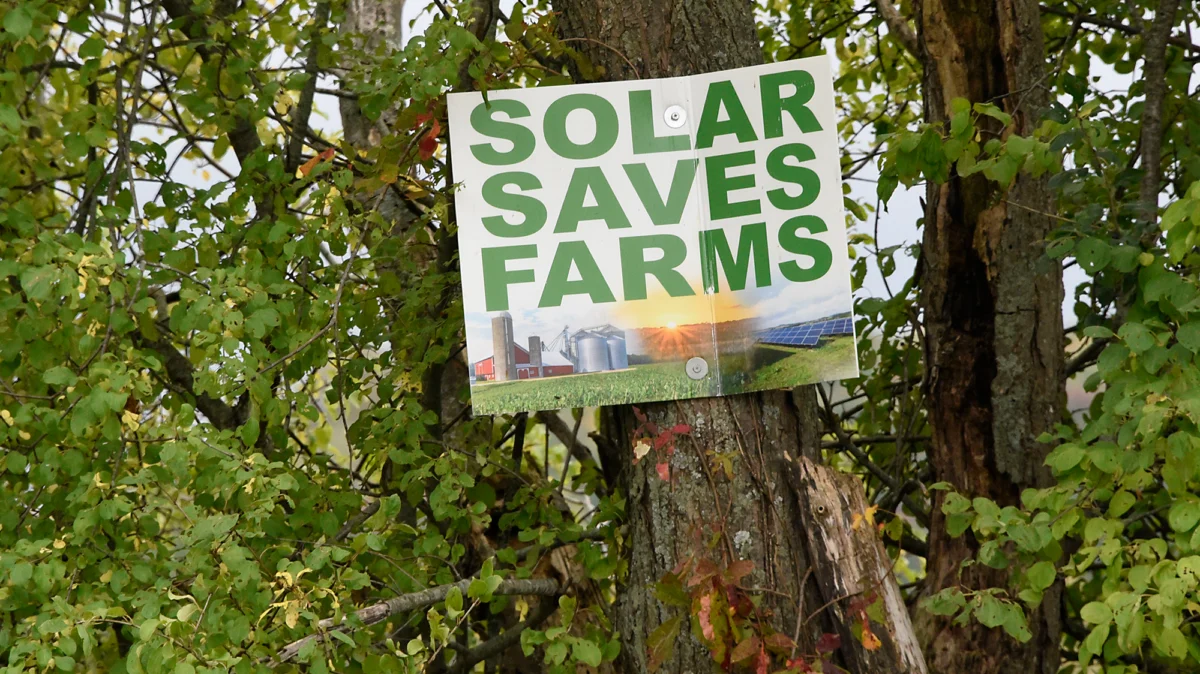
In the rolling fields of rural America, a quiet revolution is unfolding, but it is accompanied by a loud and often contentious debate. As the United States accelerates its transition toward renewable energy, utility-scale solar arrays have increasingly become the target of intense political and social scrutiny. Critics, ranging from local activists to high-profile influencers and federal officials, have painted a picture of a "solar invasion" that threatens to consume the nation’s breadbasket.
However, a closer look at the data—and a vigorous defense from state leaders—suggests that the reality is far more nuanced. In New York, state officials are currently spearheading a campaign to dismantle the misinformation surrounding land use, arguing that solar energy is not the enemy of the farmer, but rather a vital tool for economic survival and agricultural preservation.
The Core Conflict: Land Use and Economic Sovereignty
The central argument deployed by opponents of solar energy is that utility-scale installations are "gobbling up" prime farmland, permanently altering the rural landscape and undermining food security. This narrative has gained significant traction, fueled by social media campaigns and, more recently, federal intervention.
The Trump administration recently accused the state of New York of fast-tracking solar projects on high-quality agricultural land without sufficient oversight. This sparked an immediate and robust response from New York state leaders, who issued a comprehensive 11-page rebuttal. In their correspondence, officials articulated a vision where renewable energy and farming are not mutually exclusive, but rather symbiotic.
"Renewables empower our farmers to keep their land in use and in their family, while avoiding the threat of permanent conversion or abandonment," the state’s letter asserted. By leasing a portion of their acreage to solar developers, farmers can secure a reliable, long-term revenue stream—often a critical buffer against the volatile commodity markets that plague the agricultural sector. Crucially, these leases are temporary; at the end of a project’s lifecycle, the land can be decommissioned and returned to its original agricultural state.
Chronology of the Debate
The tension between land-use advocates and energy developers has been brewing for years, but it reached a boiling point in the summer of 2026.
- Early 2026: Researchers at Cornell University released a landmark study, which found that the overwhelming majority of New York farmers who opted to lease land for solar projects did not exit the industry. Instead, they utilized the income to reinvest in their operations, modernize equipment, and expand their farming capacity.
- Mid-2026: Public discourse reached a fever pitch as influencers, including Alexandra Fasulo, began using platforms like TikTok to voice concerns over the "loss" of rural character and land utility. These messages were amplified by national figures, including country music star John Rich, who was recently tapped by the White House to act as a federal envoy for landowners, focusing on what he describes as the protection of agricultural rights.
- July 2026: Following federal accusations of improper siting practices, New York officials formally responded to the USDA. The letter was a landmark moment in state policy, formally defending the right of private landowners to make independent choices about their property, provided those choices meet stringent state environmental and zoning standards.
Supporting Data: The Scale of the "Invasion"
To understand the scope of the issue, one must look at the hard numbers. The fear that solar is consuming all available farmland is not supported by current land-use statistics.
According to data from the Solar Energy Industries Association (SEIA), solar farms currently occupy approximately 0.13 percent of New York’s roughly 13,000 square miles of federally designated prime farmland. This trend is mirrored on a national scale. In the United States, solar infrastructure covers just 0.07 percent of all agricultural land.
To put these figures into perspective, consider the alternatives. Solar installations currently occupy significantly less space than other forms of land development. For instance, suburban residential sprawl—the creation of cul-de-sacs and housing developments—consumes six times more agricultural land than solar arrays. Even golf courses account for three times the land usage of solar farms. When framed against these realities, the focus on solar panels as the primary threat to rural landscapes appears mathematically disproportionate.
The Evolution of Agrivoltaics: Farming Beneath the Panels
Beyond the economics, a technological shift known as "agrivoltaics" is changing how we think about land use. The New York State Energy Research and Development Authority (NYSERDA) has been at the forefront of this, publishing a comprehensive guidebook that details how solar and farming can coexist on the same plot.
The model is simple yet effective. Sheep and cattle are frequently utilized to graze under solar arrays, providing natural vegetation management that reduces the need for herbicides or mechanical mowing. This arrangement is a win-win: the sheep owners gain access to high-quality, shaded grazing land, and the solar developers reduce their maintenance overhead.
Furthermore, research into crop-specific agrivoltaics is yielding promising results. In various climates, scientists have found that crops such as tomatoes, saffron, and certain native plant species not only survive but thrive under the dappled shade provided by solar panels. This micro-climate can actually protect sensitive crops from heat stress, a growing concern as climate change intensifies.
Official Responses and Property Rights
The New York administration’s defense centers on the concept of fundamental property rights. "Discouraging or inhibiting property owners’ ability to independently make choices about what they can and cannot do with their land can cause financial harm and undermine fundamental property rights," the state’s letter to the federal government noted.
This stance acknowledges a painful reality for many American farmers: the decline of traditional agriculture in certain regions. In California’s Central Valley, for example, long-term drought conditions have forced thousands of acres to go fallow. When water becomes too expensive or scarce to support traditional crops, solar leasing provides a pathway for families to retain ownership of their land, rather than selling it to housing developers or watching it succumb to erosion and abandonment.
Implications for the Future of Rural America
The debate over solar energy is, at its core, a debate over the future of rural identity. While some critics view the rise of solar as a departure from the "traditional" American farm, others argue that it is the key to preserving it.
The climate implications are impossible to ignore. Fossil fuel reliance is a primary driver of the extreme weather events—droughts, floods, and unpredictable frosts—that currently threaten the stability of the global food supply. By contributing to the decarbonization of the grid, solar farms are helping to mitigate the very disasters that are making farming more difficult and expensive.
As New York continues to push back against federal narratives, the state is positioning itself as a laboratory for the "Energy Transition 2.0." The objective is no longer just to build enough capacity to hit net-zero targets; it is to build that capacity in a way that is sensitive to the needs of rural communities, respects the history of the land, and provides a sustainable financial bridge for the farmers of tomorrow.
The path forward requires a move away from alarmist rhetoric and toward a collaborative approach. By utilizing zoning rules, supporting agrivoltaic research, and prioritizing transparent communication, state leaders and farmers can ensure that the transition to clean energy does not come at the cost of the rural landscape, but rather serves as its newest, most innovative harvest.
About the Author