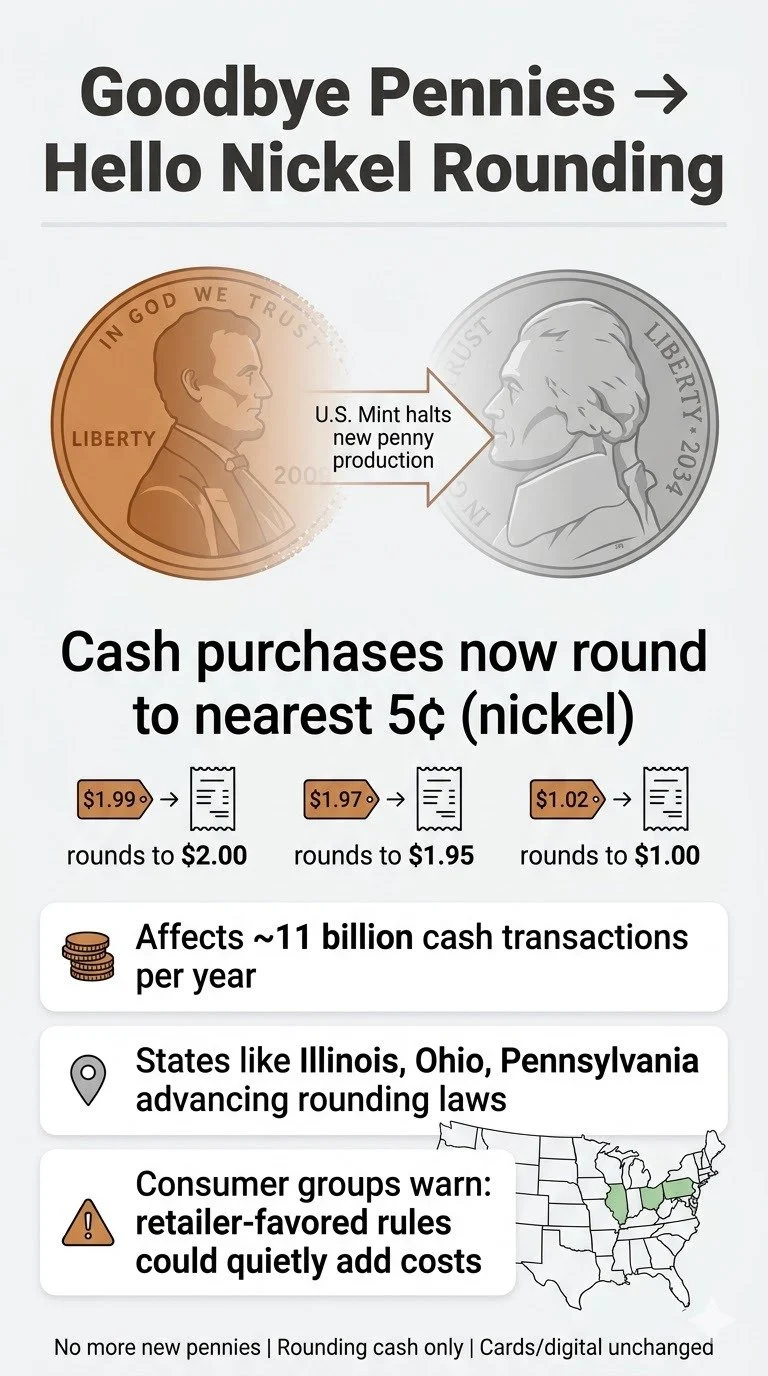
The humble penny, once a staple of the American pocket, is nearing the end of its long and storied existence. Following the U.S. Mint’s decision to halt the production of new one-cent coins, the American retail landscape is undergoing a quiet but significant structural transformation. As the physical supply of pennies dwindles, state legislatures across the country are scrambling to implement formal "rounding" policies for cash transactions, setting the stage for a fragmented patchwork of regulations that has retailers, consumer advocates, and policymakers on high alert.
The State of Play: A Legislative Scramble
The scarcity of pennies has moved from a niche economic curiosity to a pressing legislative priority. Currently, at least six state legislatures have introduced bills aimed at standardizing how retailers handle cash transactions in the absence of the one-cent coin.
The focus of these bills is primarily on the mechanics of rounding—a practice common in countries like Canada, but entirely new to the modern U.S. economy. While digital and card payments—which account for the vast majority of transactions—are unaffected by the coin shortage, the remaining 18 percent of point-of-sale purchases conducted in cash are now in a legal gray area.
In states like Illinois, Ohio, and Pennsylvania, lawmakers are currently debating the merits of various rounding mandates. The legislative proposals vary significantly: some favor a neutral mathematical approach, others lean toward the consumer, and some grant retailers the autonomy to set their own policies, provided they maintain transparency through clear signage.
In Illinois, the debate has reached a critical juncture. A bill requiring rounding to favor the consumer—punishing retailers who fail to comply with fines of up to $500—advanced out of committee last week. With a floor vote scheduled for April 12, Illinois is poised to become a test case for how the United States navigates the post-penny era.
Chronology of a Currency Crisis
The path to the current impasse was not sudden. For decades, the cost of producing a penny has exceeded its face value, a reality that has long fueled debates in Washington about the coin’s utility.
- The Long Decline: For years, the U.S. Mint reported that the cost of minting and distributing a single penny significantly exceeded one cent. Despite this, the coin remained in circulation due to public sentiment and the inertia of the federal system.
- The Production Halt: Facing mounting budgetary pressures and the declining utility of the one-cent coin in a digital-first economy, the U.S. Mint quietly ceased the production of new pennies this year.
- The Immediate Aftermath: Retailers, already grappling with inflation and supply chain issues, found themselves unable to provide change for cash customers. Initially, many stores simply absorbed the loss or asked customers to donate their change to charity.
- Legislative Reaction (2024–2025): As the coin shortage became acute, state governments realized that without federal guidance, the responsibility for managing the "change gap" fell to them. By early 2025, legislative filings began to flood state houses, leading to the current push for standardized rounding laws.
Supporting Data: The Scale of the Shift
The sheer volume of transactions affected by the loss of the penny is staggering. According to Federal Reserve payment data, there are an estimated 11 billion cash transactions annually in the United States.
While the shift might seem like a rounding error, the cumulative economic impact is significant. Consumer advocacy groups have raised alarms, noting that if rounding policies are not strictly regulated, they could facilitate a "hidden tax" on the public. If a retail chain were to systematically round up in their favor, they could potentially extract an extra two cents per transaction. While seemingly negligible to an individual, at scale, this could result in a transfer of hundreds of millions of dollars from shoppers to retailers nationwide.
To understand the potential impact, economists often look to the Canadian experience. In 2013, Canada officially eliminated the penny. The transition was relatively seamless, primarily because Canada adopted a balanced, neutral rounding system. Studies of Canadian transactions conducted in the years following the transition showed that the impact on individual consumer wallets was essentially zero, with shoppers losing or gaining less than one cent on average per purchase.
However, the U.S. context is different. Unlike Canada, which implemented a national standard, the United States is currently facing a piecemeal approach. This lack of uniformity is exactly what industry groups fear most.
Official Responses and Industry Concerns
The National Retail Federation (NRF) and other trade groups have been vocal in their opposition to the current state-by-state legislative approach. Their argument is rooted in the logistical nightmare of modern retail operations.
"We need uniform standards, or you’ll have a retailer rounding down in Michigan and rounding up in Indiana," said Jason Miller, chief policy officer at the Retail Industry Leaders Association (RILA). "That creates chaos in daily operations and consumer confusion."
For national chains, the prospect of reprogramming point-of-sale (POS) software to accommodate fifty different state-specific rounding laws is a daunting, expensive, and error-prone endeavor. Retailers are currently lobbying Congress to step in and provide a federal framework. They argue that a single, nationwide mandate—perhaps based on the Canadian model of balanced rounding—would be more efficient than a patchwork of conflicting state requirements.
The Retailer’s Dilemma
Retailers find themselves in a precarious position. If they round in favor of the consumer, they absorb a slight decrease in margin; if they round in favor of the store, they risk consumer backlash and potential legal action under consumer protection laws. The New York proposal, which allows retailers to set their own policy provided they post visible signage, represents an attempt to bridge this divide. However, critics argue that this approach puts the burden of math on the customer, who may feel tricked or cheated regardless of the signage.
Implications for the Future
The move away from the penny is symbolic of a much larger transition: the decline of cash as a primary medium of exchange. As digital wallets, contactless payments, and biometric authentication become more prevalent, the physical coin is increasingly viewed as an anachronism.
The Legal and Regulatory Outlook
If Congress fails to act, the U.S. will likely see a period of intense legal volatility. Businesses will be forced to navigate a complex regulatory environment where a transaction that is legal in one county could be a punishable offense in the next. This legal uncertainty could lead to a wave of class-action lawsuits against retailers who adopt rounding policies that are later deemed unfavorable to the consumer.
The Impact on Consumer Behavior
The shift could also alter how consumers interact with physical money. If the penny disappears, it may accelerate the decline of cash usage entirely. If consumers are forced to deal with complex rounding rules, they may find it easier to switch to digital payments, effectively hastening the end of cash as a viable payment method.
The Lessons of History
Ultimately, the U.S. is not breaking new ground; it is simply catching up to a global trend. Many developed nations have successfully retired low-denomination coins without significant economic disruption. The difficulty for the United States lies not in the rounding itself, but in the political process of standardizing it.
The current debate in state legislatures—highlighted by the Illinois bill’s punitive measures—reflects a deeper anxiety about the role of government in regulating the minutiae of daily commerce. Whether the result is a chaotic patchwork of laws or a coherent federal mandate, one thing is clear: the penny has reached the end of its life, and the American checkout line will never be the same.
As we look toward the April 12 vote in Illinois and the ongoing discussions in Washington, the fate of the one-cent coin serves as a microcosm for the broader challenges of modernizing the U.S. economy. The penny may be small, but its disappearance is triggering a massive shift in how we define value, fairness, and the future of currency in the digital age.
About the Author