In the few short years since the public debut of ChatGPT in late 2022, the architecture of the internet has undergone a fundamental, largely invisible transformation. As large language models (LLMs) have moved from experimental research labs to the center of global digital production, the distinction between human-authored and machine-generated content has blurred. A new, comprehensive analysis reveals that the digital landscape is increasingly saturated with synthetic text, marking a shift in how information is created, distributed, and consumed.
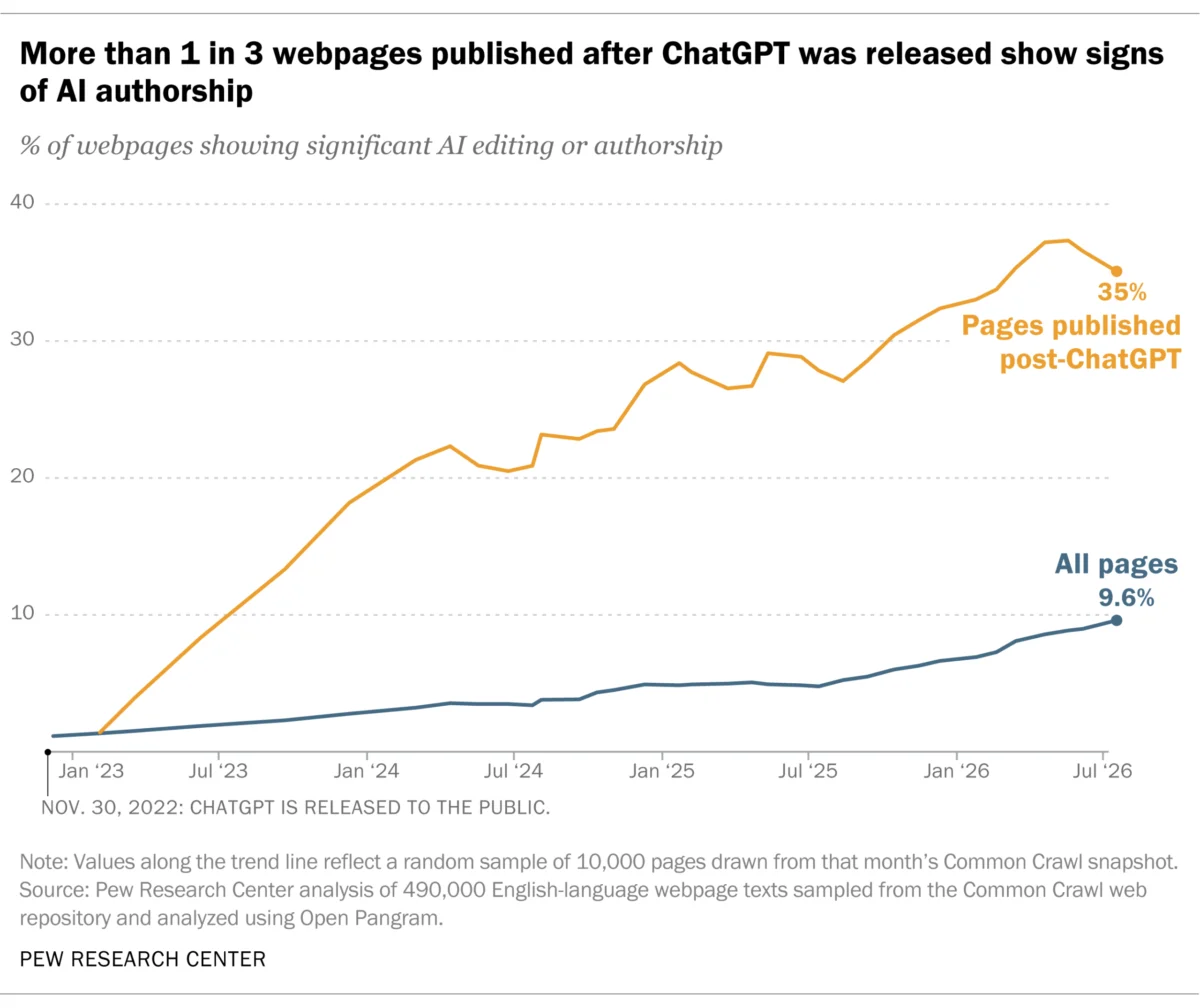
By analyzing nearly half a million webpages archived by Common Crawl between 2021 and 2026, researchers have established a clear trend: the volume of AI-assisted or AI-authored content has climbed steadily, mirroring the rapid adoption of generative AI tools. As of mid-2026, approximately 35% of newly published webpages display distinct markers of AI authorship, a figure that suggests the "human-only" web is rapidly becoming a relic of the past.
Methodology: Tracking the Digital Footprint
To capture the scale of this phenomenon, researchers turned to the Common Crawl foundation, a nonprofit repository that has been archiving the "observable internet" since 2008. By taking snapshots of the web roughly once a month, the organization provides a longitudinal view of the internet’s evolution.
For this study, researchers curated a sample of 10,000 English-language pages from each of the 49 crawls conducted between January 2021 and July 2026, totaling 490,000 individual records. The team utilized both WARC (Web ARChive) records—which contain the raw HTML—and WET (WARC Encapsulated Text) files, which isolate the body text while stripping away non-essential media and code.
A significant challenge in this study was the scarcity of verifiable publication dates. Only 10% to 15% of webpages include metadata specifying when they were created. Consequently, the study’s findings regarding post-ChatGPT trends are derived from this dated subset. While this represents a non-random slice of the web—favoring professional or structured publishing platforms over dynamic, date-less content—it provides the most accurate barometer available for assessing how creators have integrated AI into their workflows.
Detecting the Machine: The EditLens Approach
Identifying AI authorship is an inherently probabilistic endeavor. To navigate this, researchers employed editlens_Llama-3.2-3B, an open-weight detection model developed by Pangram. Unlike binary detectors that categorize text as either "human" or "robot," the model assigns a numeric score between 0 and 1. A score of 0 denotes purely human composition, while a score of 1 signals complete machine generation.
The study adopted a conservative threshold: any page scoring 0.2 or higher was flagged as containing "meaningful" signs of AI involvement. This threshold accounts for the modern reality of "hybrid authorship," where human writers use AI to draft, edit, or polish content rather than relying on fully automated generation.
To ensure the validity of these findings, the team conducted a cross-validation study using 62,370 pages processed by Pangram’s flagship commercial model, Pangram 3.3. The results were remarkably consistent: the two models agreed in 96% of cases, with a Cohen’s kappa value of 0.61. This alignment suggests that despite the probabilistic nature of AI detection, the upward trajectory of AI integration is a robust, observable fact rather than a quirk of a single algorithm.
Chronology of an AI-Driven Internet
The timeline of this digital transformation is marked by the inflection point of November 30, 2022—the date ChatGPT was released to the public.

- 2021–2022 (Pre-Generative AI Boom): During the early months of the study, AI authorship markers remained negligible. While the Open Pangram model did register a small percentage of "AI-like" signatures (roughly 1%), researchers attribute this to a higher false-positive rate on older, pre-LLM content. In this era, the internet was largely the product of human cognition.
- 2023 (The Integration Phase): Immediately following the launch of ChatGPT and subsequent competing models, the data began to shift. Web publishers, content farms, and SEO-driven platforms began experimenting with AI-assisted copywriting, leading to a noticeable uptick in the "meaningful" detection scores.
- 2024–2025 (The Normalization): AI authorship ceased to be a novel outlier and became a standard tool for content production. The proportion of flagged pages grew steadily, reflecting the integration of AI into browser extensions, writing assistants, and automated CMS (Content Management System) plugins.
- 2026 (The Saturated Present): By July 2026, the data showed that 35% of all dated content contained significant AI-authored markers. This mirrors findings from independent studies, such as The Impact of AI-Generated Text on the Internet (Dolezal et al., 2026), which utilized Internet Archive data to reach the same conclusion.
Supporting Data and Comparative Analysis
The convergence of data from multiple independent studies adds weight to these findings. The study by Dolezal et al. (2026) utilized a distinct methodology—focusing on historical web snapshots and different linguistic patterns—yet arrived at the identical 35% mark for newly published sites.
The slight divergence in the early data (2021-2022) between the open and commercial detection models serves as a cautionary tale. While the commercial Pangram 3.3 model returned near-zero AI prevalence for that period, the open-source version showed a 1% "noise" level. This disparity reinforces that detection models are not definitive arbiters of truth but rather instruments for measuring macro-level trends. The researchers caution against using these tools to police individual websites, emphasizing that their primary utility lies in their ability to track the aggregate evolution of the digital landscape.
Official Responses and Industry Context
The rapid proliferation of AI-generated content has prompted a mixed response from tech companies and regulatory bodies. Proponents of AI-integrated content argue that LLMs serve as "force multipliers," allowing businesses to scale information production and bridge the gap for non-native speakers or writers lacking professional training.
Conversely, the rise of synthetic content has sparked concerns regarding "model collapse"—a phenomenon where AI models, trained on their own previous outputs, begin to exhibit reduced quality, hallucinations, and a loss of nuance. Major search engines have updated their guidelines to prioritize "helpful, reliable, people-first content," attempting to penalize low-quality, mass-produced AI spam. However, the data suggests that as AI tools become more sophisticated, distinguishing them from human effort is becoming increasingly difficult.
Implications: What Does This Mean for the Future?
The shift toward a 35% AI-authored internet has profound implications for the future of knowledge.
1. The Erosion of Originality
As more content is generated by models trained on existing data, the "feedback loop" of information could lead to a homogenization of thought. If the internet becomes a repository of machine-generated text that is then re-ingested by future models, the diversity of human perspective—the very thing that makes the internet a valuable source of information—may diminish.
2. The Trust Deficit
The findings highlight a growing crisis of provenance. As AI authorship becomes the standard, the ability for users to verify the source of information becomes vital. If one-third of the web is potentially machine-written, the need for robust digital watermarking and verified "human-written" certifications may become a necessity for journalism, academia, and public record-keeping.
3. SEO and the Information Ecosystem
The data underscores a strategic pivot in digital marketing. For years, the internet has been dominated by content optimized for search engines. Now, with AI capable of producing this content at scale for pennies, the volume of noise is likely to increase exponentially. This will force search engines and discovery platforms to fundamentally change how they rank information, likely shifting away from keyword-density metrics toward signals of human expertise, authority, and verified real-world experience.
Conclusion
The data provided by the 2021–2026 crawls serves as a definitive record of a historical shift. We have moved past the era of the human-authored web and entered a period of collaborative, machine-assisted production. While the tools of detection continue to improve, the sheer volume of AI content suggests that the future of the internet will not be defined by human or machine, but by the complex interplay of both. As we move further into this new landscape, the challenge will be to ensure that in our rush to automate the creation of information, we do not lose the human insight that gives that information meaning.
About the Author