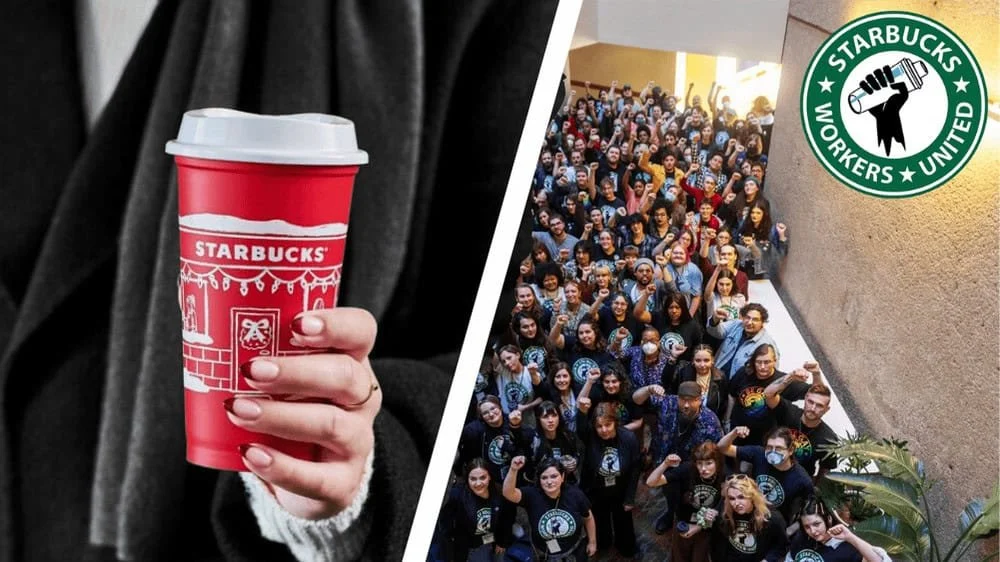
For the millions of customers who frequent Starbucks, Red Cup Day is the unofficial kickoff to the holiday season—a promotional juggernaut where the promise of a free, reusable seasonal tumbler creates lines that snake around city blocks. However, on November 14, the atmosphere outside 65 Starbucks locations across the United States was marked not by festive anticipation, but by the rhythmic chanting of picket lines.
The coordinated walkout, branded the "Red Cup Rebellion" by Starbucks Workers United, represents a significant escalation in a labor dispute that has simmered for over three years. What makes this particular protest a watershed moment in American labor history, however, is not just the disruption of a major marketing event—it is the unprecedented and vocal intervention of high-ranking elected officials. In a shift that has stunned corporate observers, the struggle for a contract has moved from the backrooms of labor mediation into the center of mainstream political discourse.
A Chronology of Confrontation
To understand the gravity of the November 14 strikes, one must look at the timeline of a company caught in a persistent tug-of-war between its corporate identity and its operational reality.
- 2021: The Spark: The first Starbucks store in Buffalo, New York, successfully votes to unionize, igniting a wave of organizing efforts across the country.
- 2022–2023: The Stalemate: As the number of unionized stores climbs toward the 500-mark, contract negotiations remain largely frozen. The union alleges "surface bargaining," while Starbucks maintains it is committed to reaching an agreement.
- September 2024: Leadership Transition: Brian Niccol, formerly the CEO of Chipotle, takes the helm at Starbucks. He inherits a company with a fractured relationship with its workforce and an intensifying public relations crisis.
- November 12, 2025: Pre-emptive Pressure: U.S. Senator Patty Murray (D-WA) sends an urgent letter to CEO Brian Niccol, imploring the company to engage in good-faith negotiations to avoid the impending holiday disruption.
- November 13, 2025: Political Mobilization: Newly elected Seattle Mayor Katie Wilson joins baristas at the iconic Starbucks Reserve Roastery, publicly endorsing a boycott of the company.
- November 14, 2025: The Red Cup Rebellion: Workers at 65 stores walk off the job on the company’s highest-traffic promotional day, effectively turning a day of holiday celebration into a day of industrial action.
The Shift in Political Calculus: From Picket Lines to Policy
Labor disputes involving private-sector retailers are historically treated as internal business matters. However, the involvement of figures like Seattle Mayor-elect Katie Wilson and New York City Mayor-elect Zohran Mamdani suggests that the political environment surrounding labor has fundamentally shifted.
The Seattle Context
For a Seattle-based mayor to call for a boycott of Starbucks—a company that is arguably the most famous corporate citizen of the Pacific Northwest—is a move of extraordinary political courage. Mayor-elect Wilson’s presence on the picket line signaled to the corporate world that the "progressive" branding that Starbucks relies upon is now being weaponized against them. By supporting the strikers, Wilson is positioning herself as a champion of a labor-aligned coalition, effectively raising the cost of non-cooperation for the coffee giant.
The New York Front
In New York, Mayor-elect Zohran Mamdani has taken an equally uncompromising stance. His viral slogan, "No contract, no coffee," serves as a direct challenge to the company’s customer base. By explicitly stating that he would not patronize the chain while the labor strike persists, Mamdani has bypassed traditional union negotiation rhetoric and engaged directly with the consumer conscience. This is no longer just about wages; it is about the ethics of consumption.
The Core Grievances: Why the Wait Continues
While the "Red Cup Rebellion" is the most visible expression of frustration, the grievances driving the movement are deeply systemic. Baristas are not merely asking for higher base pay; they are demanding a fundamental restructuring of their workplace experience.
1. Wage and Scheduling Inequity
Workers report that current staffing levels are insufficient to meet the extreme demand generated by promotional days like Red Cup Day. This leads to burnout, high turnover, and a degradation of the customer experience. The union is pushing for predictable scheduling, which would allow workers to manage their personal lives, childcare, and educational pursuits without the chaos of last-minute shift changes.
2. The Negotiation Vacuum
Perhaps the most potent driver of the strikes is the psychological exhaustion of the bargaining process. With over 500 stores unionized, the fact that zero stores have finalized a contract after years of bargaining has led to a widespread belief that the company is "running out the clock." The union characterizes this as a strategy to demoralize workers and eventually weaken the union’s influence.
3. The "Brand Identity" Paradox
Starbucks has spent decades building a brand based on the "Third Place"—a welcoming environment that values human connection. Baristas argue that by refusing to finalize a contract that addresses their basic needs, the company is betraying the very mission statement that helped it dominate the global market.
CEO Brian Niccol’s Baptism by Fire
Brian Niccol faces the most difficult challenge of his career. At Chipotle, Niccol was praised for streamlining operations and boosting shareholder value. However, Starbucks is a different animal. Unlike the fast-casual dining model, the "Starbucks experience" is built on the perceived happiness and engagement of the staff.
If Niccol chooses to continue a strategy of legal attrition, he risks alienating the very customer base that is increasingly sympathetic to the labor movement. The political pressure from figures like Senator Murray and the mayors-elect makes it nearly impossible for Niccol to frame the dispute as a simple "business-vs-union" issue. He is now caught in a public-facing conflict where his failure to resolve the strike reflects directly on his leadership style and the company’s long-term brand equity.
Implications for the Future of Retail
The events of November 14 serve as a bellwether for the retail industry at large. As inflation continues to impact the cost of living, labor organizing is no longer confined to manufacturing or logistics; it has permeated the service sector, where the "gig-like" nature of the work has traditionally been difficult to organize.
The Mainstreaming of Labor Support
The fact that mayors are now actively participating in boycotts suggests that major chains can no longer expect local governments to remain neutral in labor disputes. For corporations, this means that labor relations are now a permanent fixture of their public relations and government affairs strategies.
A Litmus Test for Progressive Corporations
Starbucks is currently the primary test case for whether a brand can maintain a "progressive" image while simultaneously suppressing or delaying unionization. If Starbucks continues to hold out, it may serve as a blueprint for other corporations to resist similar movements. Conversely, if the pressure forces a breakthrough, it could lead to a massive wave of union successes in the retail sector.
Conclusion: The Cost of Silence
The "Red Cup Rebellion" was designed to be a message that Starbucks could not ignore. By targeting the company’s most profitable day, the union demonstrated that they have the power to disrupt the brand’s most critical moments.
As the holiday season progresses, the standoff remains. The company has a choice: continue to treat the labor dispute as a legal hurdle to be overcome, or recognize that the political and social climate has shifted. For now, the rallying cry "No contract, no coffee" echoes in the streets of Seattle and New York, serving as a reminder that in the modern retail landscape, brand value and worker rights are inextricably linked. The resolution of this conflict will likely define the future of the Starbucks brand for the next decade.
About the Author