By Global Migration Analysis Desk
August 17, 2026
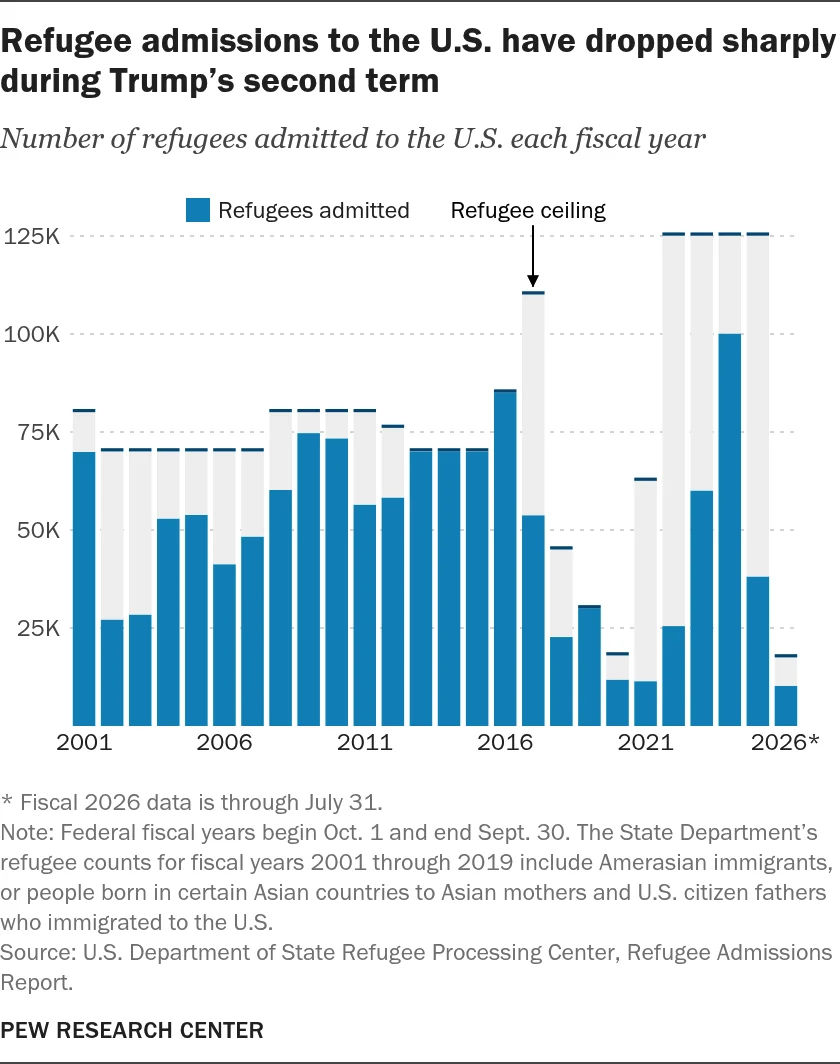
The landscape of American humanitarian policy is undergoing a profound transformation. According to a new analysis of U.S. State Department data by the Pew Research Center, the number of refugees admitted to the United States has plummeted during President Donald Trump’s second term. With the current fiscal year drawing to a close on September 30, the U.S. is on track to record its lowest annual intake of refugees since the turn of the 21st century, marking a stark departure from the record-setting levels seen just two years prior.
Main Facts: A Dramatic Policy Reversal
As of July 31, 2026, the federal government has admitted only 10,258 refugees for the entire fiscal year. This figure represents a precipitous drop from the 38,102 admissions recorded in fiscal 2025 and stands in stark contrast to the 100,034 refugees welcomed in fiscal 2024.
The administration has set a refugee admissions ceiling of 17,500 for fiscal 2026. While the government may technically admit an additional 7,000 individuals before the September 30 deadline, the ceiling itself represents the lowest cap established by any U.S. administration in at least 25 years. This policy shift signifies a fundamental recalibration of the nation’s role in global resettlement, moving away from the high-water marks established during the Biden administration, which had raised the annual ceiling to 125,000.

Chronology: From Peak to Plummet
To understand the current state of U.S. refugee policy, one must view it through the lens of recent political history. The U.S. resettlement program has long been subject to the fluctuations of executive priority and geopolitical volatility.
- 2001–2016: Following the 9/11 terrorist attacks, President George W. Bush temporarily halted refugee processing, leading to a dip in admissions. However, for much of the subsequent decade, the U.S. maintained a robust intake, culminating in 84,994 admissions in fiscal 2016.
- 2017–2020: During his first term, President Trump implemented significant restrictions, including a temporary freeze on resettlement and bans on entry from several Muslim-majority nations. Admissions fell to a low of 11,814 by fiscal 2020.
- 2021–2024: Following his inauguration, President Joe Biden prioritized the expansion of the refugee program, raising the cap to 125,000. This period saw a significant surge in humanitarian intake, peaking at over 100,000 admissions in 2024.
- 2025–2026: Upon the commencement of his second term, President Trump moved to curtail these numbers once more. The current fiscal year reflects a policy environment that favors domestic border control and highly specific, criteria-based humanitarian pathways over broad-based resettlement programs.
The Shift in Origin: The South African Priority
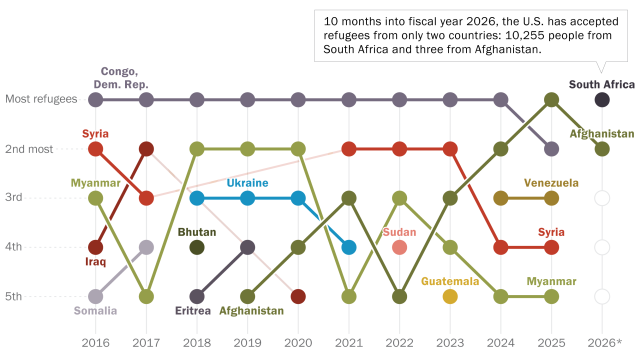
A critical development in the 2026 fiscal data is the near-total shift in the national origins of incoming refugees. Historically, the U.S. refugee program has focused on those fleeing long-standing conflicts, such as the Democratic Republic of the Congo, Syria, and Afghanistan. However, fiscal 2026 data shows that South Africans now account for virtually all refugee admissions to the U.S.
This pivot is the direct result of an executive order signed by President Trump in early 2025. The order directed federal agencies to prioritize the resettlement of Afrikaners—an ethnic group of Dutch, German, and French descent—citing claims of "government-sponsored, race-based discrimination" and the seizure of farmland in South Africa. While the administration has championed this policy as a protection of a persecuted minority, the claims have faced significant scrutiny and denial from international human rights organizations and the South African government.
Prior to 2025, South African refugees were virtually absent from U.S. resettlement statistics. By contrast, the Democratic Republic of the Congo, which held the top spot for refugee origins from 2016 through 2024, has seen its intake drop to zero so far in fiscal 2026. Similarly, Afghan refugees, who were a primary focus of resettlement efforts following the 2021 withdrawal, have seen their numbers fall to just three individuals for the current fiscal year.

Supporting Data: Comparing Global Contributions
For decades, the United States has positioned itself as the world’s leading destination for resettled refugees. However, international data from the United Nations High Commissioner for Refugees (UNHCR) reveals that the U.S. is no longer the global leader in this capacity.
In calendar year 2025, the United States fell behind both Canada and Australia in total refugee resettlements. Canada, which has maintained a consistent and expansive resettlement policy, led the world with nearly 39,000 resettled refugees. Australia followed with 19,000, while the U.S. intake dropped to approximately 11,500. This data underscores a widening gap between the U.S. and its peers, as Washington moves toward a more restrictive stance while other Western nations continue to uphold higher resettlement quotas.
Official Perspectives and Political Context
The administration’s rationale for these reductions centers on national security, the prioritization of domestic resources, and a focus on what it describes as "merit-based or specifically targeted humanitarian aid." Supporters of the administration argue that the previous high intake levels strained local social services and that the current strategy allows for a more controlled, focused approach to immigration.
However, the policy has drawn sharp criticism from humanitarian advocates who argue that the U.S. is abdicating its moral responsibility to assist the world’s most vulnerable populations. Critics point out that the global displaced population is at a record high, and by narrowing the criteria for entry, the U.S. is turning its back on those fleeing systemic violence and persecution in regions that do not fit the administration’s current priority list.
Public Opinion: A Divided Nation
Public sentiment regarding the refugee program remains complex. Pew Research Center’s November 2025 survey highlights that while a majority of Americans see some importance in taking in refugees—with 36% calling it "extremely or very important" and 39% calling it "somewhat important"—there is a distinct partisan divide.
Democrats remain consistently more favorable toward broad refugee admissions, while Republican support is often contingent on the specific nationality or situation of the refugees. For instance, when presented with the case of Ukrainian refugees in 2022, 69% of Americans expressed support for their admission. Similarly, in 2021, 56% supported the intake of Afghan refugees. These figures suggest that while the public is not monolithically opposed to resettlement, their support is often driven by empathy for specific geopolitical crises rather than a blanket commitment to the resettlement program.
Implications: The Future of Humanitarian Policy
The implications of this shift are far-reaching. By drastically lowering the ceiling and concentrating the program on a single, specific group, the United States is fundamentally changing the nature of its humanitarian footprint.
- Diplomatic Impact: As the U.S. reduces its intake, the burden of global resettlement falls more heavily on countries like Canada, Australia, and various European nations. This may lead to a loss of diplomatic leverage for the U.S. in international discussions regarding migration management.
- Infrastructure Decay: The infrastructure required to process, vet, and integrate thousands of refugees—including NGOs, local resettlement agencies, and federal screening staff—is difficult to rebuild once dismantled. A sustained period of low intake risks the permanent erosion of the domestic capacity to respond to future global humanitarian crises.
- Humanitarian Consequences: With fewer opportunities for legal resettlement, displaced persons may face prolonged stays in refugee camps or be forced to turn to dangerous, irregular migration routes, which often lead to further instability and loss of life.
As the 2026 fiscal year concludes, the focus turns to the administration’s plans for 2027. If the current trend of low caps and restricted eligibility continues, the U.S. will likely solidify its transition from being a primary global sanctuary to a nation with a highly limited, targeted, and restricted humanitarian program. The data, for now, tells a clear story of a nation in the midst of a historic pivot, effectively closing its doors to the diverse array of refugees that once defined the American resettlement experience.
About the Author