DALLAS, Texas — August 25, 2026 — In an industry defined by high-stakes negotiations, complex site selection processes, and the constant pressure to secure capital investment, the modern economic developer has become increasingly tethered to the desk. According to Global Site Location Industries (GSLI), this shift toward administrative burden is threatening the very essence of community building.
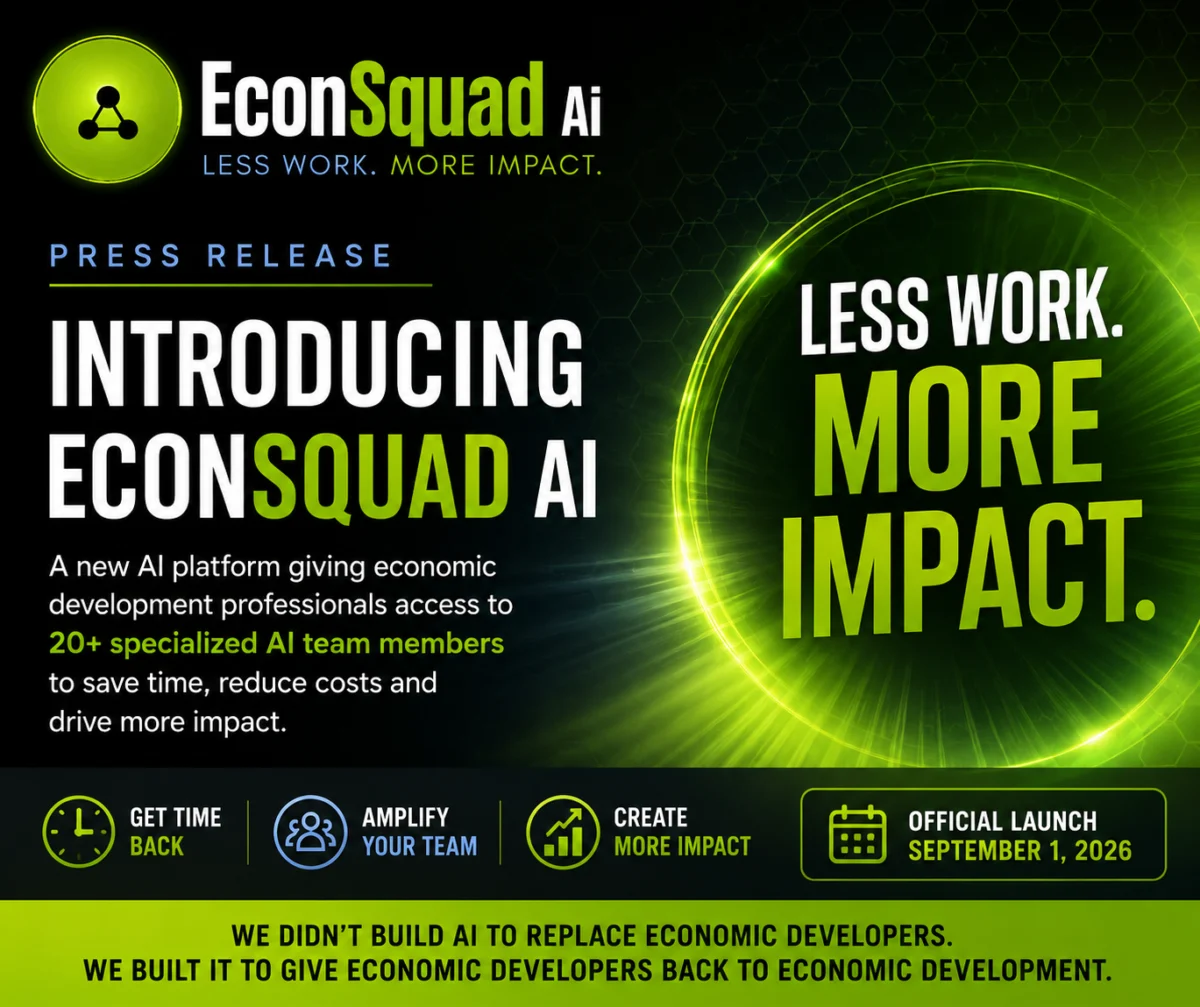
To combat this, GSLI is set to unveil "ECONSquad AI," a specialized artificial intelligence platform engineered to automate the granular, time-intensive tasks that have long distracted professionals from their primary mandate: fostering meaningful economic impact.
The Genesis of a Technological Pivot
The story of ECONSquad AI begins not in a software lab, but in the trenches of economic development. Founded in 1994 by Eric Kleinsorge, GSLI has spent over three decades acting as a bridge between communities and global corporations. Over those 30 years, Kleinsorge observed a troubling trend: the most talented practitioners in the field were increasingly spending their days acting as data entry clerks, researchers, and technical writers rather than as relationship builders and strategists.
"When I was introduced to what AI could really do, it was an epiphany," Kleinsorge explains. "I immediately thought about the thousands of hours I had watched economic developers spend doing necessary work—researching companies, completing RFPs, searching for grants, analyzing data—that kept them from the work only they can do: building relationships, helping businesses, and recruiting companies."
This realization became the cornerstone of the company’s new direction. Recognizing that the industry had reached a saturation point regarding administrative workload, GSLI began development on a platform that functions not as a generic chatbot, but as a specialized digital workforce tailored to the specific lexicon and requirements of economic development.
The ECONSquad AI Ecosystem: A Digital Team of 20+
At the heart of the platform is a suite of more than 20 specialized AI "team members." Unlike broad-spectrum AI tools that require extensive prompt engineering, ECONSquad AI is pre-trained and segmented by function. These modules are designed to handle the "heavy lifting" of the profession:
- Corporate Intelligence: Automated deep-dives into prospect company backgrounds and market trends.
- Grant Discovery & Management: Scanning national and regional databases to identify funding opportunities aligned with specific community demographics.
- RFP Efficiency: Accelerating the creation and submission of Requests for Proposals (RFPs), a notoriously tedious task in the site selection industry.
- Business Retention & Expansion (BRE): Analyzing data to predict retention risks and suggest outreach strategies.
- Site & Data Analysis: Providing real-time visualizations and reports on industrial parks, labor pools, and infrastructure readiness.
- Marketing & Communication: Drafting press releases, social media content, and high-level pitch decks for potential investors.
By offloading these functions to AI, GSLI aims to lower the barrier to entry for smaller economic development organizations (EDOs) that lack the staff to cover these diverse roles.
Chronology of an Industry Shift
To understand the necessity of this launch, one must look at the evolution of the economic developer’s role over the last decade:
- 1994–2005 (The Relationship Era): Economic development was primarily driven by in-person site visits, handshakes, and regional networking. Administrative work was handled by administrative assistants or paper-based systems.
- 2006–2016 (The Data Era): The rise of big data forced developers to become analysts. The job shifted toward compiling spreadsheets, managing CRM databases, and responding to increasingly complex digital inquiries.
- 2017–2025 (The Complexity Era): The demand for ESG (Environmental, Social, and Governance) reporting, specialized workforce metrics, and rapid-fire grant applications overwhelmed small teams. Burnout rates in the profession began to rise.
- August 2026: GSLI announces the "Economic Development Use-of-Time Revolution," positioning AI as the solution to the "Complexity Era" bottleneck.
The "Use-of-Time" Revolution: Beyond the Hype
Kleinsorge is quick to distance his platform from the general "AI hype" that has swept the corporate world. He argues that the conversation surrounding AI has been too focused on the technology itself, rather than the commodity it is actually replacing: time.
"For decades, we’ve measured economic development by jobs, investment, and projects won," Kleinsorge notes. "But we’ve rarely measured it by one of our most valuable resources—the economic developer’s time. AI gives us an opportunity to separate the work that requires you from the work that simply requires getting done."
This philosophy is the central thesis of Kleinsorge’s recent book, Less Work. More Impact. in Economic Development. The book argues that professional burnout is not a result of a lack of passion, but a lack of structural support. By automating the administrative cycle, GSLI posits that developers can reclaim 10 to 20 hours of their week, shifting that time toward high-value activities like site visits and stakeholder engagement.
Implications for Small and Mid-Sized Communities
Perhaps the most significant impact of ECONSquad AI will be felt in smaller municipalities. Often, rural or suburban economic development teams consist of only one or two people who must be experts in marketing, urban planning, finance, and government relations simultaneously.
By offering a $99/month subscription model, GSLI has priced the tool to be accessible to these smaller organizations. The value proposition is surgical: if the tool saves even three hours of work per month, it covers its own cost. If it saves ten, it essentially creates a "force multiplier" effect, allowing a two-person office to operate with the output capacity of a department three times its size.
Furthermore, this tool could reduce the reliance on expensive external consultants for routine tasks, allowing communities to keep their budget local and focus on long-term strategy rather than temporary stop-gap measures.
Addressing the Human Element
When asked about the fear that AI might replace human economic developers, Kleinsorge is emphatic. "We didn’t build AI to replace economic developers," he states. "We built it to give economic developers back to economic development."
He envisions a future where the "soft skills" of the profession—negotiation, empathy, community visioning, and political coalition building—become the primary focus of the job description. The AI does not decide which company to recruit or how to structure a tax incentive; it simply provides the data and the draft materials that allow the human expert to make those critical decisions with greater confidence and speed.
Looking Ahead: The VIP Launch
The industry is watching closely as September 1, 2026, approaches. The scheduled VIP Launch Party will serve as the official proving ground for ECONSquad AI. During this event, attendees will be treated to live demonstrations showing the AI tackling real-world scenarios—from generating a complex RFP response in minutes to conducting a multi-variable site analysis.
If GSLI’s vision holds, the launch of ECONSquad AI may mark the beginning of a fundamental restructuring of how economic development is practiced in North America. By providing the tools to reclaim time, the company is betting that the most effective way to improve a community’s future is to liberate the people tasked with building it.
About GSLI
Global Site Location Industries (GSLI) is a leader in site selection consulting and economic development advisory services. With a legacy spanning over three decades, GSLI provides the strategies, data, and tools necessary for communities to compete in a global economy.
Key Data Highlights at a Glance:
- Platform: ECONSquad AI
- Cost: $99/month
- Target Audience: Economic Development Organizations (EDOs), Chambers of Commerce, Local Government Agencies.
- Primary Goal: Automating non-essential administrative tasks to increase high-value dealmaking time.
- Launch Date: September 1, 2026.
About the Author