By Global Affairs Analysis Desk
August 28, 2026
In the complex arena of international diplomacy, the distinction between a nation and its leadership has long been a subject of study. However, recent data from the Pew Research Center’s Spring 2026 Global Attitudes Survey reveals a profound shift in how the world perceives the United States. In an era of heightened political polarization, international observers are increasingly abandoning the nuance of separating their views of the American nation from their assessment of the U.S. president.
Across all 36 countries surveyed this year, there is a clear, statistically significant correlation: positive views of the United States are inextricably linked to confidence in President Donald Trump’s handling of global affairs. Conversely, those who lack faith in the president’s leadership are significantly more likely to hold a negative view of the country itself. This phenomenon suggests that for much of the world, the U.S. and its executive are no longer viewed as distinct entities but as a "package deal."
The Erosion of Separation: A New Geopolitical Dynamic
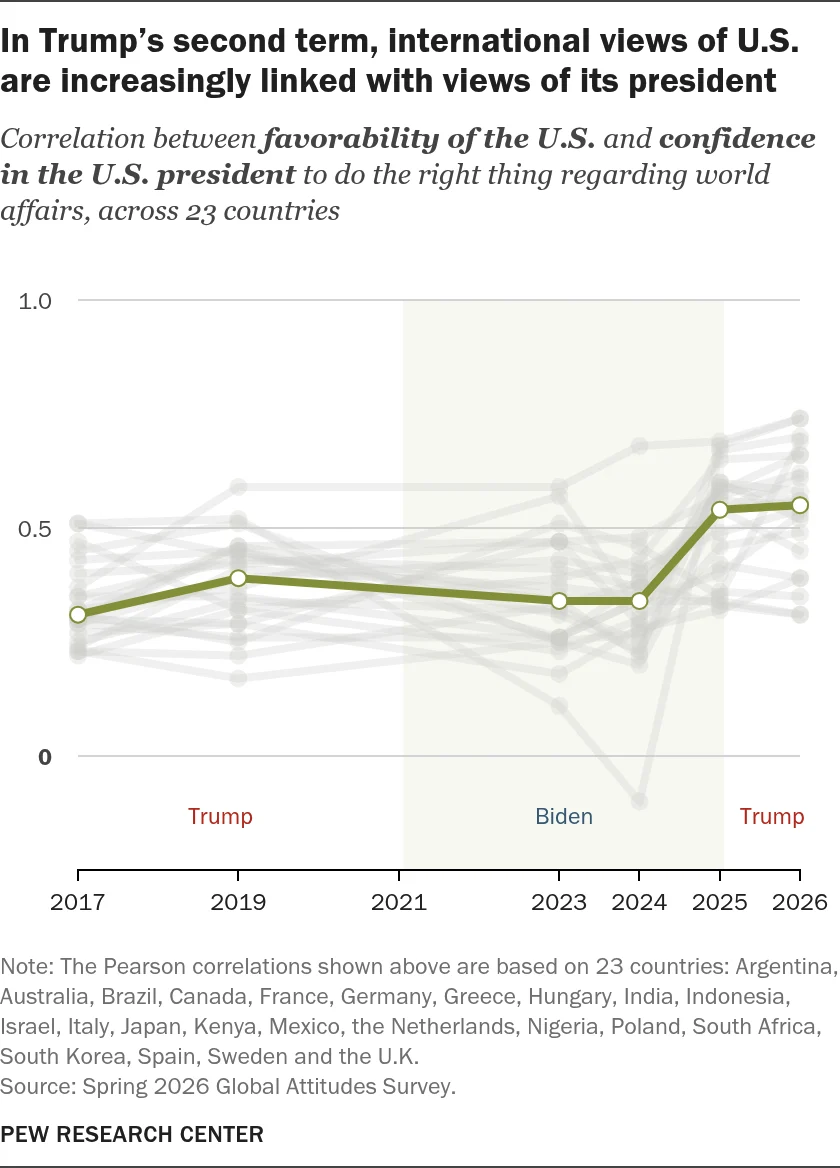
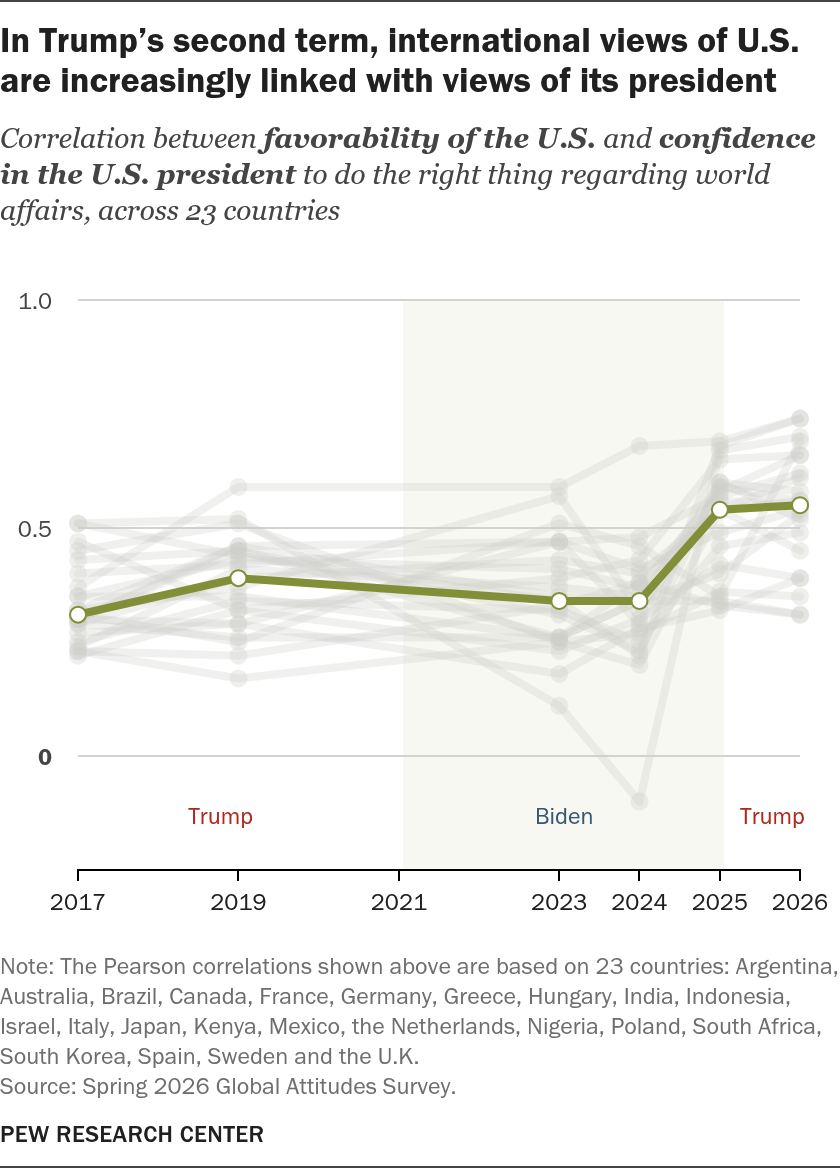
The current alignment of views is not merely a transient trend; it represents a departure from the recent past. During the presidency of Joe Biden, as well as throughout the first term of the Trump administration, the relationship between a country’s favorability toward the U.S. and its confidence in the president was notably weaker.
Take South Korea as a primary case study. In 2023 and 2024, during the final years of the Biden administration, many South Koreans expressed a favorable view of the United States while simultaneously holding lukewarm or skeptical views regarding President Biden’s effectiveness. The correlation coefficient—a statistical measure of the strength of a relationship—was a relatively modest 0.37 in 2023 and 0.35 in 2024.
However, following President Trump’s return to the White House, that dynamic shifted dramatically. The correlation climbed to 0.54 in 2025 and reached 0.61 in 2026. This indicates a tightening bond: today, 68% of South Koreans who lack confidence in Trump also hold a negative view of the U.S., a sharp increase compared to the previous administration.
This pattern is not isolated to East Asia. In Poland, the transformation has been even more striking. In 2017, during Trump’s first term, the correlation between views of the U.S. and confidence in the president was a negligible 0.22. In 2026, that figure has tripled to 0.66. Where once a majority of Poles could separate their admiration for American institutions from their feelings toward the occupant of the Oval Office, today, disapproval of the president is a powerful predictor of a negative outlook toward the U.S. as a whole.
A Chronological Shift: From Bush to the Present
To understand the depth of this shift, one must look at the historical data provided by the Pew Research Center, which has tracked these metrics for over two decades.
The Bush Era and the War in Iraq
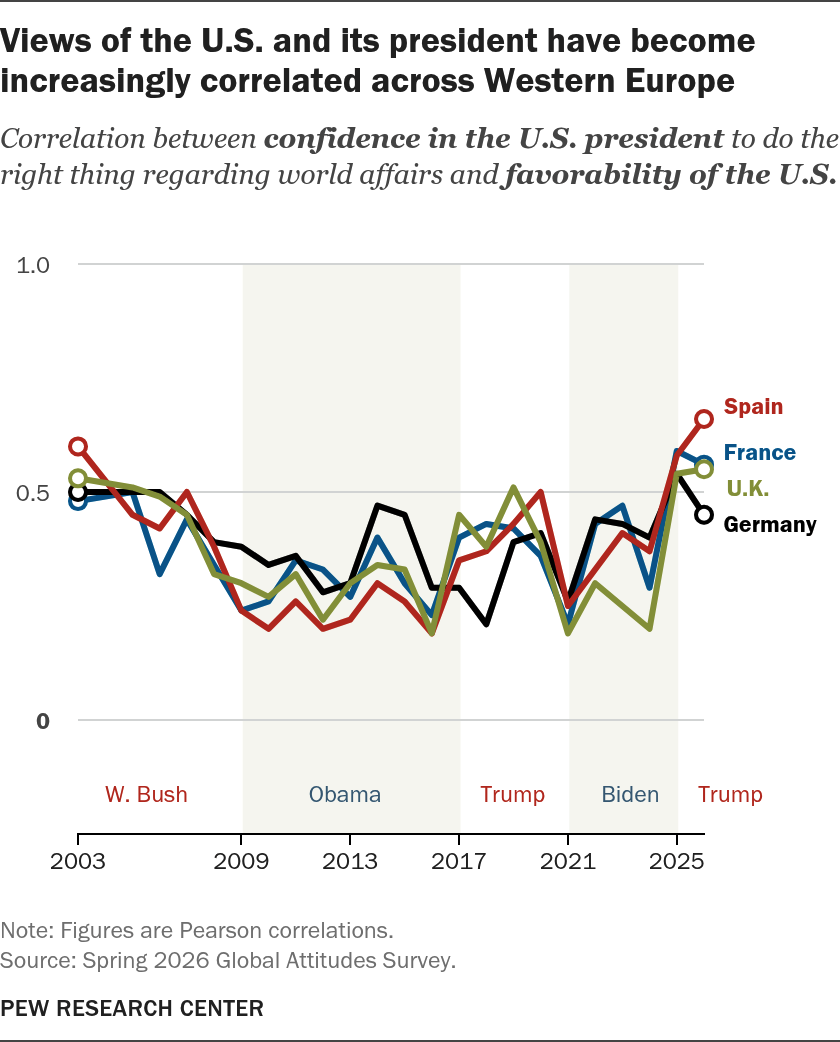
Between 2003 and 2005, during the second administration of George W. Bush—a period defined by the initiation and early stages of the Iraq War—views of the U.S. were highly correlated with confidence in the president in countries like France, Germany, Spain, and the U.K. This era of high "package deal" perception was, at the time, an outlier.
The Intervening Years: 2006–2024
Between 2006 and 2024, the correlation between presidential confidence and national favorability generally waned. During this period, international publics appeared more capable of decoupling their views of American policy and leadership from their broader cultural or geopolitical affinity for the United States. Whether due to the relative predictability of administrations or a shift in global focus, the correlation coefficients in Western Europe remained largely moderate.
The Return of the "Package Deal"
The data from 2025 and 2026 indicates that this period of relative decoupling has ended. Across Western Europe, correlations are currently at or near record highs. In Spain, for example, the correlation hit 0.66 in 2026, the highest in the two-decade dataset. This resurgence of the "package deal" mentality suggests that international perceptions of the U.S. are becoming increasingly sensitive to the persona and perceived stability of the U.S. president.
Beyond the U.S.: Global Leaders and Their Countries
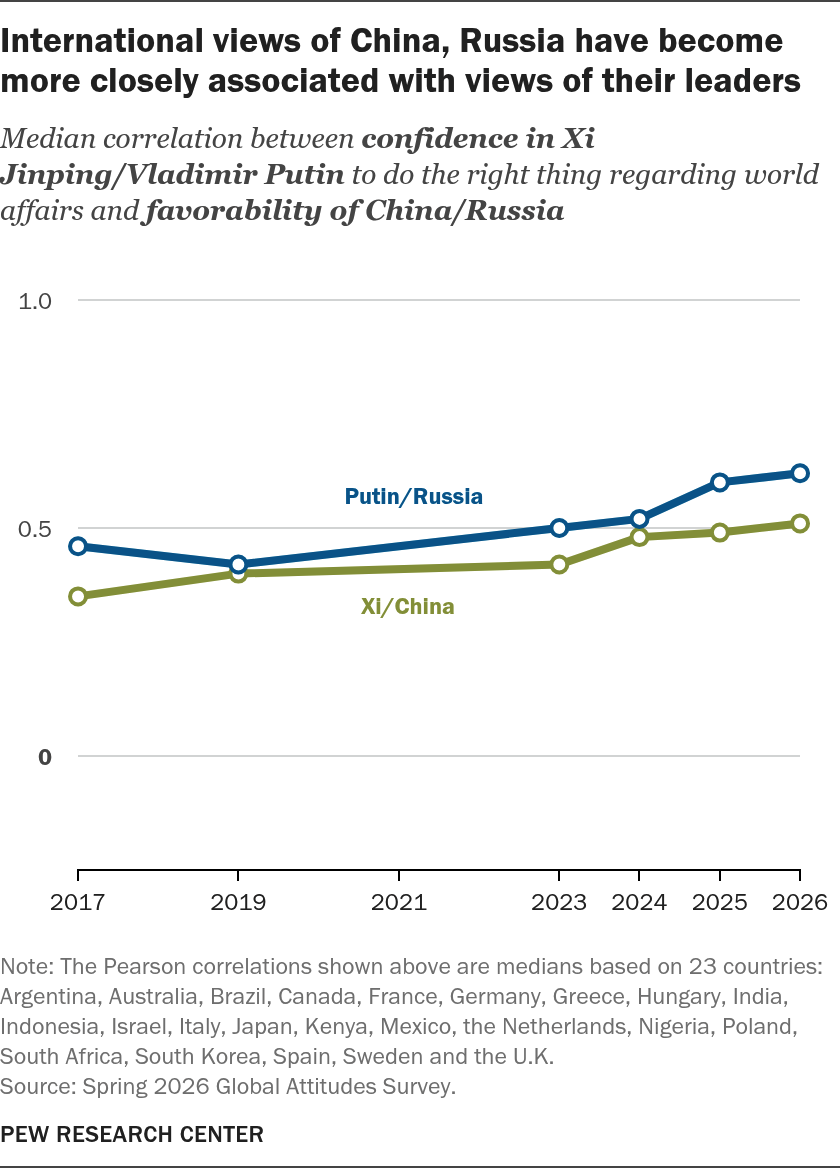
The trend of merging a country’s image with that of its leader is not unique to the United States. The 2026 survey suggests that international views of China and Russia are following an identical trajectory.
As confidence in President Xi Jinping and President Vladimir Putin to "do the right thing regarding world affairs" has fluctuated, favorability toward China and Russia has moved in lockstep. The median correlation between confidence in these leaders and the favorability of their respective nations has climbed steadily across the 23 nations surveyed since 2017. For instance, the correlation for Putin and Russia rose from 0.46 in 2017 to 0.62 in 2026. This global pattern implies that in an era of strongman politics, the brand of the nation is increasingly being subsumed by the brand of the individual leader.
Statistical Analysis: Country-Level Correlations
While individual-level data provides insight into the psychology of the voter, country-level correlations allow researchers to look at the "macro" picture, filtering out the "noise" of individual survey responses. When examining the data across 23 countries, the predictive power of presidential approval becomes undeniable.
During the Biden administration in 2024, there was a significant divergence between U.S. favorability and presidential approval. In Brazil, for instance, 64% of the population held a favorable view of the U.S., while only 37% expressed confidence in President Biden. Similar gaps were observed in Italy, Mexico, and South Korea.
By 2026, however, the gap had largely closed. The correlation across the 23 surveyed countries reached 0.90 this year. This means that, statistically, knowing a country’s level of confidence in the U.S. president provides a near-perfect indicator of that country’s overall favorability toward the United States.
There are notable exceptions to this, however. In Mexico, the contrast remains stark: 40% of the population views the U.S. favorably, yet only 11% report confidence in President Trump. This suggests that while the "package deal" effect is the dominant global trend, deep-seated historical and economic ties can sometimes shield a nation’s image from the fluctuations of presidential popularity.
Conversely, in countries like Kenya, the alignment is nearly absolute: 63% view the U.S. favorably, and 63% express confidence in the U.S. president. Similarly, in Sweden, the alignment is reflected on the negative side, with low confidence in the president (11%) mirroring low favorability toward the country (19%).
Implications for Global Diplomacy
The implications of this shift are profound for the conduct of American foreign policy. If international publics no longer distinguish between the U.S. and its president, then diplomatic efforts to build or repair relationships may become entirely dependent on the personal standing of the executive.
- The Volatility of Alliances: If a nation’s favorability is tethered to a president’s personal approval rating, alliances may become increasingly volatile, shifting drastically every four to eight years based on the domestic political cycle in Washington.
- The "Personalization" of Diplomacy: Foreign governments may shift their engagement strategies to focus exclusively on the executive branch, bypassing traditional legislative or institutional channels if they believe the president holds total authority over the nation’s "brand."
- Soft Power Constraints: For the United States, the loss of the ability to separate national image from presidential personality means that American soft power—the ability to influence through culture, values, and diplomacy—may become a captive of the political polarization that defines the U.S. presidency.
Conclusion
The 2026 Global Attitudes Survey provides a sobering look at a world where nuance is increasingly hard to find. As the global public moves toward viewing the U.S. as a "package deal," the responsibility placed on the shoulders of the American president grows.
The data suggests that the world is no longer looking past the president to the underlying institutions of American democracy. Instead, they are looking directly at the leader. Whether this is a temporary realignment or a permanent feature of the modern geopolitical landscape remains to be seen. However, as the correlations climb, it is clear that the international perception of the United States will continue to be written in the image of its commander-in-chief.
About the Author