In the modern digital landscape, the speed and accessibility of online opt-in polling have made it a cornerstone of political discourse, market research, and public policy analysis. However, a significant, growing shadow looms over this industry: the proliferation of "bogus" or fraudulent respondents. These are not merely inattentive individuals; they are often bad-faith actors or automated bots seeking to exploit survey incentives.
A comprehensive new study by the Pew Research Center, conducted in late 2024, sheds light on the efficacy of common industry "cleaning" techniques. The findings are sobering: while some methods help improve data quality, others—most notably matching respondents to national voter files—can inadvertently degrade the accuracy of the final results.
The Core Challenge: Distinguishing the Real from the Fraudulent
Online opt-in polls rely on participants recruited through online advertisements, self-enrollment portals, and email distribution lists. Unlike probability-based, offline-recruited panels—such as the American Trends Panel, which are largely immune to these specific threats—opt-in polls are constantly vulnerable to individuals who provide fraudulent information to collect rewards.

These bogus respondents frequently engage in "yea-saying" (agreeing to every question regardless of logic), provide gibberish or AI-generated text in open-ended fields, and exhibit strong "primacy effects," where they default to the first answer choice provided. As these fraudulent responses accumulate, they distort public opinion metrics, potentially misguiding decision-makers, the media, and the public.
Chronology of the Research Effort
To investigate the impact of these fraudulent cases, the Pew Research Center fielded a large-scale survey from November 14 to 19, 2024, involving 11,114 U.S. adult respondents. The goal was to stress-test three industry-standard methods for purging fraudulent data:
- Trap Questions (Attention Checks): Inserting questions that require a specific, truthful "No" answer to ensure the respondent is actually reading the survey.
- Automated Prescreening: Utilizing proprietary systems (such as CloudResearch’s "Sentry") that analyze metadata, device information, and behavioral patterns before a user even enters the survey.
- Voter File Matching: Asking respondents to provide their name and address to be verified against a national database of registered voters.
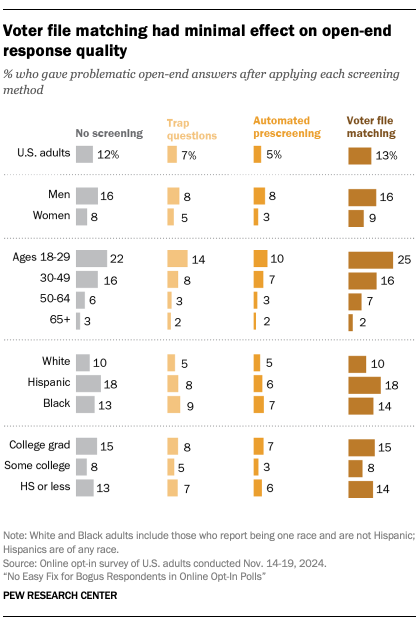
Researchers evaluated these methods based on three metrics: the frequency of "yea-saying," the quality of open-ended text responses, and the severity of response order effects.
Supporting Data: Why Some Methods Fail
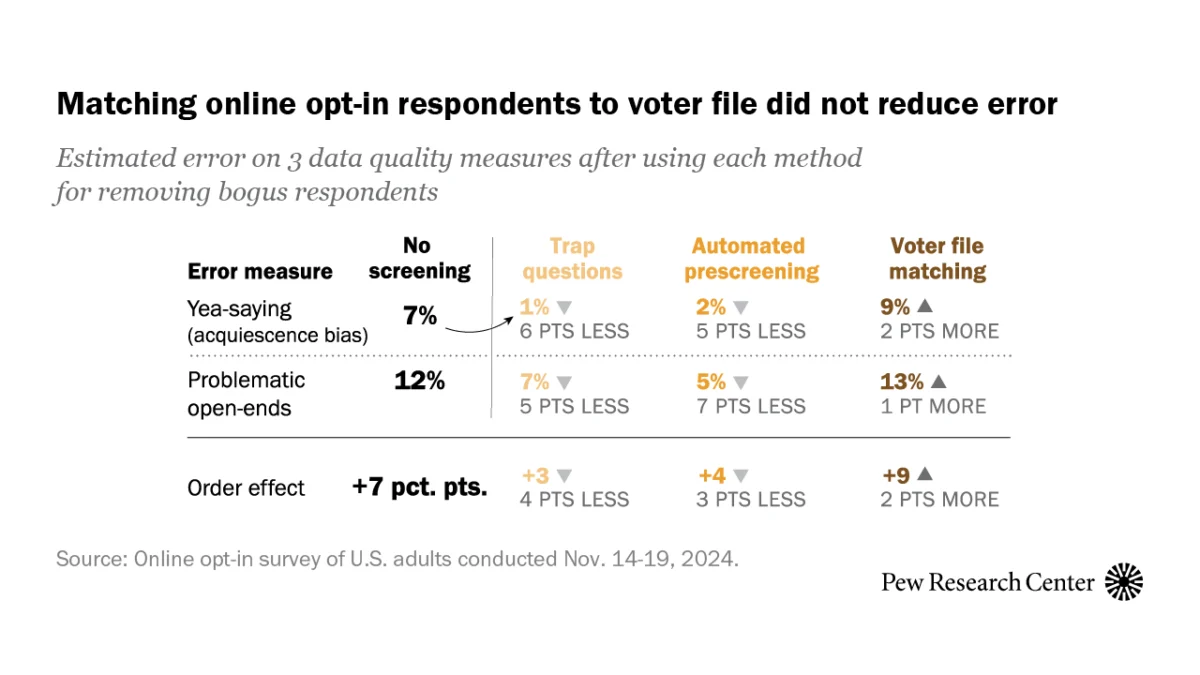
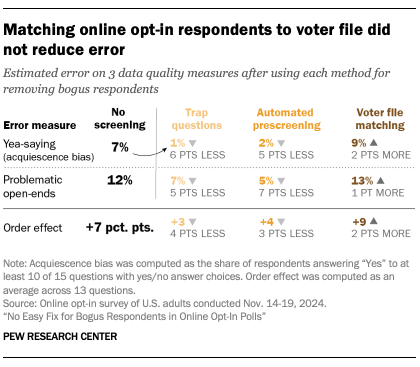
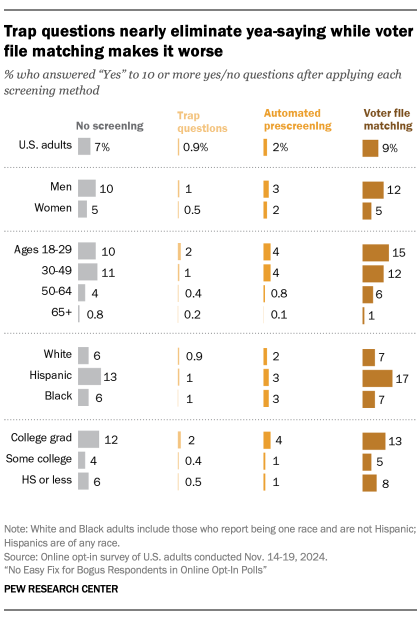
The results revealed a nuanced hierarchy of efficacy. When it came to eliminating "yea-saying," trap questions proved to be the most effective. Prior to any screening, 7% of all adults and 13% of Hispanic respondents answered "Yes" to at least 10 of 15 improbable yes/no questions. After filtering via trap questions, this figure dropped to just 1% of the total adult population. Automated prescreening performed similarly well, reducing these figures to 2% for the total population.
However, the third method—voter file matching—produced a counterintuitive and concerning outcome. Rather than cleaning the data, it appeared to make the "yea-saying" problem worse. Among the full sample, the rate of "yea-saying" increased from 7% to 9% after filtering.
The Voter File Paradox
The researchers identified two primary reasons for this failure. First, nearly half of the respondents refused to provide the necessary contact information for voter file matching. Data analysis showed that those who refused were, ironically, far less likely to be "bogus" than those who complied. By discarding the non-participants, the researchers were inadvertently throwing away high-quality, valid responses.
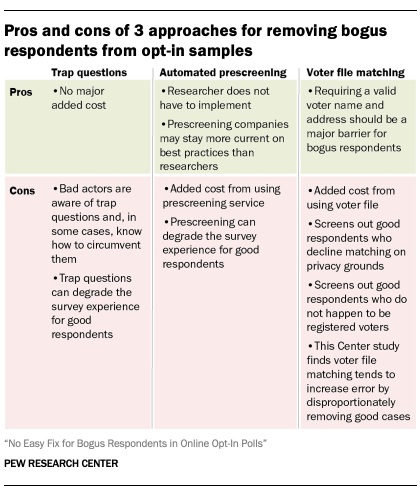
Second, some fraudulent respondents were sophisticated enough to provide contact information that successfully matched against the database, perhaps using stolen or fabricated identities. Consequently, the act of matching did not purge the most problematic actors; it simply reduced the sample size by removing cautious, privacy-conscious, or unregistered citizens.
The Impact on Demographic Accuracy
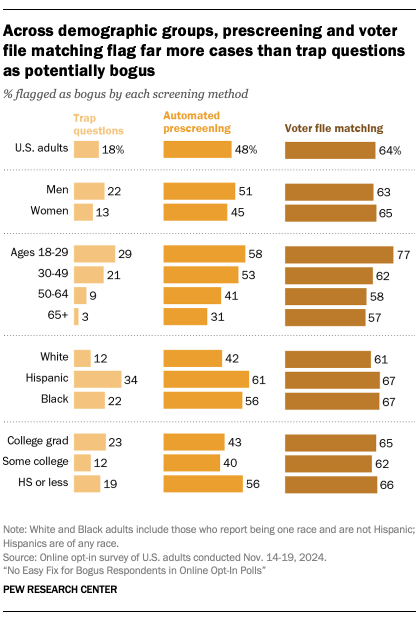
The study highlights a recurring issue in polling: bias against younger and minority demographics. Both trap questions and prescreening were disproportionately likely to flag Hispanic respondents and those aged 18 to 29 as bogus.
Crucially, the research suggests that this is not because these demographic groups are poor survey-takers, but because fraudulent respondents frequently claim to be members of these groups to bypass screening filters. When these "bogus" cases are removed, it drastically alters the demographic composition of the remaining dataset. Voter file matching, by contrast, showed a different pattern, flagging respondents more broadly based on their willingness to provide personal data, which often resulted in a demographic profile that skewed away from the general population.
Implications for Election Polling
Perhaps the most significant takeaway from the study concerns the impact on political metrics, specifically regarding the 2024 presidential election. Before any screening, the survey showed a dead heat between Donald Trump and Kamala Harris, each at 48%.
As researchers applied different screening methods, the margins shifted in favor of Harris. Trap questions shifted the race to a 3-point lead for Harris, while both prescreening and voter file matching moved the needle further, resulting in a 6- to 7-point lead for Harris. This suggests that while Trump may have had a disproportionate share of "bogus" support in this specific sample, the presence of these fraudulent actors initially masked the true leanings of the valid, attentive respondent pool.
This phenomenon is not constant; in previous studies, fraudulent respondents have been shown to shift their fake support toward whichever candidate won the election. This implies that "bogus" respondents are often not just random; they are adaptive, potentially changing their answers based on perceived social cues or their own assumptions about which candidate is the "correct" or "expected" answer.
Conclusion: A Call for Multi-Layered Validation
The Pew Research Center’s findings serve as a warning for the polling industry. There is no "silver bullet" for fraud. While trap questions and prescreening offer robust protections against the most egregious forms of inattentive and fraudulent behavior, they are not perfect.
The study confirms that voter file matching, while potentially useful for understanding voting history, is a poor tool for cleaning data in general population surveys. By focusing on registration status, it filters out valid, unregistered, or privacy-minded respondents, thereby introducing its own unique form of bias.
For the future of polling, the implications are clear: researchers must prioritize multi-layered validation strategies. Relying on a single method—or relying on methods that disproportionately target specific demographics—will likely lead to increasingly skewed representations of the American public. As artificial intelligence and automated fraud grow more sophisticated, the gap between "clean" data and "polluted" data will only widen, necessitating a more rigorous, transparent, and multi-faceted approach to survey methodology.
Ultimately, the integrity of the information provided to the public depends on the willingness of pollsters to acknowledge these limitations, report their methodologies with total transparency, and continuously evolve their defenses against those who seek to manipulate the voice of the electorate.
About the Author