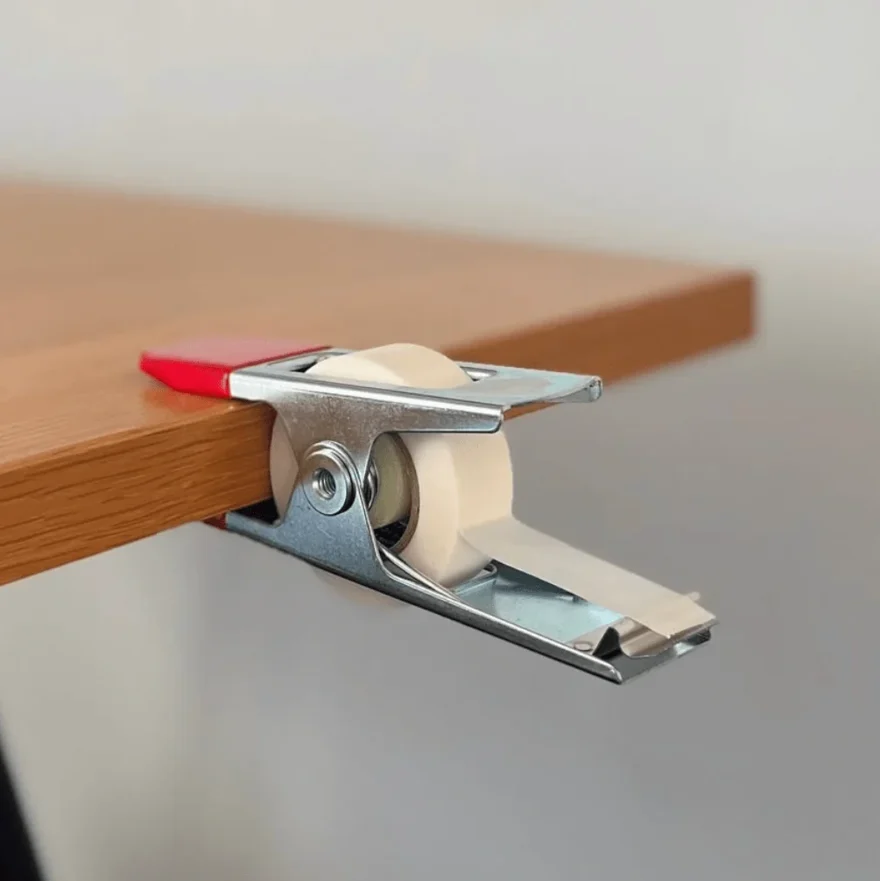
In the realm of industrial design, the most compelling products are often those that rethink the mundane. The office tape dispenser—a staple of the desktop landscape for nearly a century—has seen few radical reinventions. However, David Suhami and Nitzan Shafat, the duo behind the Israeli industrial design studio Scratch Design, recently introduced a concept that challenges the status quo: the ClampTape.
By merging the mechanical reliability of an A-clamp with the utility of a tape dispenser, Scratch Design has created a tool that addresses a common workspace frustration—the "sliding dispenser" syndrome. While the design has been lauded for its ingenuity and aesthetic, a critical flaw in its manufacturing specifications has sparked a conversation about the intersection of local design culture and global market requirements.
Main Facts: The Anatomy of the ClampTape
At its core, the ClampTape is a study in functional fusion. Rather than relying on the traditional weighted base—which often fails to keep a dispenser stationary during one-handed use—the ClampTape utilizes the physical architecture of an A-clamp. By centering the tape roll directly over the clamp’s pivot point, the device transforms the user’s workspace edge into an anchor.

The product’s design philosophy centers on stability. By exerting downward pressure on the edge of a desk or shelf, the clamp creates a fixed point of tension. When a user pulls the tape, the force is distributed through the clamp’s frame rather than against the friction of a rubber base. Early user reports, particularly those from the WMSCO shop, confirm that the hardware is exceptionally sturdy. It provides a tactile, satisfying experience that mimics the industrial feel of a shop tool rather than a flimsy office supply.
However, the design hit a significant roadblock upon its international debut. The device is calibrated for a specific tape core diameter that is widely available in Israel but incompatible with the global industry standard—most notably the 1-inch and 3-inch core diameters used by giants like 3M and Scotch.
Chronology of a Design Evolution
The development of the ClampTape represents a trajectory typical of boutique industrial design studios.

- Conceptualization (The Problem Statement): Scratch Design identified the inherent instability of desktop dispensers. They hypothesized that a "clamping" mechanism would allow for one-handed operation without the bulk of a heavy cast-iron base.
- Prototyping: The studio focused on the ergonomics of the A-clamp. They sought to balance the spring tension—too weak, and the dispenser slips; too strong, and it becomes difficult to attach to varying desk thicknesses.
- Market Launch: The product was released in the Israeli market, where it gained traction for its clever use of vertical space.
- International Expansion: As the product moved to online storefronts accessible to global consumers, the "standardization gap" became immediately apparent. International buyers began reporting that standard off-the-shelf tape refills were either too wide for the housing or featured a core diameter that failed to seat properly on the dispenser’s spindle.
- The Current Impasse: The product remains a "niche hit." It is widely admired for its form factor but frequently sidelined by the logistical nightmare of sourcing proprietary tape refills.
Supporting Data: The Case for Standardization
To understand why this is a significant hurdle, one must look at the tape industry’s infrastructure. The "Scotch" standard—named after the brand that popularized the pressure-sensitive tape—is not just a consumer convenience; it is a global manufacturing standard.
The Core Dimension Conflict
Most desktop tape dispensers in the United States and Europe utilize a standard 1-inch core (for smaller, household dispensers) or a 3-inch core (for heavy-duty office dispensers). The ClampTape, as designed by Scratch, utilizes a specific geometry that does not accommodate these dimensions.
- Manufacturing Efficiency: Retailers often sell tape in bulk. When a product requires an "odd size," it effectively forces the consumer into a closed-loop ecosystem.
- The "Convenience" Metric: Studies in office ergonomics suggest that the time taken to source non-standard refills results in "workflow friction." For a tool designed to increase efficiency, this creates a net loss in utility.
- Economic Impact: A product that cannot use readily available refills loses its value proposition within weeks of purchase. Consumers are generally unwilling to pay a premium for a tool that requires specialty sourcing for its consumables.
Official Responses and Studio Intent
While Scratch Design has not issued a formal "recall" or "revision" statement, their design portfolio suggests a studio that values iterative improvement. Industry peers have noted that the studio’s focus is primarily on the mechanical action of the device.

In discussions regarding the ClampTape, the sentiment from the studio reflects a common designer’s dilemma: Do we design for the market we are in, or the market we want to reach? For an Israeli-based studio, the decision to utilize locally available tape standards was likely a pragmatic choice during the initial fabrication phase.
However, the design community has been vocal in its feedback. Professional design forums, such as Core77, have highlighted the ClampTape as a "brilliant" design that is currently "incomplete." The consensus is clear: the studio has achieved the hard part (mechanical innovation and aesthetic appeal) and is currently tripped up by the easy part (adhering to global ISO standards for tape cores).
Implications: The Future of Globalized Design
The ClampTape serves as a microcosm for a larger issue in the modern industrial design landscape: The Globalization of Localized Prototypes.

The Burden of Design Standards
As e-commerce platforms like Amazon, Etsy, and Shopify allow boutique designers to reach a global audience, the margin for error regarding regional standards has vanished. A product designed in a garage in Tel Aviv is now competing with products designed in corporate labs in Minnesota.
Potential Revisions
For Scratch Design to capture the American crafting market—a massive demographic that values high-quality, clever tools—the implications are clear:
- Spindle Re-engineering: The studio must replace or adjust the spindle diameter to accommodate the universal 1-inch or 3-inch core.
- Housing Expansion: The side walls of the tape housing must be widened to account for the variance in tape width often found in global manufacturing.
- The "Universal" Model: Creating a modular spindle that can be swapped out depending on the user’s region would not only solve the problem but could actually become a unique selling point for the brand.
The Verdict on Design Integrity
The ClampTape is an example of "design-led" versus "market-led" development. Design-led products prioritize the experience of the object—the satisfying "click" of the clamp, the visual appeal of the exposed mechanism, and the clever repurposing of a hardware tool. These are the traits that make a product go viral on platforms like Instagram or Pinterest.

However, longevity in the market requires market-led intelligence. The implications for Scratch Design are positive if they choose to pivot. If they adjust the ClampTape to meet the global standard, they have a "killer app" for the desk. The tool is already a success in terms of brand recognition and design acclaim; it simply needs to be "domesticated" for the international consumer.
Conclusion: A Call for Iteration
The ClampTape is a testament to the fact that design is rarely a finished state. It is an ongoing conversation between the creator and the user. Scratch Design has succeeded in solving the primary ergonomic complaint of the tape dispenser—the sliding base—with a flourish of industrial elegance.
The current frustration regarding tape compatibility should not be viewed as a failure, but rather as an invitation. If the studio acts on the feedback of the global design community, the ClampTape could evolve from a clever, niche curiosity into a ubiquitous office staple. Until that update occurs, it remains a beautiful object waiting for the final, essential adjustment that will allow it to truly stick.

The world of industrial design is littered with "great ideas" that failed to account for the boring, unglamorous realities of global standards. Scratch Design has the opportunity to avoid that fate, transforming a local clever idea into a global success story by simply listening to the rhythm of the market. In the end, the best designs are those that disappear into the workflow, and for the ClampTape, that goal is only one small, standardized adjustment away.
About the Author