September 10, 2026
Introduction: The Persistence of Collective Memory
As the United States reaches the 25th anniversary of the September 11, 2001, terrorist attacks, the nation pauses to reflect on a defining moment in modern history. Even a quarter-century later, the scars and the stories remain remarkably vivid. According to a recent study conducted by the Pew Research Center, 93% of Americans who were at least 10 years old at the time of the attacks can still recall with startling precision where they were and what they were doing the moment they learned of the tragedy.
This anniversary serves as more than a memorial; it acts as a barometer for how historical trauma shapes national identity. In 2016, roughly three-quarters of U.S. adults identified 9/11 as one of the top 10 most significant historic events of their lifetimes—a consensus that far outstripped any other domestic or global occurrence. As we move further into the digital age, this collective memory remains a cornerstone of the American consciousness, framing debates on security, foreign policy, and the nature of global conflict.
The Chronology of Remembrance: From Trauma to Legacy
The journey from the morning of September 11, 2001, to today has been defined by distinct phases of national processing.
- The Immediate Aftermath (2001–2003): The immediate period was characterized by a surge in national unity, followed by the rapid implementation of the Patriot Act and the initiation of military campaigns in Afghanistan and Iraq.
- The Institutionalization of Security (2004–2011): The creation of the Department of Homeland Security and the overhaul of intelligence infrastructure defined the mid-2000s. This era saw the normalization of heightened airport security and a shift in domestic surveillance.
- The Long Tail of Conflict (2012–2021): As the wars in the Middle East stretched into their second decade, public discourse shifted toward the cost of "forever wars" and the erosion of domestic civil liberties in the name of safety.
- The Historical Perspective (2022–2026): Now, at the 25-year mark, the event has moved from current events into the realm of history. Younger generations, who have no living memory of the pre-9/11 world, are now the majority of the workforce, forcing a shift in how the legacy of the attacks is taught and remembered.
The Information Crisis: Navigating Truth in a Digital Age
While we remember the past with clarity, our present is clouded by an increasingly fractured information ecosystem. The same technological advancements that have allowed us to archive history with perfect digital fidelity have also enabled the rapid proliferation of misinformation.
The Rise of "Arbiter" and AI-Driven Verification
In response to the growing concern over misleading narratives, a new technological initiative known as "Arbiter" has emerged. This independent, nonprofit tool utilizes advanced artificial intelligence to analyze social media trends in real-time. By identifying patterns of disinformation and verifying sources, Arbiter aims to provide journalists with the tools necessary to filter noise from news.
The necessity for such a tool is underscored by a sobering reality: public trust in information sources has hit a nadir. While traditional news organizations struggle to regain the public’s confidence, social media platforms fare even worse. A 2025 study revealed that only 37% of U.S. adults hold even a moderate level of trust in information harvested from social media sites.
The Skepticism of the Digital Consumer
The distrust is not merely a perception; it is a lived experience. In a 2024 survey, the Pew Research Center found that a significant majority of users across platforms like X, Facebook, Instagram, and TikTok frequently encounter content they deem inaccurate. When asked what they dislike most about consuming news on social media, "lack of accuracy" was the overwhelming consensus. This skepticism poses a profound challenge for democratic discourse: if citizens cannot agree on a baseline of facts, the capacity for civic participation is severely diminished.
Supporting Data: The Knowledge Gap
A critical paradox defines the American public today: while citizens overwhelmingly agree that being informed is a civic duty, they simultaneously report feeling inadequately equipped to navigate complex policy issues.
The Importance vs. Informedness Matrix
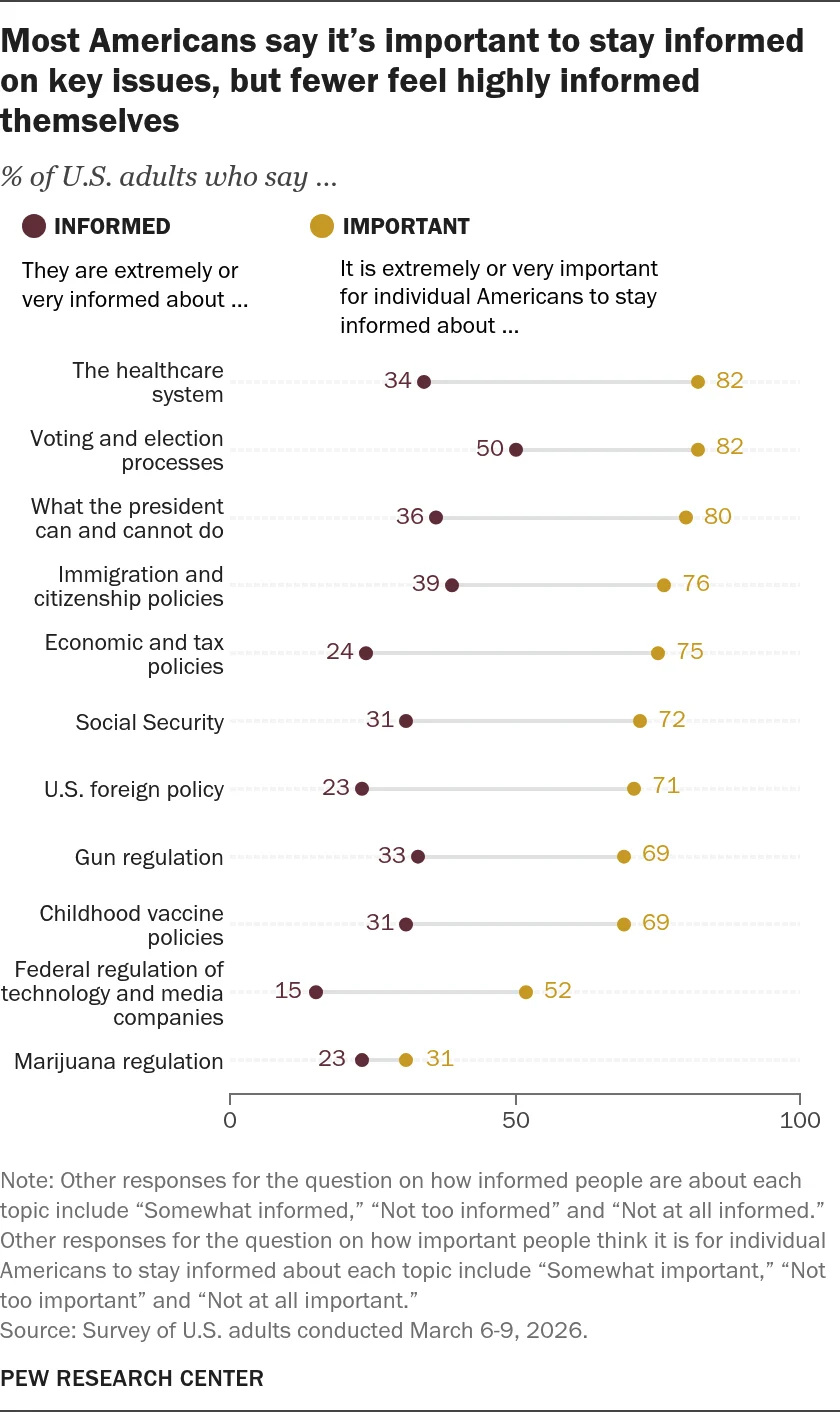
According to a March 2026 survey, there is a stark discrepancy between what Americans value and what they know.
The Civic Priority Gap:
- Healthcare: 82% of Americans believe it is crucial to be informed, yet only 34% feel they are "extremely or very" informed.
- Voting and Election Processes: While 82% view this as a priority, only half (50%) feel confident in their level of understanding.
- Economic and Tax Policy: 75% say it is vital, but only 24% feel highly informed.
- Foreign Policy: 71% believe it is essential to stay informed, but only 23% report having a strong grasp of these issues.
This "informedness gap" is particularly acute in technical areas such as federal regulation of technology, where only 15% of the population claims to be highly informed, despite over half (52%) identifying it as a necessary area of knowledge.
Official Responses and Expert Analysis
Policy analysts and media experts suggest that the solution to this knowledge gap lies in a multi-faceted approach.
"We are seeing a collapse in the gatekeeper model," says Dr. Elena Vance, a senior researcher in media communications. "For decades, the public relied on a centralized media infrastructure. Today, we have decentralized, algorithmic silos. The ‘Arbiter’ project is a move toward a new form of digital hygiene—a way to crowd-source truth rather than rely solely on corporate-controlled platforms."
Furthermore, government entities are beginning to acknowledge that media literacy is a national security issue. Discussions at the legislative level have pivoted toward incentivizing platforms to prioritize verifiable information. However, these efforts face constant friction regarding the balance between combatting misinformation and protecting free speech.
Implications for the Future of Democracy
As we look beyond the 25th anniversary of 9/11, the implications of this data are clear: the stability of the American republic depends on closing the gap between the importance we place on issues and our actual capacity to understand them.
The Path Forward
- Media Literacy as Curriculum: The data suggests that without a deliberate effort to educate the public on how to evaluate sources, the current trend of low trust will likely continue.
- Technological Accountability: Tools like Arbiter represent a necessary evolution in journalism, but they cannot replace the individual responsibility of the citizen to verify information before sharing.
- Reframing Civic Duty: The 9/11 anniversary serves as a reminder that national unity is often forged in times of crisis. The challenge for the next 25 years is to build a similar sense of common purpose without the tragedy of an attack, focusing instead on the common goal of an informed, rational, and engaged citizenry.
The decline in trust, the rise of AI-driven tools, and the persistent knowledge gap are not isolated phenomena. They are part of a larger, systemic transformation of the public square. As we honor the past, we must also reconcile with the reality that our future depends on our ability to navigate a digital landscape that is as perilous as it is promising.
The briefing concludes with a call to action for the reader: the news is not just something to be consumed, but a discipline to be practiced. In an era where "accuracy" is the most sought-after and elusive commodity, the responsibility to remain informed is more vital than ever.
The Briefing is a collaborative effort by the Pew Research Center’s team, including Naomi Forman-Katz, Christopher St. Aubin, Emily Tomasik, Joanne Haner, and Sawyer Reed. It is edited by Michael Lipka and copy-edited by David Kent. We invite our readers to participate in our ongoing research by emailing [email protected] or completing our brief feedback survey.
About the Author