For decades, the American media landscape was defined by the steady arrival of the morning newspaper and the 6:00 p.m. television broadcast. Today, that paradigm has shifted irrevocably. A new report from the Pew Research Center, conducted under the auspices of the Pew-Knight Initiative, reveals that social media has cemented its role as a cornerstone of the American news diet. As of mid-2026, a clear majority of U.S. adults—58%—identify social media platforms as an important gateway for keeping up with daily current events.
This transformation is not merely a matter of convenience; it represents a fundamental change in how citizens interact with the world, form political identities, and engage with their communities. As traditional newsrooms face declining subscriptions and shrinking audiences, the "megaphone" of social media has increasingly become the primary lens through which the American public views reality.
The Rapid Ascent: A Statistical Overview
The data from the June 2026 survey provides a stark contrast to the information environment of just four years ago. In 2022, only 43% of U.S. adults viewed social media as an important news source. By 2026, that figure has climbed to 58%. More significantly, the intensity of this reliance has tripled: while only 5% of respondents in 2022 identified social media as their most important source of news, that number has surged to 13% today.
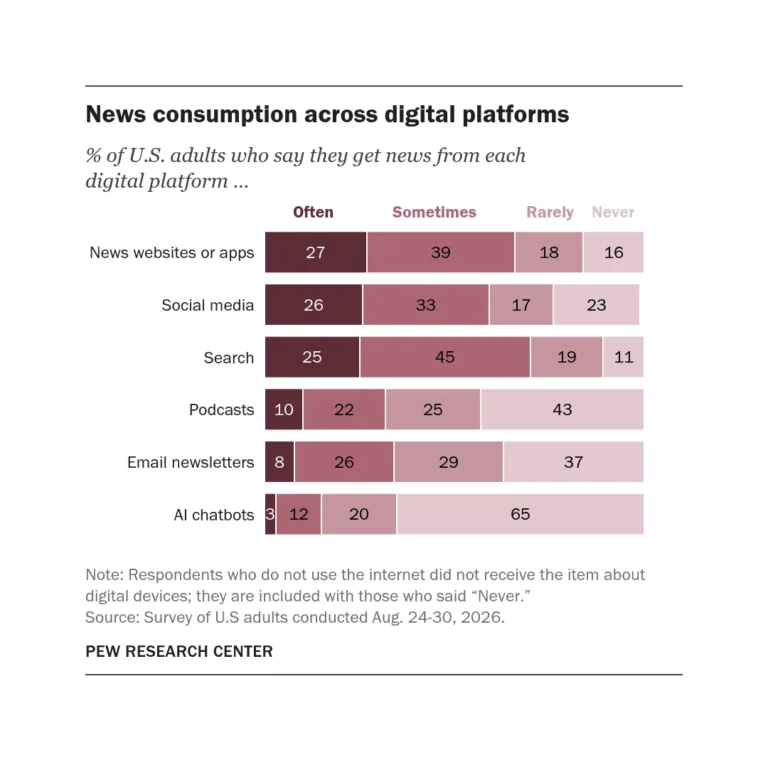
This upward trend is consistent with broader industry observations. Platforms that were once strictly for social networking—such as TikTok, Instagram, and X (formerly Twitter)—have morphed into primary news destinations. Algorithms designed to maximize engagement now prioritize trending topics, breaking news, and viral political commentary, effectively placing the news cycle directly into the hands of users scrolling through their personalized feeds.
A Generational Divide: The Digital Native Advantage
The shift toward social media is not uniform across all demographics; it is sharply divided by age. The youngest cohorts of the American electorate are leading the charge, effectively moving away from traditional broadcasting and print media entirely.

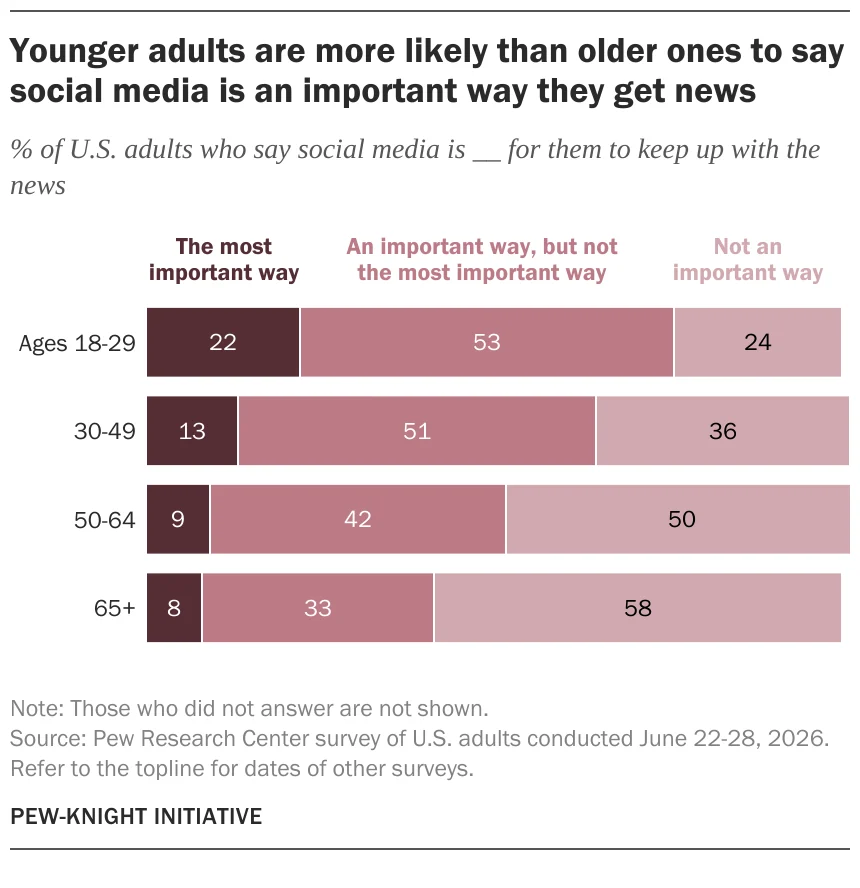
Among adults aged 18 to 29, a staggering 76% now rely on social media for their news. Nearly one-quarter of this demographic (22%) classifies these platforms as their most important source of information. This is a profound shift that suggests a generational decoupling from legacy media institutions. For these "digital natives," the concept of "tuning in" to a scheduled broadcast is increasingly foreign, replaced by an on-demand, algorithmic feed that is constantly refreshed.
In contrast, the older population remains tethered to more traditional models. While 41% of adults aged 65 and older acknowledge social media as an important component of their information gathering, they are far more likely to rely on television and legacy outlets as their primary sources. The implications of this divide are significant: as the population ages, the reliance on social media as a dominant source of information is projected to grow, potentially leaving a shrinking share of the public relying on traditional journalism for their primary news intake.
Chronology of a Media Transformation
To understand how we arrived at this point, one must look at the evolution of the digital news ecosystem over the last decade:
- 2015–2018: The Integration Phase: Social media platforms begin implementing "trending" features, and publishers start optimizing content specifically for the Facebook and Twitter feeds. News organizations treat social media as a distribution channel rather than a destination.
- 2019–2021: The Algorithmic Shift: Platforms shift their focus toward video-first content. The rise of TikTok forces competitors like Instagram (Reels) and YouTube (Shorts) to prioritize short-form, high-impact news snippets, making it easier for users to consume "the news" without leaving the app.
- 2022: The Inflection Point: Pew research indicates that 43% of Americans view social media as an important news source. Public trust begins to oscillate as the lines between "content creator" and "journalist" blur.
- 2023–2025: The Crisis of Authority: As economic pressures mount on traditional newspapers, newsroom layoffs accelerate. Simultaneously, social media platforms expand their live-streaming capabilities, allowing citizen journalists to capture breaking events in real-time, often outpacing professional news crews.
- 2026: The New Normal: A clear majority (58%) of Americans report that social media is an essential part of their news consumption. The platform-as-publisher model is now the dominant paradigm for the average American adult.
Supporting Data: Dissecting the Demographics
The survey data highlights a clear correlation between age and reliance on digital news. As the age of the respondent increases, the "importance" of social media decreases, while the percentage of those who find it "not an important way" to get news increases proportionally.
| Age Group | Most Important (%) | Important, but not most (%) | Not Important (%) |
|---|---|---|---|
| 18–29 | 22 | 53 | 24 |
| 30–49 | 13 | 51 | 36 |
| 50–64 | 9 | 42 | 50 |
| 65+ | 8 | 33 | 58 |
This data suggests that social media’s influence is not merely a passing trend but a structural evolution of the American information environment. The "middle-aged" demographic (30–49) acts as the current swing group, with a combined 64% viewing it as an important source, bridging the gap between the digital-first younger generation and the traditionalist older generation.

Official Perspectives: The Role of the Pew-Knight Initiative
The Pew-Knight Initiative, a collaborative research endeavor between the Pew Research Center and the John S. and James L. Knight Foundation, was created specifically to study these phenomena. By tracking how Americans absorb civic information, the Initiative aims to provide a "fact tank" for understanding how modern technology affects the health of our democracy.
According to the research team, the shift to social media is not just about where people look, but how they perceive information. The study highlights that young adults are not only more likely to get their news from social media, but they are also more likely to express trust in the information they encounter there. This creates a feedback loop: when users trust a platform, they use it more; as they use it more, the algorithm learns their preferences, creating a "filter bubble" that can reinforce pre-existing beliefs.
"For years, we have observed large shares of Americans getting news on social media," the researchers noted. "But by asking about the importance of these sources, we are beginning to see a transition from social media as a secondary supplement to a primary pillar of public information."
The Implications for Democracy and Civil Discourse
The migration of the American public toward social media as a primary news source carries profound implications that go beyond simple audience statistics.
1. The Challenge of Misinformation
Because social media platforms rely on engagement-based algorithms, content that evokes strong emotional responses—often characterized by outrage or polarization—tends to spread more quickly than nuanced reporting. This creates an environment where misinformation can travel faster than corrections, posing a significant challenge to the shared reality required for a functioning democracy.

2. The Economic Crisis of Traditional News
As advertising dollars shift toward tech giants and away from local journalism, the infrastructure of the "fourth estate" is weakening. When local news outlets disappear, the resulting "news deserts" often leave citizens with no alternative but to turn to social media for local information, where facts are often unverified and accountability is nonexistent.
3. The Fragmentation of the Public Square
The "public square" has effectively been splintered into millions of private feeds. While this allows for a diversity of voices, it also makes it increasingly difficult for the nation to engage in a unified debate on policy, science, or history. When individuals receive their news through entirely different, algorithmically curated lenses, the common ground necessary for political compromise shrinks.
4. The Rise of the Citizen Journalist
Conversely, the democratization of news dissemination has empowered marginalized groups to bypass traditional gatekeepers. Stories that were once ignored by major networks can now gain national traction through social media, holding power to account in ways that were previously impossible. The challenge for the future is not to eliminate social media as a news source, but to foster digital literacy so that citizens can navigate this complex, fragmented, and fast-paced landscape with the skepticism and critical thinking it requires.
Conclusion
The findings from the 2026 Pew-Knight study are clear: social media is no longer a peripheral player in the American information ecosystem. It has become the central stage. With 58% of U.S. adults now relying on these platforms to keep up with the world, the focus of the conversation must shift from asking whether people are using social media to how we can ensure the information they find there is accurate, transparent, and conducive to a healthy, informed, and cohesive society.
As we look toward the future, the challenge for both tech platforms and the public is to balance the convenience and speed of social media news with the rigor and ethics of traditional journalism. The transformation is complete; the task now is to ensure it serves the public good.
About the Author