In a watershed moment for the industrial robotics sector, Massachusetts-based startup Walden Robotics officially emerged from stealth mode this week, signaling a paradigm shift in how humanoids will integrate into the global supply chain. Backed by a staggering $300 million in venture funding, the company is poised to deploy general-purpose humanoid robots designed not to replace human workers, but to function as sophisticated, collaborative partners in complex manufacturing and logistics environments.
The company’s debut marks a significant leap forward in the application of "Physical AI"—the integration of advanced machine learning models into physical hardware capable of navigating the unpredictable terrain of factory floors and distribution centers.
The Genesis: From Toyota Research Institute to Industrial Reality
The trajectory of Walden Robotics is inextricably linked to the cutting-edge research conducted at the Toyota Research Institute (TRI). Founded by Dr. Russ Tedrake, a distinguished professor at MIT and a former Senior Vice President of Large Behavior Models at TRI, the company represents the commercial fruition of years of intensive development in robotic dexterity and behavioral learning.
Walden Robotics officially spun out of TRI in January 2026. Unlike many startups that spend years in theoretical R&D, the company opted for a "boots-on-the-ground" philosophy. By February, barely a month after its inception, Walden’s humanoid platforms were already undergoing live testing at a Toyota manufacturing facility in North America. The speed of this transition—from the laboratory bench to a high-output production line in under 60 days—is unprecedented in the robotics industry.
A Massive Injection of Capital
The scale of Walden’s initial funding round underscores the confidence institutional investors have in the company’s vision. With $300 million secured, Walden Robotics has bypassed the typical "seed-to-Series-A" grind, entering the market with the capital reserves necessary to scale manufacturing and software development simultaneously.
The round was co-led by Toyota Motor Corp, Toyota Invention Partners, Toyota Ventures, and Deviation Capital. The participation of the Toyota ecosystem is particularly telling, as it suggests that the world’s largest automaker is not just a financier, but a primary development partner.
The cap table reads like a "who’s who" of industrial and technological titans. Additional backing includes:
- Tech Giants: NVIDIA, Samsung Ventures, and CoreWeave Ventures.
- Aerospace & Logistics: Boeing and Prologis Ventures.
- Venture Capital Firms: AE Ventures, Calibrate Ventures, Colle Capital, Shine Capital, NextView Ventures, Squarepoint Capital, One Madison Group, KAS Venture Partners, and Menlo Ventures.
This diverse consortium of investors suggests that Walden’s utility is expected to transcend the automotive industry, finding applications in aerospace, global logistics, and high-tech manufacturing.
The Philosophy: Augmentation over Automation
Central to Walden’s mission is a rejection of the "lights-out manufacturing" concept—a factory model where machines work in total darkness, devoid of human presence. Instead, Walden advocates for a collaborative model where humanoid robots handle the "dull, dirty, and dangerous" tasks, leaving the nuanced, creative work to human team members.
"Core advances in Physical AI, and all of the excitement and attention surrounding it, has made disruptive change possible," said Dr. Russ Tedrake, co-founder and CEO of Walden. "But providing real value to customers and building a robust and scalable business requires a deep understanding and respect for how manufacturing is done today. The best way to make fast and positive progress is by working closely together with the real experts."
The goal is to delegate high-repetition, physically taxing, or ergonomically challenging tasks to the humanoid platforms. By doing so, the company argues, skilled workers are liberated to focus on problem-solving, quality control, and the "dedication to craft" that remains uniquely human.
How the Technology Works: Continuous Learning
Unlike traditional industrial robots—which are often bolted to the floor and programmed to repeat a single motion millions of times—Walden’s humanoids are designed to be general-purpose. They utilize sophisticated machine learning models that allow them to adapt to new environments and tasks with minimal retraining.
The Learning Loop
The robots employ a continuous improvement cycle. As they operate, they ingest sensory data from their environment, allowing them to adjust their posture, grip, and pathfinding in real-time. If a task changes—such as a shift in the assembly sequence or a different item to be sorted—the robot can be updated with new "behaviors" rather than being physically overhauled.
Physical AI Integration
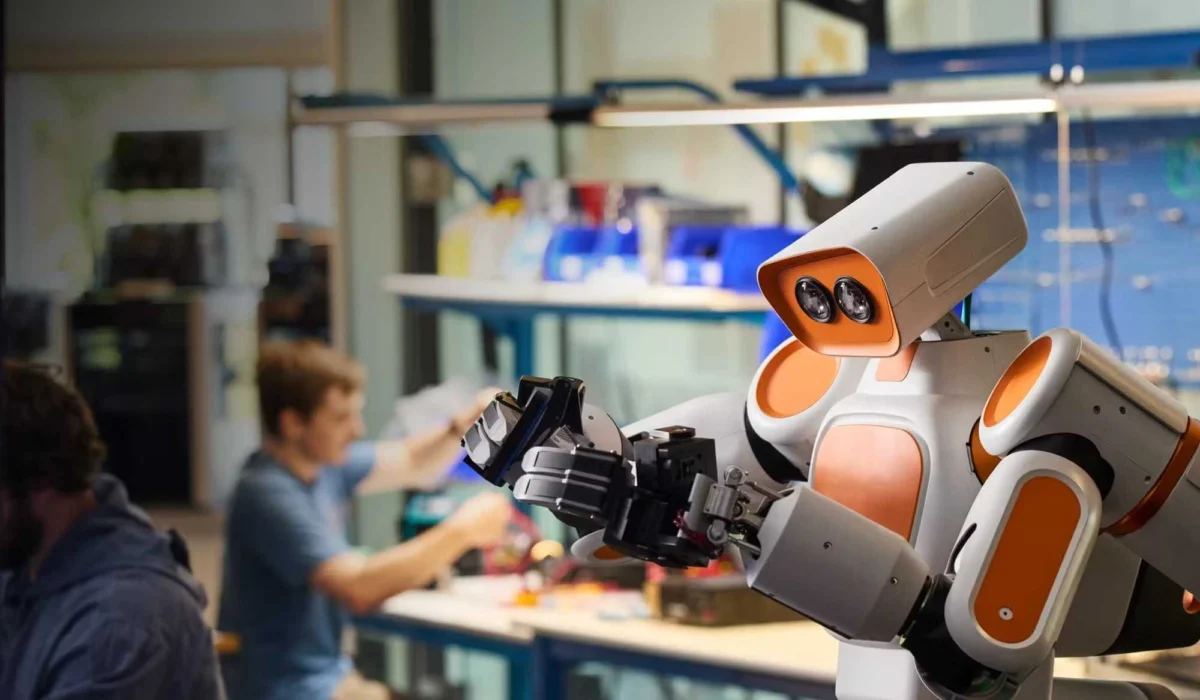
Physical AI is the secret sauce. While Large Language Models (LLMs) process text, Walden’s Large Behavior Models (LBMs) process physical outcomes. These models enable the robot to understand the intent behind a movement. For example, if a human colleague hands the robot a tool, the robot is trained to recognize the gesture and respond with the appropriate grip strength and coordination, mirroring the fluid cooperation seen between human teammates.
Implications for the Global Labor Market
The entry of Walden Robotics into the industrial sphere brings significant economic and societal implications.
The Productivity Gap
For decades, the manufacturing sector has struggled with an aging workforce and a shortage of skilled labor. In many regions, the physical toll of industrial work has led to high turnover rates and a loss of institutional knowledge. Walden’s humanoids offer a potential solution: they can handle the heavy lifting, allowing older workers to transition into supervisory or specialized technical roles, thereby retaining their expertise in the company for longer.
Changing the Shop Floor Dynamic
Critics of robotics often raise concerns about displacement. However, Walden’s narrative focuses on "gratifying and impactful" work. By removing the physical burden of labor, the company hopes to make manufacturing roles more appealing to a younger generation that is currently trending away from industrial careers. If a worker can act as a "robot supervisor" rather than a manual laborer, the perception of factory work may shift from a grind to a high-tech profession.
Scalability and Logistics
The inclusion of Prologis Ventures among the investors highlights the potential for these robots to revolutionize logistics. In massive distribution centers, humanoids could bridge the gap between fixed automation (like conveyor belts) and the high degree of dexterity required for "picking and packing" varied inventory. If Walden can prove that their robots can navigate the chaotic, human-centric environment of a warehouse, the implications for e-commerce efficiency would be profound.
Challenges Ahead: Safety and Integration
Despite the optimism, Walden faces significant hurdles. Integrating humanoid robots into a workspace shared with humans requires an impeccable safety architecture. The robots must be able to detect, anticipate, and avoid human movement with near-perfect reliability.
Furthermore, the "general-purpose" claim will be tested. Developing a robot that is "good at everything" is notoriously difficult compared to building one that is "the best at one thing." Walden must prove that their robots can maintain high uptime and ROI (Return on Investment) while performing a variety of tasks, avoiding the "jack-of-all-trades, master of none" pitfall.
The Road Ahead
As Walden Robotics transitions from its pilot programs to broader industrial deployment, the eyes of the global manufacturing community will be fixed on their progress. With the support of giants like Toyota, Boeing, and NVIDIA, they have the resources to survive the inevitable "valley of death" that claims many robotics startups.
If Walden succeeds, it will not just be a victory for the company, but a validation of the broader vision of the Fourth Industrial Revolution. We are moving toward a future where the distinction between "machine" and "worker" is blurred by intelligence, and where the most advanced tool in the factory is a colleague that never tires, never stops learning, and always respects the human hand at its side.
In the words of the industry experts watching this launch, Walden Robotics isn’t just building machines; they are building the infrastructure of the next century’s workforce. Whether this leads to a renaissance in domestic manufacturing or a radical restructuring of labor remains to be seen, but one thing is certain: the era of the industrial humanoid has officially begun.
About the Author