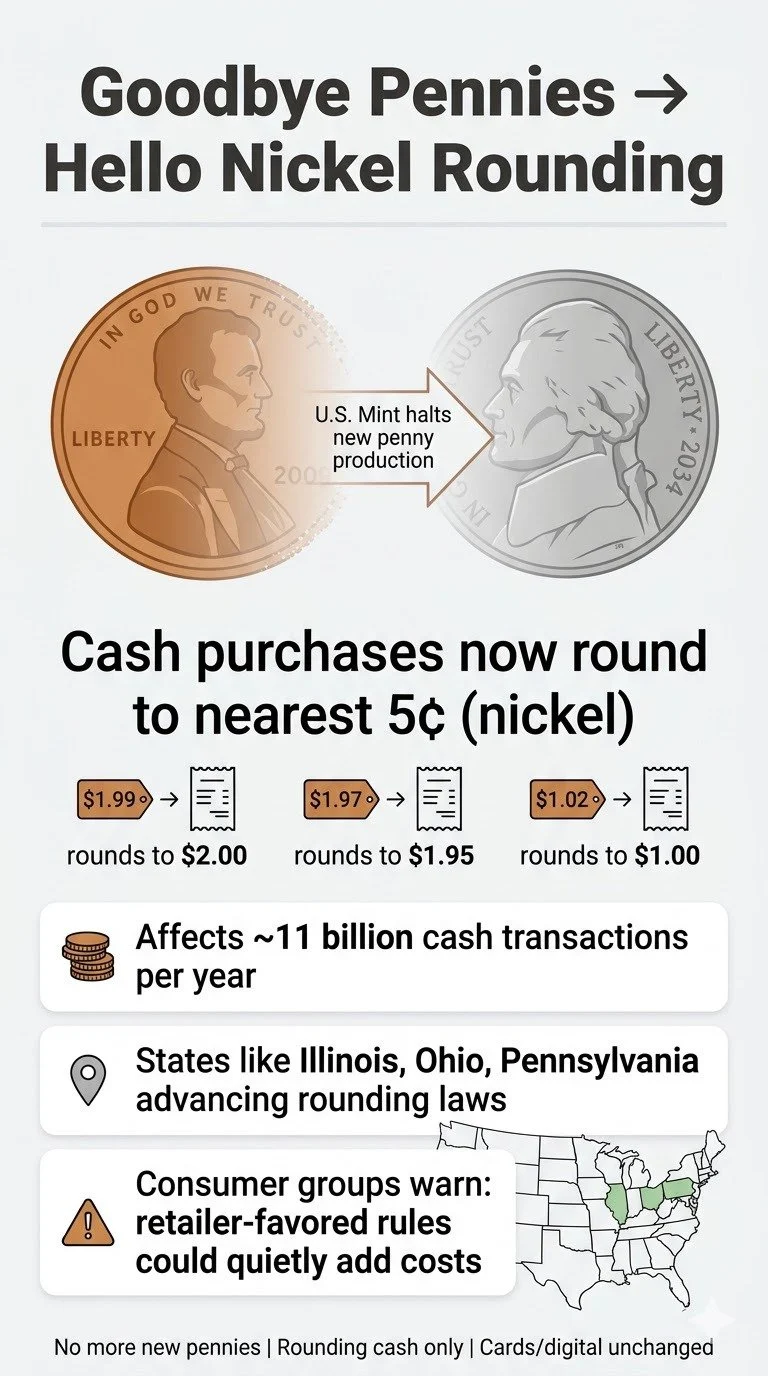
The humble penny, once a staple of the American pocket, is nearing the end of its long and storied circulation. With the U.S. Mint halting the production of new one-cent coins, the domestic economy is facing a quiet but profound logistical transformation. As physical currency becomes increasingly scarce, at least six state legislatures have rushed to introduce bills that would standardize how retailers handle cash transactions, specifically focusing on rounding totals to the nearest nickel.
This shift represents more than a mere change in coinage; it marks a significant evolution in how Americans interact with currency in a digital-first world. While credit cards, mobile wallets, and contactless payments remain unaffected—calculating exact change electronically—the transition poses a unique challenge for the 18 percent of point-of-sale transactions that were still conducted in cash as of 2023.
The Current Legislative Landscape
The legislative response has been swift and, at times, inconsistent. According to recent legislative filings and reports from PBS News, states like Illinois, Ohio, and Pennsylvania are currently debating how to manage the "penny gap." The primary point of contention revolves around the methodology of rounding: should it favor the consumer, the retailer, or adhere to a neutral mathematical formula?
In New York, lawmakers have proposed a flexible approach that would allow retailers to choose their own rounding method, provided they display clear, prominent signage at every register to inform consumers of the policy. Conversely, other states are taking a more prescriptive route, seeking to codify specific rounding mandates into state law to prevent price gouging or consumer confusion.
The Illinois Benchmark
The most advanced of these efforts is currently unfolding in Illinois. Last week, an Illinois bill successfully advanced out of committee, setting a precedent for state-level regulation. The proposed law requires that rounding be done exclusively in the consumer’s favor and includes punitive measures, such as fines of up to $500 per violation, for businesses that fail to comply. A floor vote on the measure is currently scheduled for April 12, serving as a critical bellwether for how other states may eventually structure their own policies.
Chronology of a Disappearing Coin
The decline of the penny has not been an overnight occurrence. For decades, the cost of producing and distributing a penny has exceeded its face value, leading to persistent calls from economists and fiscal hawks to retire the coin.
- Pre-2010s: Economic debates regarding the "seigniorage" loss—the cost of producing money versus its worth—gained traction.
- 2013: Canada officially eliminated the penny, providing a real-world case study for the United States. Canada’s transition to "balanced rounding" was largely smooth, with minimal impact on consumer purchasing power.
- 2020-2023: The global supply chain disruptions and labor shortages, coupled with the continued rise of digital payment adoption, accelerated the decline of cash usage in the United States.
- 2024: The U.S. Mint’s production halt serves as the final catalyst, forcing the hand of state legislators to address the impending shortage of small-denomination change.
Supporting Data and Economic Implications
The Federal Reserve estimates that there are roughly 11 billion cash transactions annually in the United States. With the removal of the penny, the mathematical necessity of rounding becomes a macroeconomic issue.
Consumer advocacy groups have expressed significant concern regarding the potential for "rounding creep." If retailers were permitted to round up consistently in their favor, it could result in an extra two cents per transaction on average. While this seems trivial on an individual basis, the aggregate effect is staggering: such a policy could potentially transfer hundreds of millions of dollars from the pockets of shoppers to the coffers of retail corporations annually.
However, historical data suggests these fears might be overblown. Studies of Canadian transactions following their 2013 shift revealed that the impact was statistically negligible. In most cases, consumers lost or gained less than one cent per purchase, and the "balanced" nature of rounding (rounding up to the nearest nickel for some totals and down for others) neutralized the impact over time. Retailers in Canada reported virtually no consumer complaints once the policies were normalized.
The Case for Federal Guidance
The current legislative patchwork presents a significant operational headache for the retail sector. The National Retail Federation (NRF) has been vocal in its opposition to a state-by-state approach, arguing that it creates unnecessary complexity.
"We need uniform standards, or you’ll have a retailer rounding down in Michigan and rounding up in Indiana," says Jason Miller, chief policy officer at the Retail Industry Leaders Association. "That creates chaos in daily operations and consumer confusion."
For national chains, the prospect of reprogramming point-of-sale (POS) software differently for every state is a logistical nightmare. Each state’s unique requirement—some favoring the consumer, some favoring the store, and others requiring specific signage—would necessitate custom coding and constant updates to store systems. The NRF has officially petitioned Congress to issue federal guidance. By establishing a single national standard for rounding, Congress could effectively eliminate the risk of state-level inconsistencies and provide a stable framework for the retail industry.
Implications for Retailers and Consumers
The move toward a post-penny economy forces a re-evaluation of how businesses manage their cash flow.
Retailer Strategy
For the average retail business, the transition is primarily a technical one. Most modern POS systems are already capable of handling complex rounding logic, but the hurdle lies in compliance and transparency. If a retailer chooses to implement a "consumer-favorable" rounding policy, they might use it as a marketing tool, signaling to customers that they are being treated fairly. If, however, they implement a neutral or retailer-favorable system, the burden of communication increases significantly to avoid public backlash.
Consumer Experience
For the average shopper, the transition will likely be imperceptible. The overwhelming prevalence of credit cards, debit cards, and mobile payments means that the vast majority of consumers will never experience the rounding process. For those who rely on cash, the experience will depend entirely on the legislative environment of their state. Those in states with strong consumer-protection mandates will likely see their totals rounded down, effectively receiving a small "discount" on cash purchases.
Looking Ahead: A Cashless Future?
The halting of penny production is a symptom of a larger, irreversible trend toward a cashless society. As the U.S. Treasury and the Mint adjust to this new reality, the question is not whether the penny will return, but how the United States will manage the transition to a more efficient, digital-centric monetary system.
While the current legislative flurry indicates a period of adjustment, it also highlights a lack of federal foresight. By leaving the decision to individual states, the government has created a window of uncertainty for both retailers and consumers. Whether through Congressional intervention or the eventual settling of state laws into a de facto national standard, the "penny-less" transition is now a certainty.
The ultimate success of this transition will depend on transparency. As long as retailers clearly communicate their rounding policies and regulators ensure that no entity is unfairly profiting from the absence of the one-cent coin, the transition should be as seamless as it was for our neighbors to the north. However, until a unified federal policy is enacted, shoppers and store managers alike must navigate a landscape of varying rules, keeping a watchful eye on the cash register to see exactly how their change is being handled.
The penny may be on its way out, but the conversation it has sparked regarding the future of physical currency is only just beginning. As states continue to deliberate, the primary objective remains clear: maintaining trust in the monetary system while embracing the efficiencies of a modern, digital-first economy.
About the Author