As the race to achieve supremacy in artificial intelligence (AI) intensifies, a new national survey by the Pew Research Center reveals a striking paradox: while the United States is deeply entrenched in a geopolitical and technological contest with China, a significant portion of the American public perceives the U.S. as falling behind.
The survey, conducted in late June 2026, highlights that Americans are three times more likely to believe that China is more advanced in AI development than the U.S. Yet, perhaps more telling than the competitive anxiety is the profound uncertainty among the populace, with a full third of adults expressing doubt about which nation currently holds the lead.
The Current Landscape: A Three-to-One Margin of Doubt
The technological rivalry between Washington and Beijing has become the defining geopolitical struggle of the decade. From semiconductor export controls to massive investments in large language models (LLMs), the competition is palpable. However, the American public’s perception of this reality is cautious.
According to the data, 36% of U.S. adults believe China has surpassed the U.S. in AI development, compared to just 12% who believe the U.S. holds the superior position. While 18% of respondents suggest the two superpowers are neck-and-neck, the most notable takeaway is the 33% of respondents who simply do not know—a reflection of how complex and opaque the rapid evolution of AI remains for the average citizen.

Demographic analysis reveals a gendered divide in this perception. Women are significantly more likely to view China as the leader (41%) compared to men (31%). Furthermore, there is a clear correlation between AI literacy and national confidence: those who regularly engage with AI chatbots are more likely to assert that the U.S. is leading (16%) compared to those who do not use such tools (9%).
A Chronology of Escalation: How We Got Here
To understand the current climate of public opinion, one must look at the rapid acceleration of the AI narrative over the past several years.
- 2022–2023: The Breakthrough: The public introduction of sophisticated generative AI tools shifted the conversation from theoretical research to immediate, real-world utility. During this period, the U.S. and China began aggressively outlining national strategies for AI dominance.
- 2024: Global Showcasing: The World Artificial Intelligence Conference in Shanghai became a focal point for global observers, with China signaling its intent to dominate the industrial application of AI, fueling media coverage that emphasized the "global race."
- 2025: The Regulatory Iron Curtain: As the U.S. government, under the Biden administration, implemented stricter rules to prevent AI technology from reaching adversarial military sectors, the discourse shifted from innovation to "national security" and "containment."
- 2026: The Current Standoff: With high-level rhetoric from political leaders in both parties, the "AI race" has moved from the boardrooms of Silicon Valley into the center of the American political consciousness, leading to the current sentiment where public anxiety over perceived stagnation has reached a fever pitch.
The Mandate for Leadership: Importance vs. Reality
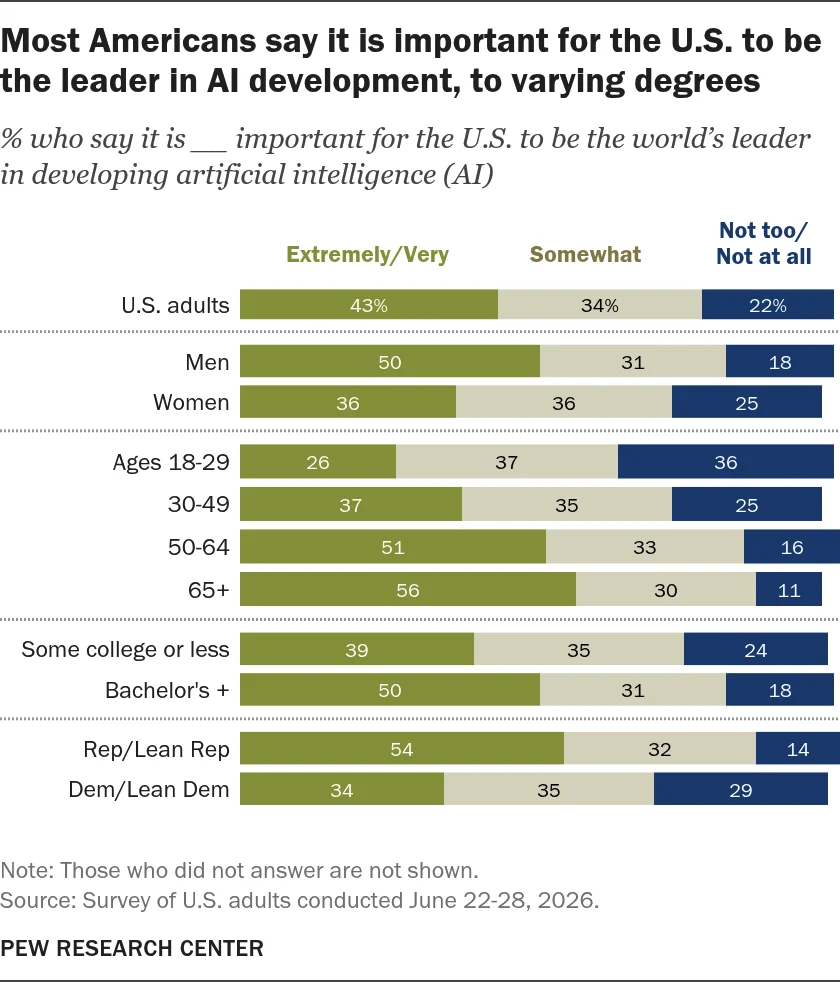
Despite the widespread belief that China may be pulling ahead, there remains a strong consensus among Americans that U.S. leadership in the field is vital. Approximately 43% of Americans classify the U.S. leading in AI development as "extremely or very important."
However, this sentiment is not uniform. The desire for U.S. dominance is significantly higher among older generations. Adults aged 65 and older are more than twice as likely as those aged 18 to 29 to prioritize American leadership in AI. This age gap suggests that for younger generations, the global, borderless nature of the internet and AI may be tempering traditional "nationalist" perspectives on technological development.

Education also plays a defining role. Half of those with a bachelor’s degree or higher view U.S. leadership as a top-tier priority, compared to 39% of those with some college education or less.
Political Divergence: The Rhetoric of Power
The survey highlights a sharp partisan divide regarding the importance of the AI race. A clear majority of Republicans (54%) insist that it is critical for the U.S. to lead, while only 34% of Democrats express the same level of urgency.
This split reflects the broader political messaging of the era. Republican leadership, including former President Donald Trump, has frequently framed AI development as a zero-sum game, explicitly declaring that the U.S. must possess the most powerful systems to secure global dominance. Conversely, Democratic leadership, such as former President Joe Biden, has emphasized a strategy of "defensive" AI, focusing on restricting access to hostile entities and ensuring that AI, as a tool, does not facilitate cyber-warfare or human rights abuses.
The Inequality Concern: AI as a Global Wedge
Beyond the narrow scope of the U.S.-China rivalry, there is a burgeoning fear that the "AI revolution" will exacerbate global inequality. A staggering 51% of Americans predict that the rise of AI will widen the gap between rich and poor countries.

This view is rooted in the reality of infrastructure: high-end AI development requires massive capital, high-bandwidth compute, and stable, democratic institutions. Smaller or developing nations, lacking the initial investment capacity to participate in the "AI race," may find themselves as mere consumers of foreign technologies rather than producers.
Interestingly, those with higher levels of education and those who actively use AI technology are more likely to predict this widening gap (62% and 55%, respectively). This suggests that as users become more familiar with the power of these tools, they also become more acutely aware of the "compute divide" that currently separates the global north from the global south.
Implications for the Future
The findings from this 2026 survey serve as a crucial barometer for policymakers. The fact that one-third of the population feels unsure about the state of the AI race indicates a "knowledge gap" that could be exploited by political campaigns or disinformation actors.
Furthermore, the public’s apprehension regarding inequality highlights a growing demand for policy frameworks that address the social consequences of technology, rather than just the technological performance metrics. If the public perceives that AI is benefiting only a handful of wealthy nations—and perhaps only a handful of wealthy corporations—the domestic support for continued massive public investment in AI could begin to erode.

The challenge for the U.S. government is twofold: first, to articulate a clear, transparent vision of where the country stands in the global race to combat the "I don’t know" factor; and second, to develop a strategy that ensures the benefits of AI are not just a tool for hegemony, but a force for broader economic stability. As the 2026 data confirms, the American public is watching—and they are deeply concerned about the world that this new intelligence is creating.
Methodology Note
This analysis is based on a survey of 3,488 U.S. adults conducted by the Pew Research Center from June 22 to June 28, 2026. The survey was administered via the American Trends Panel, a nationally representative online panel. The data has been weighted to reflect the demographic composition of the U.S. adult population. Detailed information on the study’s design, including the full questionnaire and specific statistical adjustments, can be accessed through the Pew Research Center’s official repository for 2026 research publications.
About the Author