As Tadej Pogačar prepares to mount the podium on the Champs-Élysées this Sunday, his victory will be etched into the history books as a testament to athletic dominance. Yet, the 2026 Tour de France will likely be remembered by historians and sports scientists for a much darker reason: it was the year the climate crisis effectively took the steering wheel of the world’s most prestigious cycling race.
For 23 days, the peloton navigated not just treacherous mountain passes and tactical maneuvers, but an unrelenting gauntlet of record-breaking heatwaves and wildfire threats. The "Grande Boucle," once defined by the whims of the French summer, is now struggling to survive in a rapidly warming world, raising profound questions about whether the sport’s current format is compatible with a future defined by extreme weather.
A Crisis of Heat and Fire: The Chronology of a Volatile Race
The 2026 Tour began under the shadow of a changing climate, and it wasn’t long before environmental realities disrupted the pageantry of the sport.
The Opening Volleys
The trouble manifested early in the third stage, held in the Pyrénées-Orientales region. As the race wound through the southern landscape, massive wildfires threatened the route. In an unprecedented move, organizers were forced to evaluate the safety of the entire field, eventually deciding that the race could continue only under strict constraints. The caravan of support vehicles, a staple of the Tour’s logistics, was stripped down to the bare essentials, and local authorities urged spectators—typically the lifeblood of the event—to stay away from the final 27 miles of the 121-mile stage to prevent fire risks and ensure emergency access.
The Heatwave Escalation
Following the fire threat, the race transitioned into a more insidious, persistent danger: a brutal, prolonged European heatwave. Data from ProCyclingStats underscores the severity of the shift. The average temperature during the first two weeks of the 2026 Tour hit a staggering 87 degrees Fahrenheit (30.5°C), a significant jump from the 79-degree average recorded in 2022.
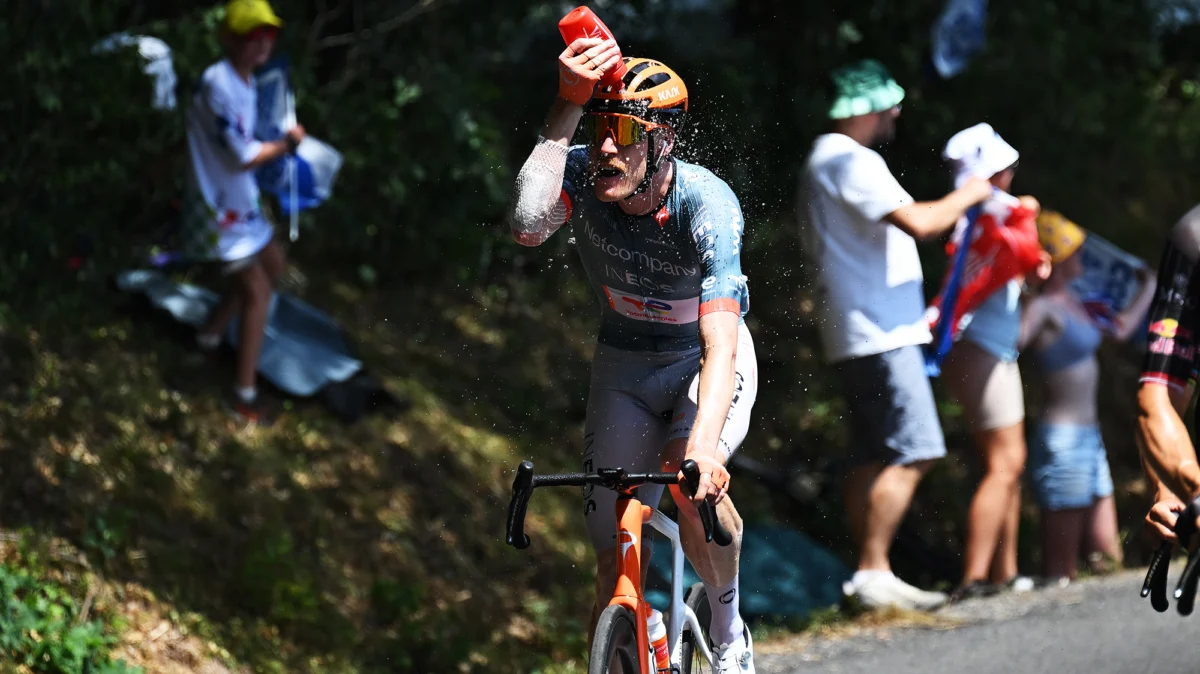
As the race progressed, the heat became a constant antagonist. Riders were no longer merely battling each other; they were battling physiological failure. The intensity peaked during Stage 4, where temperatures exceeded 100 degrees Fahrenheit, leaving even the elite athletes struggling. Tadej Pogačar himself admitted to suffering from a "full headache" at the start line, a symptom of early-stage heat exhaustion.
The Historic Precedent
The breaking point arrived at Stage 9. Recognizing that the physical toll on the riders had reached a threshold of dangerous volatility, organizers took the historic step of shortening the stage by 30 kilometers (18.6 miles). It was the first time in the long, storied history of the Tour that a stage was truncated due to extreme heat, signaling that the "impossible future" warned of by environmentalists has already arrived.
Supporting Data: The Physiology of Exhaustion
The Tour de France is, by design, an endurance event that pushes human biology to its absolute limit. Riders cover roughly 100 miles per day for three weeks, often maintaining speeds of 30 mph for hours. Under normal circumstances, this is a feat of extraordinary recovery and metabolic efficiency. Under the conditions of 2026, it became a high-stakes physiological experiment.
The Hydration Deficit
Under the intense heat, the standard fueling protocols of the peloton were rendered obsolete. Reports from team managers indicated that riders were consuming upwards of 28 bottles of water per day—a volume several times higher than the historical norm. To manage body temperature, teams turned to "ice vests" worn before the race and "ice socks" filled with slush tucked into jerseys during the ride. These measures, once considered optional performance enhancers, became essential survival tools.
The Lack of Recovery
Perhaps the most damaging aspect of the 2026 heatwave was the lack of nighttime cooling. Many European hotels, particularly in rural or mountainous regions, lack air conditioning systems capable of managing the extreme overnight temperatures.
"When we have these high nighttime temperatures, the body isn’t able to recover sufficiently," noted Kurt Shickman of the World Resources Institute. For a cyclist, sleep is the primary mechanism for muscle repair and cognitive recovery. Without the ability to cool down, riders began each subsequent stage with "a couple strikes against them," according to Shickman. This cumulative fatigue created a dangerous feedback loop, leaving athletes increasingly susceptible to heatstroke as the race dragged on.
Official Responses and the "Duty of Care"
The governing body of cycling, the UCI (Union Cycliste Internationale), faced immense pressure throughout the month. Their response was reactive but ultimately necessitated by the scale of the crisis.
Regulatory Shifts
In response to the extreme conditions, the UCI relaxed its strict regulations on "feed zones," allowing riders to access extra water and nutrients more frequently to stave off dehydration. Furthermore, the French government granted regional authorities the explicit power to cancel stages entirely if a "red alert" for heat was issued—a direct acknowledgment that the race cannot be allowed to proceed at the cost of human life.
The Call for Calendar Reform
The most significant shift in the discourse, however, came from the riders themselves. Tadej Pogačar, arguably the face of modern cycling, issued a blunt critique of the status quo.
"If I had the power," Pogačar stated during a press conference, "I would change all the calendar and not race in July and August in hot places."
This sentiment was echoed by team directors like Yvon Ledanois of XDS-Astana, who noted that the issue wasn’t a single "freak" day of heat, but the new, relentless nature of the climate. The suggestion to shift the Tour to a cooler window in the calendar is gaining traction, though it faces massive logistical and commercial hurdles. Moving the Tour would require a complete overhaul of the global cycling calendar, potentially clashing with other major events and disrupting decades of tradition.
Implications: A Sport at a Crossroads
The 2026 Tour de France has served as a wake-up call for the entire sporting world. When an event that relies on the physical resilience of the human body takes place in an environment that is no longer compatible with human health, the event itself must change.
The Future of Fan Participation
The Tour has always been defined by its accessibility—the throngs of fans lining the mountain passes, cheering on the riders inches away. However, as extreme heat and wildfire risks become the "new normal," the ability to maintain this open-access model is in jeopardy. If organizers must continue to restrict crowds for safety reasons, the very soul of the Tour—its proximity to the public—will be diminished.
The "Impossible Future"
The reality is that the Tour de France is becoming increasingly difficult to justify in the heart of summer. As temperatures continue to trend upward, the risk of a mass-casualty event or a mid-race disaster grows. The organizers are now caught between a history that demands the race remain as it is and a climate that demands it be fundamentally altered.
Whether that means shifting the dates to late spring or early autumn, or shortening the route to avoid the most vulnerable regions, the "Grande Boucle" is facing an existential reckoning. The 2026 Tour proved that the sport can no longer ignore the weather. As the riders cross the finish line in Paris this Sunday, they will be doing so in a world that has irrevocably changed—and their race will never be the same again.
About the Author