In the vast, frost-bitten expanse of the Canadian Arctic, the silence is growing. It is not merely the absence of human activity in the traditional sense, but a deepening void of knowledge regarding the rapid transformation of one of the planet’s most critical ecosystems. As climate change accelerates, altering the very composition of the circumpolar north, the scientific infrastructure designed to monitor these changes is quietly, systematically, and perhaps permanently, being dismantled.
For decades, remote outposts like the research station on Mitivik Island served as the eyes and ears of the scientific community. Today, those eyes are closing. The Canadian government’s decision to shutter the Mitivik facility in 2024—marking the end of a thirty-year effort to understand the decline of eider ducks—is not an isolated incident. It is a bellwether for a broader, worrying trend of institutional retreat from the front lines of climate science.
The Rise and Fall of Mitivik Island
Decades ago, Mitivik Island, situated near the mouth of Hudson Bay, hosted one of the world’s most significant nesting colonies of eider ducks. By the 1990s, global concern over a steep population collapse prompted the Canadian government to establish a modest research station. The goal was simple: to determine why these birds were disappearing and to prevent their extinction.
The partnership that followed was a triumph of collaborative science. Inuit hunters from nearby Southampton Island, who rely on eiders for traditional food and cultural practices, worked alongside international researchers. Together, they mapped the birds’ migratory paths, identified overwintering grounds, and uncovered the complex web of stressors—from emerging diseases to the encroaching threat of polar bears—that defined the Arctic experience.
At its peak, the station supported a population of roughly 8,000 nesting pairs. However, as funding grew thin and environmental challenges mounted, the colony began to crash. By the time the government pulled the plug in 2024, the population had dwindled to just a few hundred pairs. The station, once a beacon of conservation success, was abandoned, leaving a void in data that may never be filled.
A Chronology of Retreat
The decline of Arctic research is not a sudden event, but a slow erosion of capacity that has intensified over the last decade.
- 1990s: The establishment of the Mitivik Island research station begins a period of intensive, community-led biological monitoring.
- 2005–2006: Researchers identify a catastrophic avian cholera outbreak, likely linked to warming temperatures, which kills thousands of nesting eiders.
- Late 2000s: Funding justifications shift as the prospect of Arctic oil and gas development wanes, leading to a pivot toward climate change priorities.
- 2021–2024: A period of rapid contraction. The number of U.S. research publications on climate change in Greenland drops by 32%. The Arctic Research Consortium of the United States loses its operating grants.
- 2024: Environment and Climate Change Canada closes the Mitivik research station.
- 2025: The Canadian federal government announces a 10% reduction in the workforce of its Environment and Climate Change department, further paralyzing long-term monitoring efforts.
The Changing Face of Arctic Threats
The challenges facing Arctic wildlife today are more multifaceted than they were thirty years ago. As sea ice recedes earlier each spring, the delicate synchronicity of the Arctic food web is fracturing.
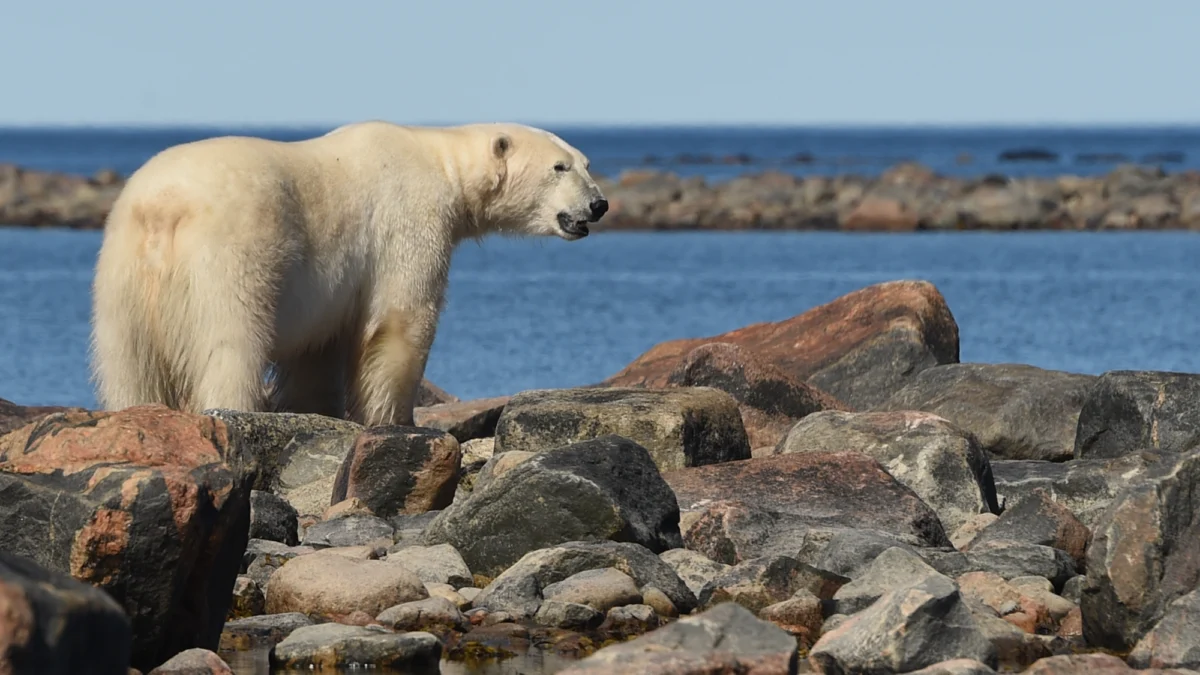
Polar bears, once marine-reliant predators, are increasingly forced onto land during the critical egg-laying season for ground-nesting birds. Grant Gilchrist, the founder of the Mitivik station, famously described the bears as "grazing cows," moving leisurely through nesting colonies and consuming eggs with ease. Meanwhile, the warming climate has introduced new pathogens, such as the avian cholera that decimated the eider population, and enabled the migration of invasive species and diseases that threaten native populations.
Even the chemistry of the Arctic is shifting. Research by scientists like Jennifer Provencher has revealed a complex interplay between parasites and contaminants. While gastrointestinal worms in eiders are a symptom of a warming environment, they also act as a biological filter, absorbing mercury and lead leaching from melting permafrost. These contaminants, if left unchecked, pose severe risks not only to the birds but to the Inuit communities that rely on them for sustenance.
Geopolitical Shifts and Funding Priorities
Why, at a moment when the Arctic is warming faster than any other region on Earth, are governments retreating? The answer lies in a volatile mix of budgetary austerity and shifting geopolitical agendas.
According to experts like Larry Hinzman of the University of Alaska, Fairbanks, the era of climate-driven funding has been eclipsed by a renewed focus on national security and the extraction of rare minerals. As tensions rise between the world’s major powers—exacerbated by the war in Ukraine and the isolation of Russian scientific collaboration—the Arctic Council, once a neutral forum for environmental cooperation, has seen its influence curtailed.
The contrast in government spending is stark. While Canada has struggled to maintain basic wildlife monitoring, it has committed $405 million to a new highway project aimed at facilitating resource extraction and asserting sovereignty. This reflects a broader global tendency: prioritize the exploitation of the "New North" over the preservation of the "Old Arctic."
Official Responses and Institutional Silences
When pressed on the cessation of research, Environment and Climate Change Canada has maintained a posture of vague commitment. In official statements, the department claims to be "committed to the long-term conservation of biological biodiversity," citing new partnerships with Indigenous groups and the deployment of new tracking technologies.
However, critics argue that these "new programs" are poor substitutes for the physical presence of researchers in the field. Remote sensing and satellite tracking can provide data on movement, but they cannot document the nuances of disease, the subtle shifts in behavior, or the lived experience of Indigenous observers who see the changes firsthand. As Andrew Derocher of the University of Alberta notes, research on species like the polar bear—which resides in Canada in greater numbers than anywhere else—has been hollowed out to the point where tracking the population’s health is becoming "impossible."
The Implications: A Future in the Dark
The cost of this scientific retreat is immeasurable. Without consistent, on-the-ground monitoring, we are flying blind into a climate crisis. We are losing the ability to distinguish between natural fluctuations and human-induced collapses.
Mark Mallory, a former Canadian Wildlife Service scientist turned academic, offers a sobering perspective. He argues that the problem isn’t just a lack of data—it is a lack of political will to act on the data we already possess. "Do we really think 10 or 20 more years of data… is going to change anything in the minds of politicians?" he asks.
Yet, for those who have spent their lives in the field, the mission remains vital. The Inuit hunters and the scientists who work with them know that the Arctic is not just a strategic territory or a source of minerals; it is a living, breathing system that is currently under immense duress.
As the research stations go dark, the animals remain, struggling to adapt to a world that no longer resembles the one they evolved to inhabit. We may soon find that the most profound consequence of our silence in the Arctic is that we will be entirely unprepared for the day the collapse is no longer just a scientific prediction, but a permanent, irreversible reality. The "ebbs and flows" of research funding, as Hinzman notes, have reached a point of unprecedented decline. In the race between climate change and our ability to understand it, the climate is winning, and the silence of the Arctic is growing louder by the day.
About the Author