By Investigative Desk
August 6, 2026
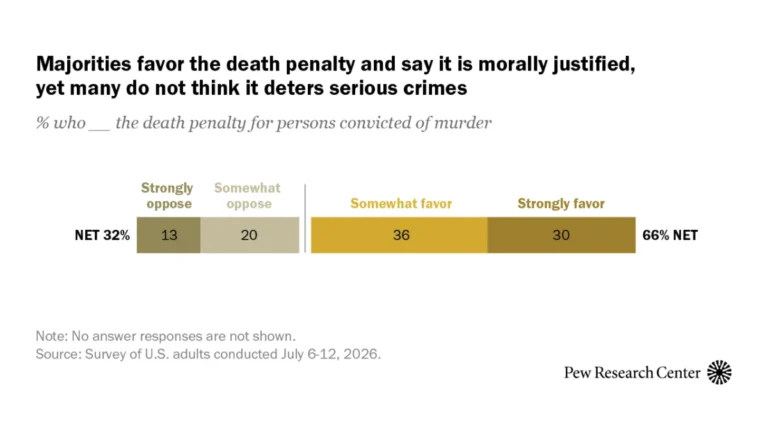
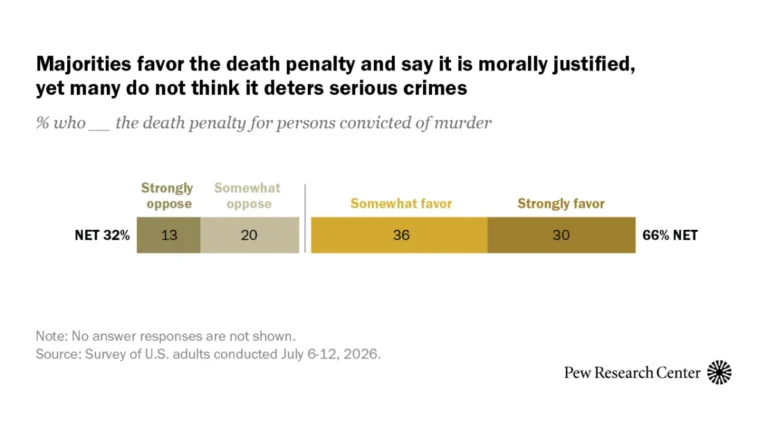
The debate over capital punishment in the United States remains one of the most volatile and divisive issues in the American legal and moral landscape. A comprehensive new survey conducted by the Pew Research Center between July 6 and July 12, 2026, reveals a nation starkly partitioned not only by political affiliation but by race, age, and educational attainment. As the judicial system continues to grapple with the ethics of state-sanctioned execution, the data suggests that the "American consensus" on the death penalty is increasingly frayed, characterized by a fundamental disagreement over morality, deterrence, and the inherent fairness of the justice system.
The State of the Debate: Core Findings
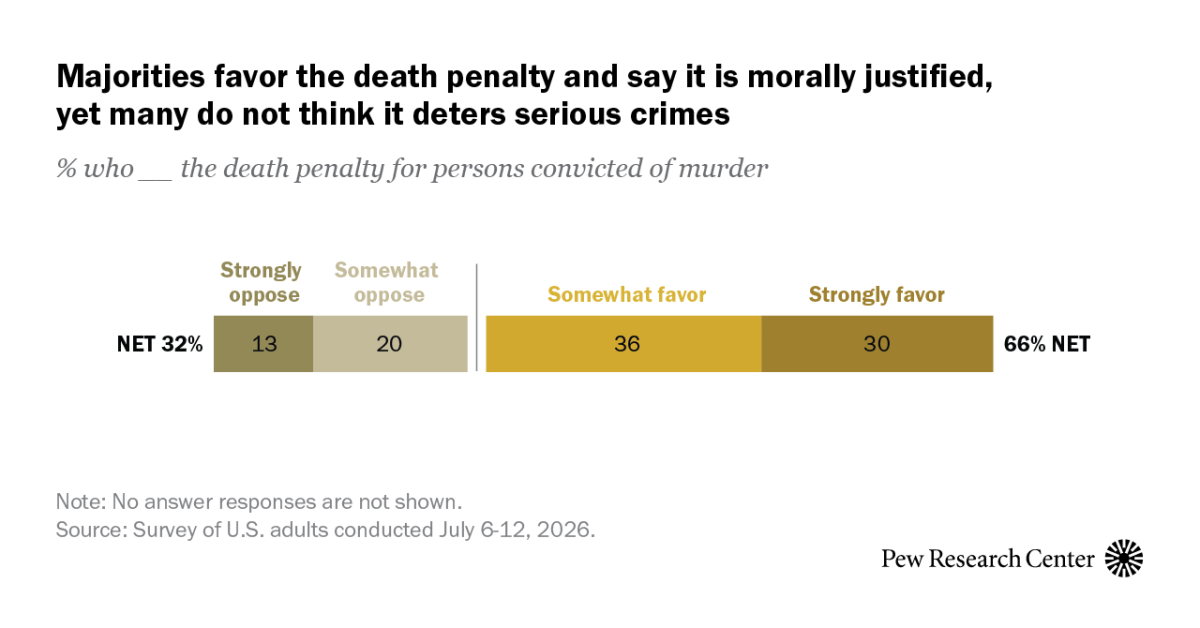
The survey, which polled a representative sample of U.S. adults, paints a complex picture of public sentiment. While a majority of Americans (68%) continue to express the view that the death penalty is morally justified when someone commits a crime such as murder, this headline figure masks deep-seated anxieties. Nearly three-quarters of respondents (73%) admitted to a significant fear that the justice system risks executing an innocent person.
This duality—supporting the death penalty in principle while fearing its fallibility in practice—forms the crux of the modern American death penalty debate. The tension between the desire for retributive justice and the fear of irreparable judicial error is no longer a fringe concern; it is a mainstream sentiment that transcends demographic boundaries.
A Chronology of the Modern Death Penalty Struggle
To understand the current impasse, one must view the trajectory of capital punishment in the U.S. over the last several decades.
- 1972 (Furman v. Georgia): The Supreme Court effectively halts capital punishment, ruling that the arbitrary and inconsistent application of the death penalty violates the Eighth Amendment’s prohibition against "cruel and unusual punishment."
- 1976 (Gregg v. Georgia): The Court reinstates capital punishment after states revise their statutes to include "bifurcated" trials—separating the guilt phase from the sentencing phase—and introducing "aggravating factors" to guide jury discretion.
- 1990s–2000s: The era of DNA exonerations begins. As high-profile cases involving innocent death-row inmates come to light, public support for the death penalty begins a slow, secular decline.
- 2010s–2020s: A wave of state-level moratoriums and legislative repeals sweeps across parts of the country. Simultaneously, the struggle to procure lethal injection drugs leads to a decline in actual executions, shifting the debate toward the administrative and logistical failures of the system.
- 2026: The current survey reflects a period of stagnation. Despite high moral support, the administrative legitimacy of the death penalty is under intense scrutiny, with public concern over racial bias and innocence reaching a fever pitch.
Supporting Data: The Demographic Divide
The Pew Research data highlights significant disparities in how different groups view the administration of justice.
The Racial Gap in Perception
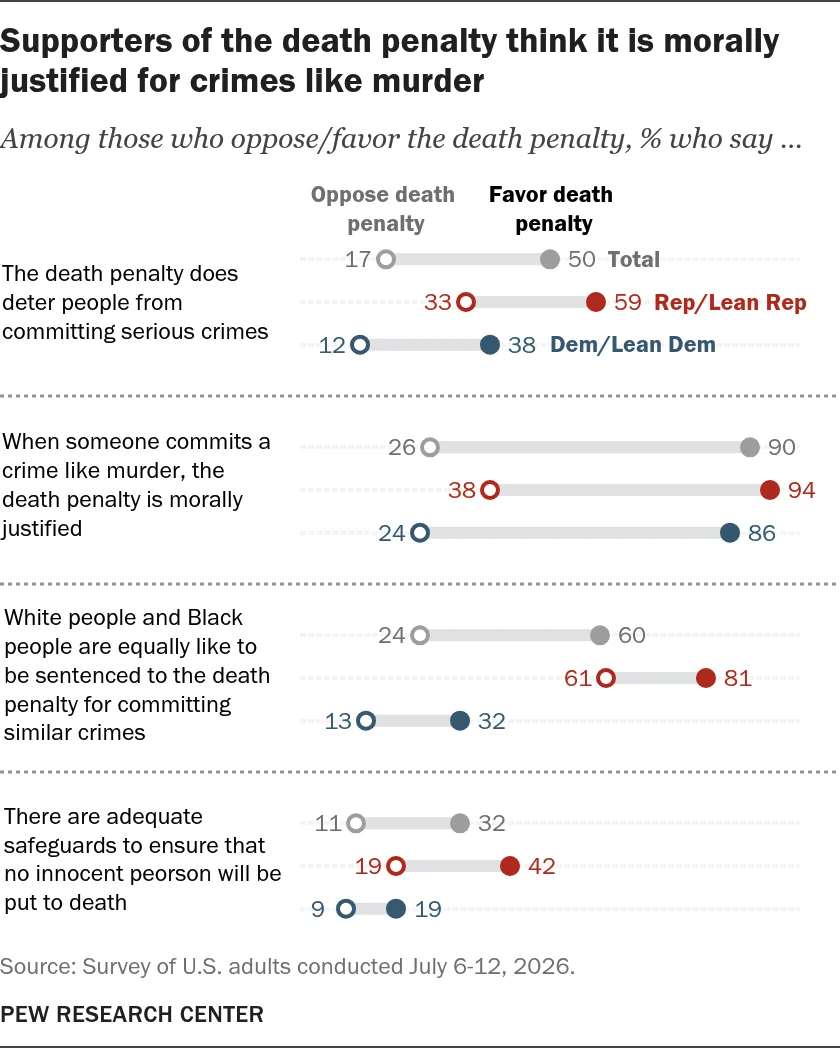
Perhaps the most striking finding is the chasm between Black and White Americans regarding the fairness of sentencing. When asked if Black and White people are equally likely to be sentenced to death for similar crimes, only 13% of Black respondents agreed that the system is fair. In contrast, 58% of White respondents believed the system is equitable. This 45-point gap underscores the persistent racial disparities that critics have long identified in the capital sentencing process.
Education and Age Influences
Educational attainment serves as a significant marker of opinion. Postgraduate degree holders are far more likely (40%) to label the death penalty as "morally wrong" compared to those with a high school education or less (24%). Similarly, younger Americans (ages 18-29) express more skepticism, with 36% viewing the practice as morally indefensible, compared to only 25% of those aged 50-64.
The Deterrence Myth
One of the most persistent arguments for the death penalty—that it serves as a deterrent to violent crime—appears to be losing its grip on the public consciousness. A majority of Americans (59%) now explicitly state that the death penalty does not deter people from committing serious crimes. Even among those who favor the death penalty, only 50% are convinced of its deterrent effect, suggesting that many supporters favor it for retribution rather than public safety utility.
Perspectives from Political Ideology
Political affiliation remains the single most reliable predictor of support for capital punishment. The survey data reveals that supporters and opponents operate from entirely different premises:
- Moral Justification: 94% of Republicans and those who lean Republican believe the death penalty is morally justified for murder, compared to 86% of Democrats and those who lean Democratic. While the gap is smaller than in other areas, it confirms that moral conviction remains the bedrock of support.
- The Question of Safeguards: When asked if there are adequate safeguards to prevent the execution of the innocent, only 19% of Democrats agreed, while 42% of Republicans held that view. This indicates that the "innocence problem" is a significantly higher hurdle for those on the left, but is not entirely dismissed by the right.
- Racial Bias: The divergence is most extreme here. 81% of Republicans believe that the sentencing process is equally applied regardless of race, whereas only 32% of Democrats share that confidence.
Implications for the American Justice System
The findings of this 2026 survey carry profound implications for the future of American law.
The Crisis of Legitimacy
For the death penalty to remain a viable institution, it must command a level of public confidence that the current system is failing to secure. When nearly three-quarters of the population fears the execution of an innocent person, the "moral justification" for the death penalty begins to erode. Legislatures are increasingly forced to choose between massive systemic reform—which is expensive and difficult to implement—and the gradual abandonment of capital punishment altogether.
The Legal Pathway
As public opinion shifts, legal challenges are likely to follow. If a large segment of the population continues to view the process as racially biased and prone to error, defense attorneys will continue to utilize these data points to challenge sentencing protocols. The judiciary, sensitive to evolving standards of decency, may eventually find that the systemic flaws identified by the public outweigh the retributive goals of the state.
The Political Standoff
Politically, the issue is likely to remain in a state of gridlock. While the data shows that younger generations and those with higher education levels are shifting toward abolitionist views, the core support for the death penalty remains robust among the Republican base. This suggests that the death penalty will remain a "wedge issue" in national elections for the foreseeable future, preventing any clear federal consensus.
Conclusion: A System at a Crossroads
The 2026 Pew Research Center survey does not provide a mandate for either total abolition or full-throated support. Instead, it reveals an American public caught in a profound moral dilemma. We are a nation that believes, in the abstract, that some crimes demand the ultimate penalty, yet we are increasingly terrified that our mechanisms for delivering that justice are fundamentally broken.
The challenge for policymakers in the coming years will be to reconcile this tension. As long as the questions of racial equity, the risk of innocence, and the efficacy of deterrence remain unanswered, the death penalty will continue to be a source of national friction—a relic of traditional justice struggling to survive in a modern, skeptical, and increasingly divided society. The debate is no longer just about whether the death penalty is "right"; it is about whether a democracy can justify a system that its own citizens fundamentally distrust.
About the Author