As the digital landscape undergoes its most significant transformation since the advent of the World Wide Web, a pressing question looms over researchers, publishers, and casual users alike: How much of the internet is now being written by machines? A comprehensive new analysis provides a sobering look at this shifting paradigm, revealing that the infrastructure of the web is increasingly populated by AI-authored or AI-assisted text.
By leveraging vast archival datasets and cutting-edge detection models, researchers have confirmed that since the public debut of ChatGPT in late 2022, the prevalence of artificial intelligence in web content has seen a meteoric rise. This article examines the methodology, the findings, and the profound implications of an internet that is becoming, quite literally, a self-referential loop of synthetic text.
The Methodology: Mapping the Digital Archive
To grasp the scale of AI-authored content, researchers turned to the most authoritative source for historical web data: Common Crawl. A nonprofit organization that has maintained a massive, open-access archive of the internet since 2008, Common Crawl performs regular "crawls"—snapshots of the observable web—roughly once a month. Because these snapshots prioritize publicly accessible pages, the data provides an unparalleled longitudinal view of internet evolution, though it naturally skews away from gated content like paywalled news sites or private, password-protected networks.
Data Collection Parameters
The study methodology was rigorous. Researchers randomly sampled 10,000 English-language webpages from each of the 49 distinct crawls conducted between January 2021 and July 2026. This resulted in a massive dataset of 490,000 unique pages. For every sampled page, the team extracted both the WARC (Web ARChive) record, which preserves the full HTML, and the WET (WARC Encapsulated Text) file, which strips away code and media to isolate the raw body text.
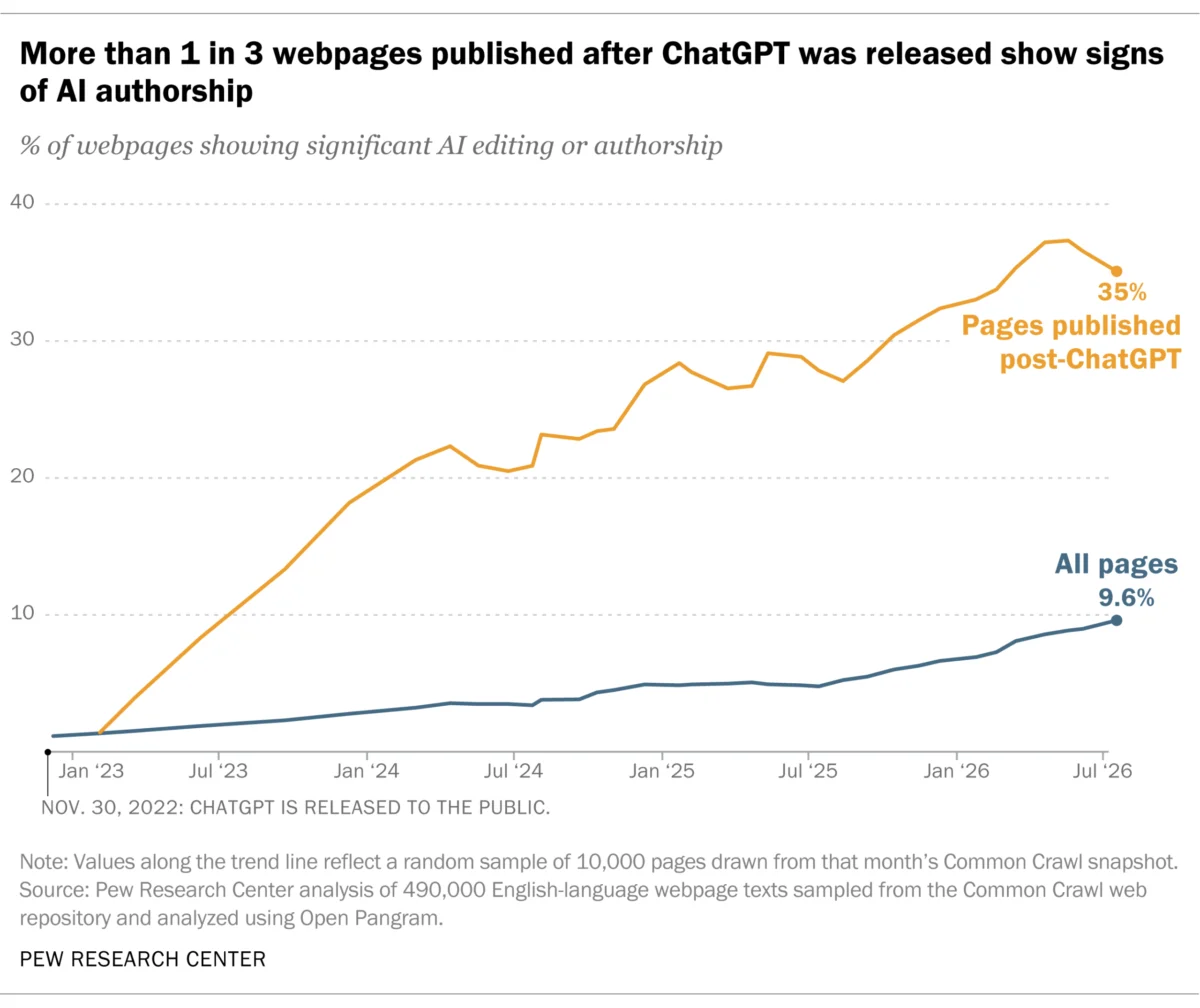
The primary hurdle in this research was the lack of reliable metadata. Only about 10% to 15% of the sampled pages contained explicit publication date fields in their HTML. While this means the resulting post-ChatGPT estimates reflect the prevalence of AI among "dated" content rather than the entire web, the trend lines remain consistent. These findings align closely with other major studies, such as The Impact of AI-Generated Text on the Internet (Dolezal et al., 2026), which similarly identified that approximately 35% of newly published sites rely on AI-assisted text.
Chronology: From Human Craft to Synthetic Synthesis
The timeline of AI integration on the web is not merely a story of technological advancement; it is a story of rapid, widespread adoption that tracks almost perfectly with the availability of user-friendly generative AI tools.
Pre-ChatGPT: The Baseline (2021–2022)
Prior to the launch of ChatGPT on November 30, 2022, the "AI signature" detected on the web was minimal. When researchers analyzed the 2021 and early 2022 crawls, they found negligible amounts of synthetic text. While some detection models initially flagged a small fraction of these pages as AI-authored—likely a result of "false positives" where sophisticated human writing styles mimicked the statistical predictability of early language models—the data indicates that the web was, for all intents and purposes, a human-authored ecosystem.
The ChatGPT Inflection Point (2023)
Immediately following the public release of ChatGPT, the digital landscape began to change. The barrier to entry for automated content creation collapsed. Small-scale publishers, marketing agencies, and independent bloggers began integrating LLMs into their workflows to increase output, optimize for search engines, and reduce costs. The 2023 crawls began to show a statistically significant uptick in pages containing "meaningful" signs of AI influence.
The Proliferation Phase (2024–2026)
By the time the July 2026 crawl was analyzed, the shift had become structural. A staggering 35% of pages with detectable publication dates showed clear signs of AI authorship or significant AI editing. This era is characterized not just by "bot-written" sites, but by the widespread use of AI as an editorial copilot—a tool that summarizes, expands, and polishes human input, leaving behind a discernible statistical fingerprint that advanced models can identify with high confidence.
Detecting the Invisible: The Science of AI Fingerprinting
To quantify this, the researchers utilized editlens_Llama-3.2-3B, an open-weight detection model engineered by Pangram. Unlike binary detectors of the past, this model provides a continuous score from 0 to 1. A score of 0 signifies purely human-generated text, while 1 signifies fully synthetic content.

Defining "Meaningful" Authorship
The researchers established a threshold: any page scoring 0.2 or higher was flagged as having "meaningful" signs of AI authorship. This threshold is crucial; it accounts for the reality that modern web content is rarely 100% machine-made. Most AI-assisted content exists in the "grey zone," where human authors use AI to draft segments, brainstorm ideas, or rephrase existing content.
Cross-Model Validation
To ensure the findings were robust and not a byproduct of a specific model’s biases, the team ran a subset of 62,370 pages through Pangram’s flagship commercial model, Pangram 3.3. The results were remarkably consistent. The two models reached the same conclusion in 96% of cases, yielding a Cohen’s kappa of 0.61—a strong indicator of agreement. While the models occasionally disagreed on individual pages—a reminder that AI detection is probabilistic, not deterministic—the aggregate data showed that the rise of AI-authored content is a verified, systemic trend regardless of the detection tool employed.
Official Perspectives and Expert Responses
The findings have sparked a robust debate among technologists and researchers regarding the "AI-ification" of the web.
Pangram, the developer of the detection models used in the study, has publicly emphasized that their tools are primarily designed for research purposes. A company spokesperson noted, "While our models offer high accuracy in detecting synthetic patterns, we advise against using these scores as definitive proof of authorship for individual pages. The goal is to track macro-trends in the information ecosystem, not to police individual creators."
Independent observers, such as the authors of the Dolezal et al. (2026) report, have lauded the study for its transparency. "The alignment between our research using Internet Archive data and the study utilizing Common Crawl is striking," said Dr. Elena Vance, a lead researcher in the field of AI sociology. "It confirms that the ‘AI-assisted web’ is not just a theory; it is the current state of digital publishing. We are seeing a fundamental shift in the provenance of human knowledge."
Implications: A Web in a Feedback Loop
The implications of these findings are profound, touching on the future of search, the integrity of information, and the preservation of human creativity.
The "Model Collapse" Risk
As the web becomes increasingly saturated with AI-generated text, the very data used to train future AI models is becoming "synthetic." This creates a potential feedback loop—often called "model collapse"—where future generations of AI are trained on the output of their predecessors, potentially leading to a degradation in the quality, diversity, and reasoning capabilities of language models.
The Erosion of Search Integrity
Search engines have long relied on the assumption that content is created by humans for humans. If a significant percentage of the web is now generated by AI—often optimized for search engine rankings rather than reader value—the utility of search tools could be severely compromised. Users may find themselves trapped in an echo chamber of machine-generated content, making it increasingly difficult to find authentic human perspectives.
The Future of Digital Literacy
Ultimately, the study suggests that we are entering an era of "post-truth" authorship. As it becomes harder to distinguish between human-written and AI-assisted content, the burden of digital literacy will shift onto the reader. We must develop more sophisticated ways to attribute content and verify sources, lest the internet cease to be a repository of human knowledge and instead become a vast, automated factory of noise.
The data from the 2026 crawls serves as a wake-up call. The internet is no longer just a mirror of human thought; it is a collaborative project between man and machine. Whether this leads to an era of hyper-productivity or a hollowed-out information landscape will depend on how we choose to regulate, verify, and value human authorship in the years to come.
About the Author