In an era defined by the blurring lines between artificial intelligence, advanced robotics, and semiconductor-driven infrastructure, the pace of technological development has frequently outstripped the mechanisms of global regulation. To address this widening chasm, ASTM International—the West Conshohocken, Pennsylvania-based global standards organization—has officially launched a high-priority initiative aimed at accelerating the development of safety and performance benchmarks for what it identifies as “rapidly converging technologies” (CETs).
By establishing a dedicated Critical and Emerging Technologies (CET) Division, ASTM is pivoting away from the traditional, reactive model of standardization—which often waits for technology to mature before codifying best practices—toward a proactive framework that builds safety, quality, and interoperability directly into the development lifecycle of nascent technologies.
Main Facts: The New Architecture of Standardization
The core objective of the new CET Division is to provide a neutral, global platform where technical experts can collaborate to define the parameters of safe and effective innovation. ASTM defines “convergent technologies” not as isolated advancements, but as interdependent systems. The modern manufacturing floor, for instance, no longer treats AI as a distinct software layer; it is inextricably woven into the mechanical nervous system of robotics and the energy-efficient architecture of modern power grids.
The primary mission of the division is to:
- Establish a proactive roadmap: By identifying where technologies intersect, ASTM intends to create standards alongside the evolution of the tech, rather than attempting to retroactively regulate established markets.
- Harmonize global divergence: Currently, over 40 national governments maintain disparate lists of critical technologies. These lists shift frequently, creating regulatory friction for multinational firms. ASTM aims to act as a global nexus to unify these benchmarks.
- Transition from Advanced Manufacturing: The new division replaces the former Advanced Manufacturing Division, effectively scaling up its existing methodologies to cover a broader, more dynamic landscape of emerging technological sectors.
Chronology: The Evolution Toward a Convergent Model
The creation of the CET Division is the culmination of years of organizational evolution within ASTM.
2015–2019: The Focus on Advanced Manufacturing
ASTM’s initial efforts were heavily concentrated on the maturation of advanced manufacturing, specifically 3D printing (additive manufacturing) and digital transformation in factory floors. During this period, the organization recognized that traditional committee-based standards development was too slow for the rapid iteration cycles seen in software-defined hardware.
2020–2022: The Recognition of Interdependency
As the COVID-19 pandemic accelerated the adoption of AI-driven supply chain management and automated logistics, the ASTM leadership observed a significant trend: individual industry sectors could no longer function as silos. An autonomous vehicle, for example, required standards for its sensor array, the software logic governing its decision-making, and the battery chemistry powering its drive train—three areas that were historically managed by separate bodies.
2023: The Strategic Shift
ASTM leadership began the internal restructuring process, moving to sunset the Advanced Manufacturing Division and pivot toward the CET framework. This involved intense coordination with approximately 10 active ASTM committees and diplomatic outreach to partners across 25 countries.
2024: The Launch of the CET Division
The formal launch of the CET Division represents the organization’s current operational state. It is now actively identifying high-impact areas for standardization, utilizing market intelligence to forecast which technologies will reach commercial scale first.
Supporting Data: The Need for Speed
The rationale behind this initiative is supported by the sheer complexity of modern industrial ecosystems. When technology evolves in isolation, it leads to "fragmentation debt"—a state where incompatible systems make it nearly impossible to integrate global supply chains.
- Global Reach: The division currently maintains a footprint across 25 countries, ensuring that the standards developed in Pennsylvania reflect the engineering realities of global manufacturing hubs in Europe, Asia, and North America.
- The 10-Committee Anchor: The division operates through 10 primary technical committees, each acting as a specialized node for specific technological domains.
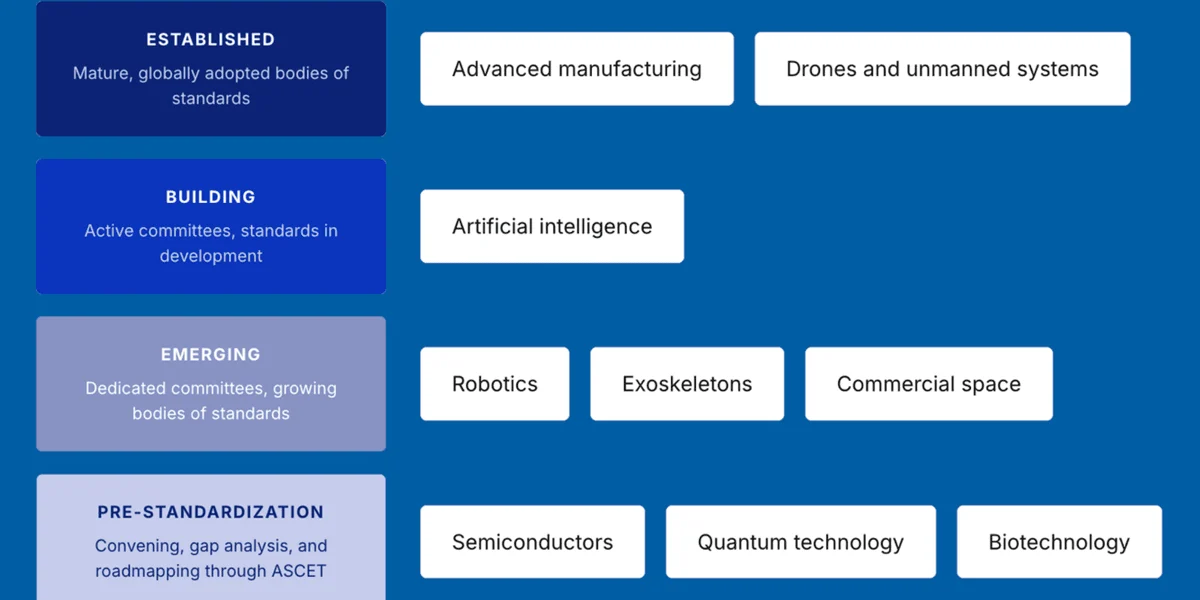
- The Multi-Tiered Approach: ASTM is applying a "maturity-based" model. Recognizing that a nascent AI algorithm requires different oversight than a fully industrialised 3D-printed aerospace component, the CET division tailors its standards development based on the readiness level of the tech in question.
"A technology is industrialized and at scale when the quality holds, the results repeat, and it performs the same way globally," notes Mohsen Seifi, Ph.D., vice president of the Critical and Emerging Technologies Division at ASTM International. This focus on repeatability is the cornerstone of their data-driven approach to standardizing innovation.
Official Responses: Shifting the Paradigm
The leadership at ASTM views this shift as a fundamental requirement for the future of global trade. Dr. Seifi emphasized that the role of the organization has moved from being a document-based standards body to becoming an innovation partner.
“We reach [the bar of industrialization] faster by engaging early, shaping standards while the technology is still taking form, and carrying the work through to training and certification with partners across industry, government, and academia worldwide,” Dr. Seifi stated during the announcement.
The perspective from the academic and governmental stakeholders involved has been largely positive. By creating a collaborative environment, ASTM is providing a roadmap for governments that are struggling to keep pace with the legislative demands of AI and autonomous systems. Instead of drafting laws in a vacuum, policymakers are increasingly looking to ASTM’s technical roadmaps to inform their own regulatory frameworks.
Implications: The Future of Global Industry
The creation of the CET Division has profound implications for global industries, particularly those relying on deep-tech integration.
1. Reducing Time-to-Market for Innovators
Startups and mid-market firms often struggle to enter new markets because they lack the resources to navigate the labyrinth of regional standards. By establishing global benchmarks early, ASTM provides a "passport" for new technologies. If a product meets an ASTM CET standard, it is theoretically ready for deployment in any of the 25+ participating countries, drastically reducing the cost of compliance.
2. Ensuring Safety in a Black-Box World
With the rise of AI in critical infrastructure—such as smart grids and autonomous shipping—the "black box" nature of machine learning poses a significant risk. ASTM’s CET division is tasked with defining "transparency standards" that ensure AI-driven systems remain predictable. By focusing on how these systems perform at the point of intersection, the organization can build safety protocols that govern the interaction between software and physical hardware.
3. A Catalyst for Education and Training
Standards are only as effective as the workforce that implements them. As part of its new mandate, the CET division is building comprehensive training and certification programs. These programs are designed to bridge the skills gap, ensuring that the current workforce can manage the transition to the next generation of industrial technology. This is not merely about writing standards; it is about building the ecosystem required to support them.
4. Reshaping the Global Regulatory Landscape
Perhaps the most significant implication is the potential for ASTM to become the primary clearinghouse for global technology policy. By engaging with 40+ national governments, ASTM is positioning itself as the neutral arbiter of "what constitutes safe and effective technology." This could lead to a more unified global economy, where technological advancements are not gated by nationalistic regulatory barriers but are instead empowered by shared, high-quality standards.
Conclusion: A Proactive Future
The launch of the Critical and Emerging Technologies Division marks a significant turning point for ASTM International and the broader industrial sector. By moving away from the reactive, post-hoc standardization of the past, the organization is acknowledging that the future of technology is not just about the individual invention—it is about the convergence of systems.
As these technologies continue to accelerate, the work being done in the halls of the CET Division will become the bedrock upon which the next decade of industrial growth is built. Whether it is through the integration of AI in manufacturing or the complex infrastructure requirements of the green energy transition, ASTM’s new initiative provides the structure necessary to ensure that innovation is not just rapid, but also reliable, safe, and universally applicable.
The world of technology is no longer moving in straight lines; it is converging into a complex, interdependent web. ASTM International’s decision to meet that complexity head-on is a necessary evolution, ensuring that the rapid pace of change does not come at the expense of quality or safety. As the CET Division scales its efforts, it will likely become the definitive authority on how we define, measure, and scale the technologies of tomorrow.
About the Author