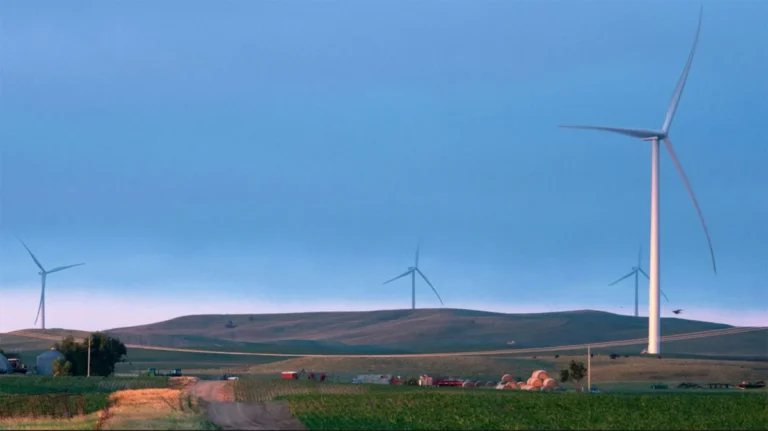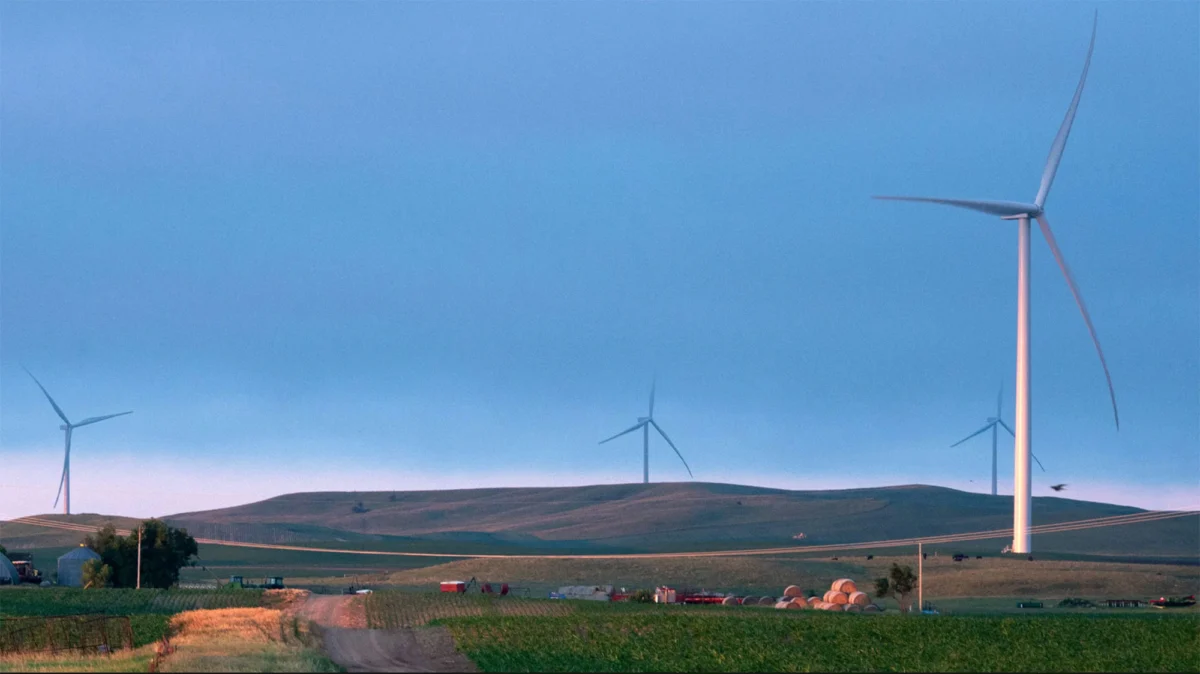
On a breezy May afternoon in Wishek, North Dakota, the landscape is defined by a striking contrast: the timeless, rolling prairies of McIntosh County and the towering, modern architecture of the Badger Wind Farm. George Wolff, a fourth-generation farmer, stands near his barn, his boots caked in the mud of a challenging planting season. Behind him, a 3-megawatt turbine—one of two installed on his 3,500-acre property—rotates rhythmically against the horizon.
For Wolff, these turbines are not just infrastructure; they are a lifeline. In an era of volatile commodity prices, the lease payments from the Danish energy firm Ørsted provide a reliable financial cushion. Yet, less than a mile away, this same technology has sparked a firestorm of resentment, deepening a cultural and political divide that is currently reshaping the future of energy across the American Midwest.
The Winds of Change: A Shifting Economic Landscape
The Badger Wind Farm, a 92-turbine, 250-megawatt project that went online in January 2026, represents the largest economic development initiative in the history of Wishek, a town of approximately 850 residents. While the project brings in an estimated $1.3 million in annual tax revenue for the county—funds earmarked for schools, roads, and emergency services—the social cost has been steep.
For many lifelong residents, the turbines represent an aesthetic and cultural intrusion. Larry Wald, a former mayor and council member, speaks for a growing contingent of locals who feel that the "open country" they once cherished has been irrevocably altered. "These towers are the first thing you see when you come into Wishek and the last thing you see on your way out," Wald says.

This sentiment is echoed by others, such as Lila Raile, whose home, once a sanctuary with sweeping views of farmland, is now enveloped by the industrial scale of the wind farm. For Raile and her peers, the issue is not merely the presence of the turbines, but the perceived lack of agency. They argue that rural communities are being used as pawns by multinational energy companies, with little regard for the long-term character of the land or the well-being of non-participating neighbors.
A Chronology of North Dakota’s Energy Evolution
North Dakota’s journey with wind energy has been marked by distinct phases, moving from initial enthusiasm to a state of legislative paralysis:
- 2003: The state welcomes its first large-scale wind farm, NextEra Energy’s project in LaMoure County. For the next two decades, North Dakota pursues an "all-of-the-above" energy policy, embracing coal, oil, gas, and renewables.
- 2005–2020: A period of rapid expansion. During these 15 years, 38 wind farms come online, transforming the state into a regional energy powerhouse.
- 2017: Early signs of friction emerge. State Senator Dwight Cook introduces legislation to impose a two-year ban on new wind farms, citing concerns about coal industry disruption. The bill is ultimately withdrawn, but the seed of doubt is planted.
- 2020–2026: The pace of development slows drastically. Despite the completion of projects like the Merricourt wind farm, only four new projects are finalized in this six-year window.
- 2025: Political shifts at the federal and state levels culminate in the "One Big Beautiful Bill Act," which phases out key federal tax credits for wind and solar, signaling a federal pivot away from renewable subsidies.
- 2026: McIntosh County implements a one-year moratorium on new wind projects, reflecting the height of local frustration following the activation of the Badger Wind Farm.
Supporting Data: The Economic Reality vs. The Political Narrative
The economic argument for wind power in North Dakota remains statistically robust, even as political support wanes. According to industry reports, wind energy has generated more than $10 billion in total economic activity across the state. For individual landowners, the financial impact is tangible; collectively, farmers and ranchers have received between $25 million and $30 million annually in lease payments since 2020.
However, the "all-of-the-above" policy is increasingly under fire. Critics argue that wind power is not serving the state’s internal needs, but rather facilitating the decarbonization goals of neighboring states like Minnesota. Currently, 76% of electricity consumed within North Dakota is derived from its five primary coal plants. These plants, which burn lignite coal, are central to the state’s identity and economy, yet they are increasingly pitted against the burgeoning renewable sector.

Official Responses and the Regulatory Standoff
The regulatory environment has turned decidedly cold. The North Dakota Public Service Commission (PSC), which holds the power to approve or deny energy projects, has become a theater for ideological battle.
PSC Chair Randy Christmann has been a vocal critic of the wind industry, arguing that renewable expansion is being used to justify the premature retirement of coal assets. In a heated exchange during a May hearing regarding the Longspur wind project, Christmann challenged a local farmer, noting that approximately 40% of U.S. coal capacity has been removed from the grid over the last two decades. "One is being added and the other one is being pushed out," he asserted.
At the legislative level, Representative Anna Novak, who represents a district in "coal country," captures the evolving mood: "For many years, it was like, ‘We can do everything, we can have it all.’ But there has been the realization that more wind on the line… means that there’s less coal that’s mined."
This perspective is bolstered by federal representatives like Julie Fedorchak, who has campaigned on the platform of rolling back renewable energy incentives and aggressively supporting coal-fired generation.

The Human Implication: A Community at a Crossroads
As the regulatory and political landscape hardens, the human cost is felt most keenly in places like Wishek. The community is split between those who view the energy transition as a pragmatic necessity and those who see it as a violation of their heritage.
Brenda Dohn, the former mayor of Wishek, emphasizes the need for a pragmatic path forward. "It’s here. You have to change your mindset," she says. "You can’t light them on fire, you can’t kick them over. So how do we move forward from this?" Dohn’s tenure saw the city secure $150,000 in goodwill donations from Ørsted, which helped fund a new firehouse and public swimming pool—a small consolation for a community grappling with a fundamental identity crisis.
For George Wolff, the decision to host turbines was a matter of survival. "Some of the farmers here, they think if you don’t make your money off of a bushel of wheat or a pound of beef, it’s not right," he reflects. "I don’t feel that way. I think, well, they’re producing electricity, and that’s something we all use."
Conclusion: The Future of the Prairie
The "wind boom" in North Dakota appears to be reaching an inflection point. As developers face increasingly hostile local ordinances and a skeptical regulatory body, the future of large-scale renewable infrastructure in the state remains uncertain.

Whether the state can reconcile its coal-dependent past with an energy-diverse future depends on whether leaders can move beyond the current binary of "coal versus wind." For families like the Wolffs, the immediate future involves continuing the legacy of their ancestors—passing down the land, whether it is dotted with wheat, cattle, or the spinning blades of a wind turbine. The challenge for North Dakota, however, is whether it can maintain its social fabric while navigating a transition that pits its economic interests against its cultural values. As the wind continues to blow across the prairies, the debate over how best to harness it shows no sign of abating.
About the Author