As the United States hurtles toward the 2026 midterm elections, a new technological variable has entered the political ecosystem: the artificial intelligence chatbot. With platforms like ChatGPT, Copilot, and Gemini becoming household staples, observers have speculated whether these tools would become the primary portals through which voters navigate the complex landscape of candidates, policy positions, and registration logistics.
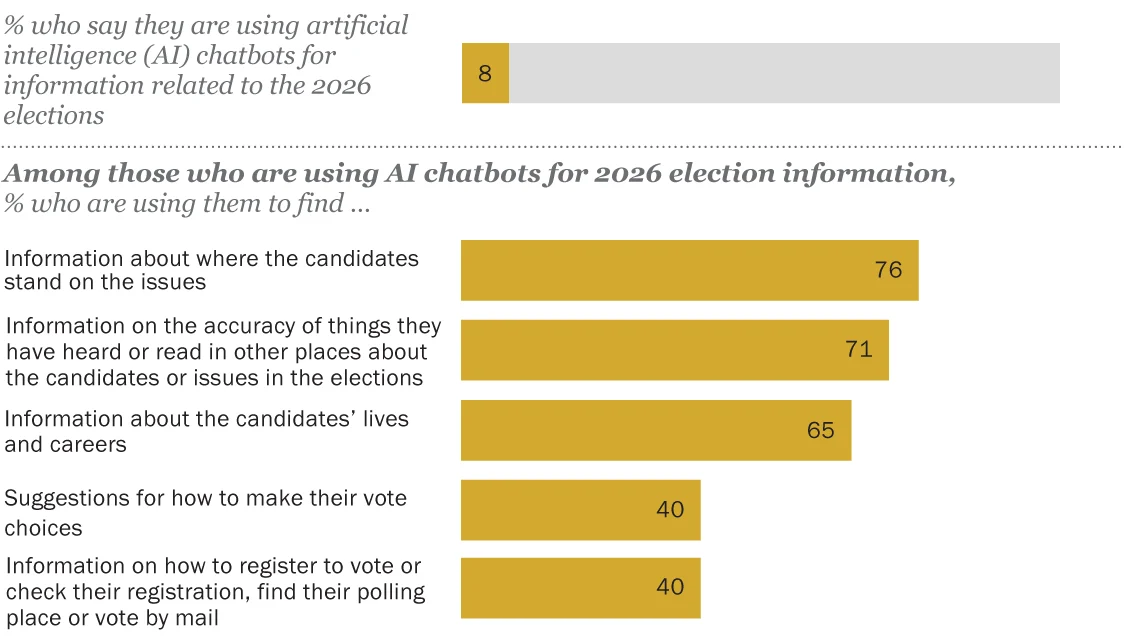
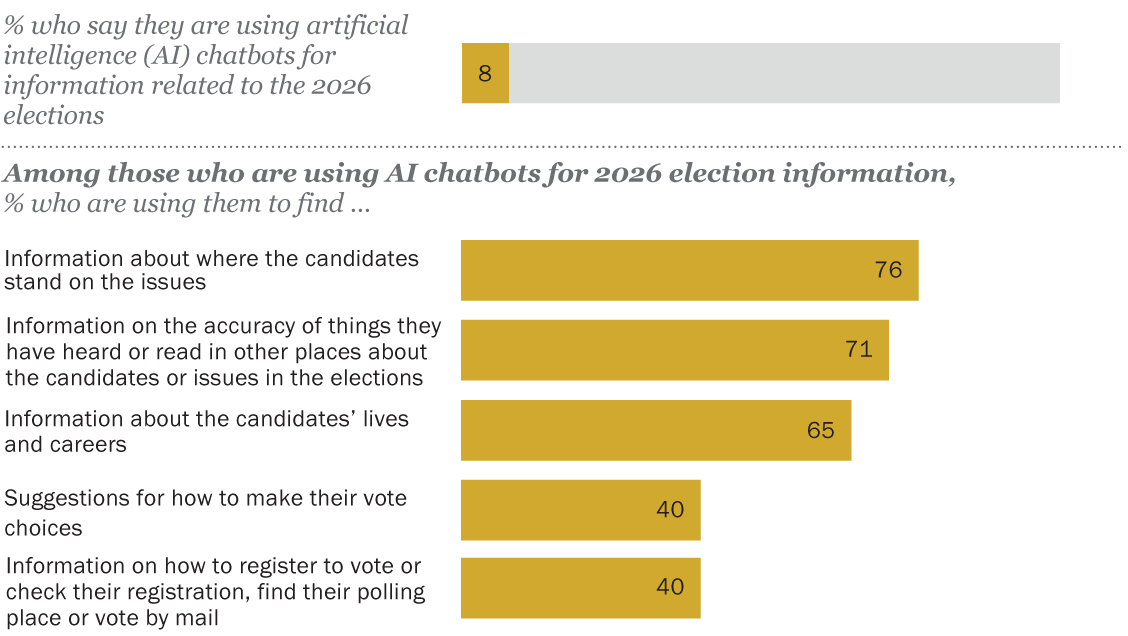
However, according to a comprehensive new study from the Pew Research Center, the reality of voter behavior is far more tempered than the hype surrounding generative AI might suggest. While roughly half of all American adults now use AI chatbots for various daily tasks, a mere 8% report turning to these digital assistants to inform their decisions or research regarding the upcoming midterm elections.
The State of AI Adoption in the Political Sphere
The integration of AI into the American political consciousness has been swift, yet its application remains remarkably narrow. The Pew Research Center survey, which polled 5,273 U.S. adults between October 12 and 18, 2026, provides a granular look at this digital shift. The findings suggest that while the "AI revolution" is well underway in workplaces and creative industries, it has yet to supplant traditional media, candidate websites, and grassroots campaigning as the primary source of political intelligence.
"We have studied Americans’ views of politics for decades," the researchers noted in their report, "and we have also explored their views of artificial intelligence and chatbots in recent years." This latest effort sought to bridge those two fields of inquiry, attempting to discern if the conversational nature of AI would prove more effective than the static search engine results of the past.
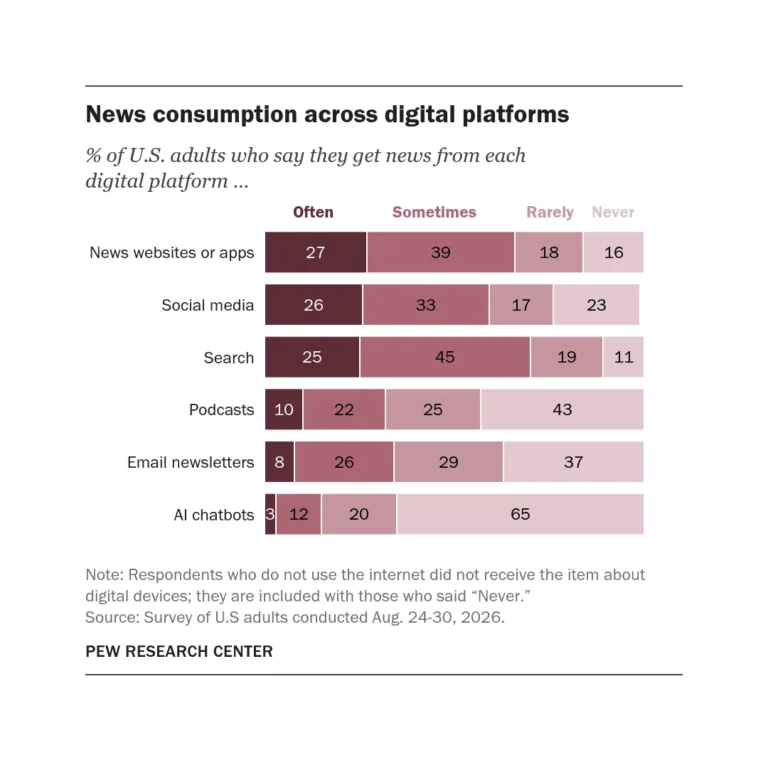
The data reveals a striking disparity between the general utility of AI and its specific utility for political engagement. While 50% of adults utilize these tools for general tasks, the 8% figure for election-related inquiries indicates that the majority of voters still prefer conventional methods—such as legacy news outlets, social media, and official government portals—to gather their political information.
A Chronology of the Digital Shift
The trajectory of this trend is rooted in the rapid proliferation of Large Language Models (LLMs) over the past several years.
- 2023–2024: The public introduction of sophisticated generative AI models created a wave of experimentation. Initially, these tools were used primarily for text generation, coding, and basic information retrieval.
- 2025: As AI tools became integrated into search engines (such as Microsoft’s Copilot and Google’s Gemini), the barrier to entry for voters dropped significantly. However, concerns regarding "hallucinations"—where AI provides false or misleading information—began to temper institutional adoption.
- Early 2026: As the midterm election cycle began, political campaigns scrambled to understand how to leverage these tools. Meanwhile, election officials expressed concerns about the potential for AI-generated misinformation to influence voter sentiment.
- October 2026: The Pew Research Center conducted its survey, capturing a snapshot of the electorate just weeks before the midterms. The findings serve as a "state of the union" for AI’s role in democracy, confirming that while the technology is present, it is not yet a dominant force in the average voter’s decision-making process.
Supporting Data: What Are Users Actually Asking?
For the 8% of Americans who do leverage AI for election-related research, the behavior is remarkably focused. The survey highlights that these users are not using chatbots for casual political banter; rather, they are using them as high-efficiency research assistants.
Among those who turn to chatbots for election information:
- 76% are seeking information on where candidates stand on key issues.
- 71% are using the tools as a secondary layer of fact-checking for information they heard or read elsewhere.
- 65% are looking for biographical data, including the professional histories and personal lives of candidates.
- 40% are using chatbots to navigate the logistical hurdles of the voting process, such as registration verification, polling place identification, and mail-in ballot procedures.
- 40% are seeking suggestions or summaries to help inform their final vote choices.
This data suggests that users are treating chatbots as a "summarization engine" rather than an oracle. By consolidating candidate platforms and cross-referencing political claims, voters are attempting to bypass the noise of traditional partisan media.
Demographic Divides in AI Literacy
The adoption of these tools is not uniform across the American electorate. Consistent with broader trends in technology usage, age remains the most significant predictor of AI engagement.
Adults under the age of 50 are significantly more comfortable with the nuances of conversational AI. In the survey, 11% of those under 50 reported using chatbots for election-related research. In contrast, that figure drops to just 4% for voters aged 50 and older. This "age gap" reflects a broader societal trend where younger generations are more likely to integrate AI into their information-gathering routines, while older generations may maintain a higher degree of skepticism or a stronger reliance on traditional news consumption habits.
Implications for Democracy and Campaigning
The limited adoption of AI for election research presents a dual-sided reality for political strategists and democratic institutions.
For Campaigns
For candidates and political parties, the fact that only 8% of voters are using AI means that the "AI ground game" is currently a secondary theatre of operations. While it is not yet the primary way to reach voters, the high percentage of users who do use it for candidate research (76%) suggests that campaigns must ensure their platforms, press releases, and candidate bios are structured in a way that is easily "digestible" by the web-scraping models that power these chatbots. If a candidate’s official website is unindexed or lacks clear, concise policy breakdowns, they risk being misrepresented or ignored by the AI.
For Election Integrity
The 71% of users who utilize chatbots for fact-checking poses both a risk and an opportunity. If a chatbot is fed high-quality, non-partisan data, it can serve as a powerful bulwark against misinformation. However, the risk of "hallucinations" remains a critical concern. If a chatbot misreports a polling place or provides an incorrect summary of a candidate’s voting record, the speed at which that misinformation can be disseminated is unprecedented.
For the Electorate
The findings suggest that we are currently in an "experimental" phase of digital democracy. Voters are testing the waters, using AI to help navigate a fragmented media environment, but they are not yet handing over the keys to their political identity. The reliance on AI for logistical support (polling places, registration) is perhaps the most stable and useful application discovered by the survey, hinting at a future where government portals may eventually be replaced by secure, government-verified AI interfaces.
Conclusion
As we look toward the 2026 midterms, the Pew Research Center survey provides a sobering counter-narrative to the idea that AI is currently reshaping the American electoral process. While the technology is sophisticated and increasingly accessible, the human element of political choice remains anchored in traditional habits and skepticism.
The 8% who use chatbots are acting as early adopters—a vanguard of a potentially larger shift in the coming years. For now, however, the digital assistant is not yet the kingmaker of American politics. Whether this number grows in future cycles will likely depend on the reliability of the tools, the evolution of digital literacy, and the extent to which political organizations choose to embrace these platforms as a legitimate source of truth.
As Ted Van Green, a research analyst at the Pew Research Center, highlights, the interplay between technology and policy is a dynamic field of study. As the data shows, while the tools of the future are here, the voters of today are still deciding exactly how much of their political agency they are willing to delegate to the machine.
About the Author