A new comprehensive study from the Pew-Knight Initiative has unveiled a compelling, nuanced portrait of American public life. By analyzing the diverse ways citizens participate in their communities—from voting and volunteering to following news and attending religious services—researchers have identified distinct patterns of behavior that fundamentally shape how Americans understand the political landscape.
The findings suggest that the frequency and nature of an individual’s engagement with society are not merely markers of activity; they are strong predictors of political literacy. Americans who are highly engaged in public life are notably more likely to possess factual knowledge about the nation’s political institutions, figures, and policies. Conversely, those who occupy the margins of public life are significantly more likely to report uncertainty when confronted with foundational questions about their government.

Mapping the Landscape of Public Engagement
The Pew-Knight Initiative’s research, which utilized data from two major surveys conducted in 2025, sought to move beyond the traditional, siloed approach to measuring civic life. Rather than studying voting, news consumption, or volunteering as isolated activities, the researchers utilized a cluster analysis of 19 distinct measures to categorize U.S. adults into four primary "engagement groups."
This classification system provides a more holistic view of how the public functions. The four groups are:

- Mobilizers: The most active cohort, these individuals are deeply involved across the entire spectrum of politics, community service, news consumption, and religious participation. They represent the high-water mark of civic life.
- Connectors: While they exhibit high levels of engagement in community building, such as joining groups and charitable giving, they are markedly less focused on the political sphere than the Mobilizers.
- Spectators: This group remains highly attentive to the news cycle, keeping a close watch on national events, yet they generally refrain from direct, hands-on participation in political or community activism.
- Outsiders: Representing the least engaged segment of the population, this group reports the lowest levels of participation in almost all surveyed activities, including voting, volunteering, and even following the news.
The Correlation Between Participation and Knowledge
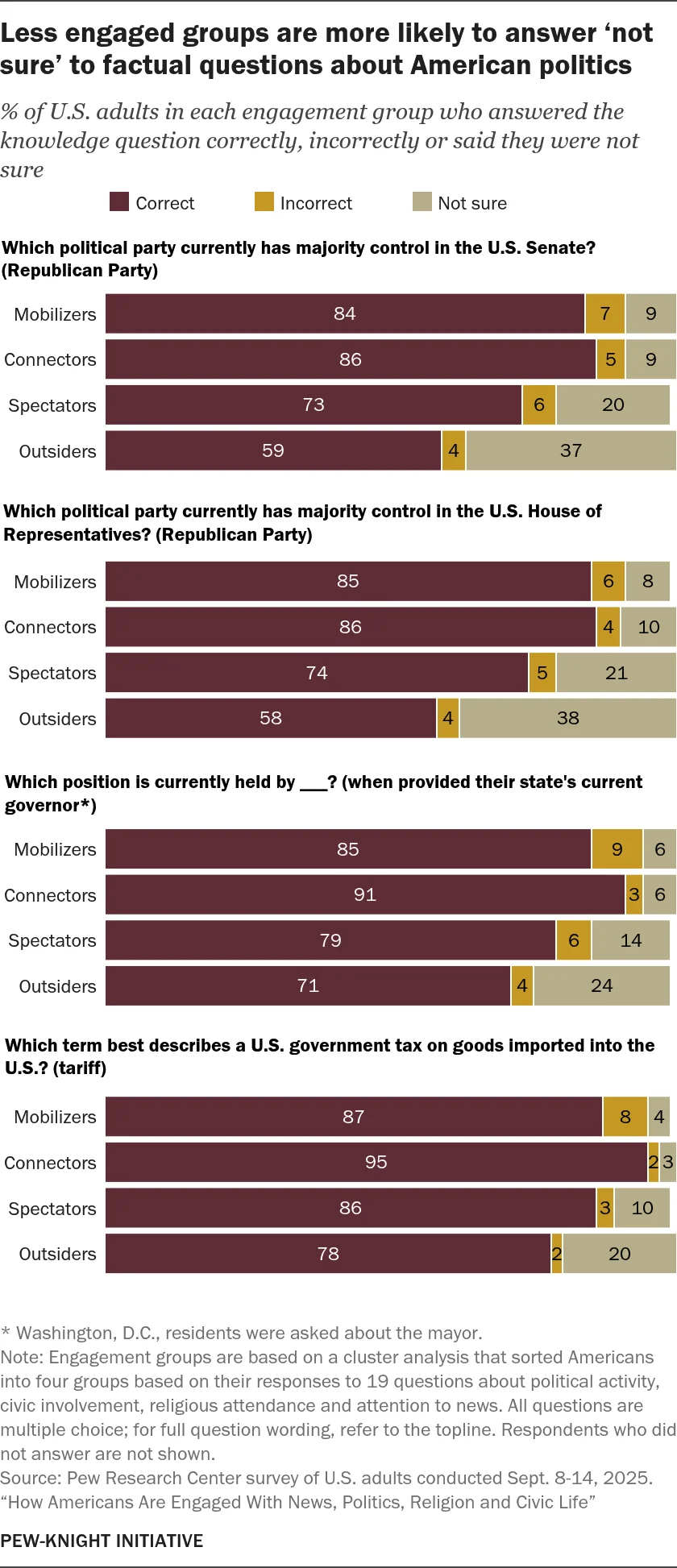
To gauge the relationship between these engagement patterns and political literacy, the researchers administered a four-question quiz covering core facts about American governance. The questions asked respondents to identify which political party controls the U.S. Senate and the U.S. House of Representatives, the name of their state’s governor, and the definition of a tariff.
While the majority of Americans correctly answered these questions, a clear hierarchy of knowledge emerged based on the engagement group. Nearly three-quarters of respondents correctly identified the majority party in both chambers of Congress (73%), while even higher percentages could name their governor (80%) and define a tariff (86%).

However, the "Outsiders" group consistently lagged behind. For instance, while 84% of Mobilizers correctly identified the Republican majority in the Senate, only 59% of Outsiders could do the same. Crucially, the gap between these groups is driven almost exclusively by the "not sure" response category rather than incorrect guesses. On all four questions, fewer than 10% of any group provided a wrong answer, suggesting that the divide is not about misinformation, but about the presence or absence of a fundamental political knowledge base.
Supporting Data: The "Not Sure" Phenomenon
The data reveals a stark contrast when looking at the aggregate results. Fifty percent of those classified as "Outsiders" admitted to being "not sure" about the answer to at least one of the four questions. In comparison, only 15% of "Mobilizers" and 16% of "Connectors" fell into this category.

Furthermore, when evaluating the ability to answer all four questions correctly, the disparity becomes even more pronounced. A solid majority of "Connectors" (72%) and "Mobilizers" (68%) answered all four correctly, while only 41% of "Outsiders" achieved a perfect score.
This suggests that active engagement serves as a reinforcing cycle. As citizens interact with their communities and follow the news, they naturally acquire the information necessary to navigate the political system. Those who remain outside these networks are less likely to encounter this information in their day-to-day lives, leading to higher levels of civic uncertainty.
Demographics: The Roles of Education and Age
The research highlights that while engagement is a powerful driver of knowledge, it does not exist in a vacuum. It is inextricably linked to two major demographic factors: education and age.
Education acts as a force multiplier for knowledge across all engagement levels. For instance, among "Spectators," 67% of those with a college degree answered all four questions correctly, compared with only 46% of those with a high school diploma or less. This trend remains consistent across all four groups, indicating that formal education provides tools that complement the benefits of civic engagement.

Age also plays a critical, and perhaps more intuitive, role. In every engagement group, older adults are consistently more likely to answer all four questions correctly than their younger counterparts. The "oldest-youngest" gap is particularly wide in the "Mobilizers" category (+34 percentage points) and the "Outsiders" category (+33 percentage points). These findings imply that both life experience and the habits developed over time contribute significantly to a person’s level of political awareness.
The Gender Gap in Confidence
One of the most intriguing findings from the study is the role of gender in how citizens respond to knowledge-based questions. Long-standing academic research has often shown that men are more prone to guessing when they are unsure of an answer, whereas women are more likely to admit they do not know.

The Pew-Knight data confirms this trend persists today. Among the most engaged group, the "Mobilizers," there is no significant gap; both men and women reported being "not sure" at similar rates (13% and 15% respectively). However, as engagement drops, the gap widens. Among "Outsiders," 59% of women reported being unsure about at least one question, compared to 38% of men. This suggests that the "knowledge gap" between genders may, in part, be a "confidence gap" in how individuals interact with the survey format itself.
Implications for the American Future
The implications of this research are profound for the health of American democracy. By identifying that engagement is linked to knowledge—even when controlling for age and education—the study suggests that the way people live their lives has a direct impact on the quality of their democratic participation.

If large segments of the population—specifically the "Outsiders"—are disconnected from the information networks that define public life, the ability of those individuals to advocate for their own interests or hold elected officials accountable is inherently limited. The "not sure" response is more than a survey metric; it is a signal of a civic disconnect.
As the political cycle continues to evolve, the challenge for civic organizations and policymakers is to determine how to better bridge these gaps. If engagement is the gateway to knowledge, then the most effective way to improve the political literacy of the electorate may not be through traditional education alone, but by finding new ways to draw "Outsiders" into the "Connectors" or "Mobilizers" spheres.
The Pew-Knight Initiative’s research serves as a reminder that the health of a democracy is not just measured by the ballots cast on Election Day, but by the myriad, daily ways in which citizens choose to participate in the life of their communities. By understanding these engagement groups, we gain a clearer view of both the strengths of American civic life and the persistent barriers that prevent a fully informed and active citizenry.
About the Author