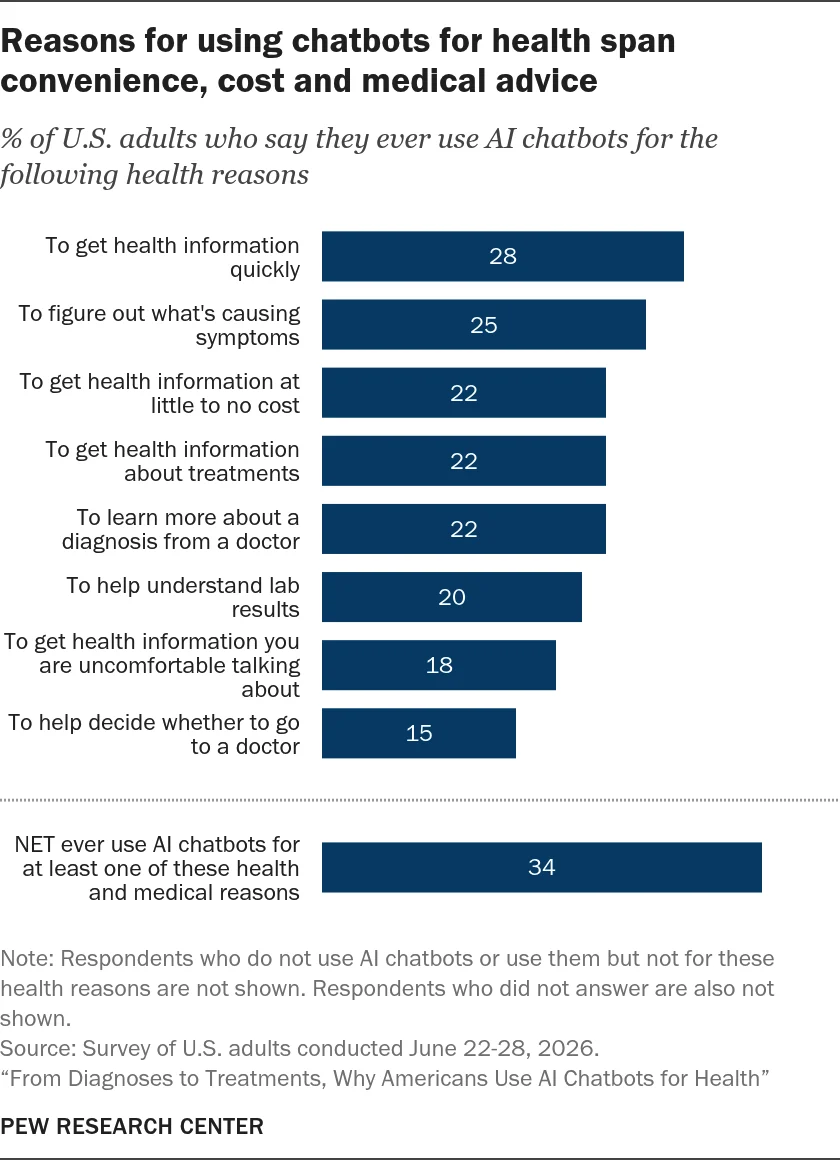
In an era defined by rapid technological integration, the traditional patient-doctor relationship is undergoing a profound transformation. A growing segment of the American population is bypassing, or at least supplementing, clinical visits by turning to artificial intelligence (AI) chatbots for health-related guidance. A comprehensive new study from the Pew Research Center, conducted in June 2026, reveals that 34% of U.S. adults have utilized AI chatbots to navigate a variety of medical concerns, ranging from symptom identification to the complex interpretation of lab results.
As these tools become increasingly sophisticated, they are carving out a significant niche in the healthcare landscape. However, the reliance on algorithmic assistance raises critical questions regarding privacy, the accuracy of medical advice, and the changing expectations of the modern patient.
The Rise of the AI-Enabled Patient: Main Findings
The Pew Research Center’s survey of 3,488 U.S. adults provides a granular look at the habits of these “chatbot health users.” The data suggests that for a large portion of the public, convenience is the primary driver. In a world where scheduling a doctor’s appointment can take weeks and navigating administrative hurdles can be exhausting, AI offers an instantaneous, always-on alternative.
The motivations for using these tools are multifaceted:
- Speed and Accessibility: 28% of respondents report using chatbots to obtain health information quickly.
- Symptom Triage: 25% of users lean on AI to help determine the underlying causes of physical symptoms.
- Cost Efficiency: 22% of users are motivated by the fact that chatbots are free or low-cost, a significant factor in a nation where medical expenses are a leading cause of financial stress.
- Information Supplementation: 22% of users employ chatbots to better understand medical treatments, while an equal percentage use them to gain clarity on diagnoses previously provided by a human physician.
A Chronology of the Shift
The integration of AI into the health sphere did not happen overnight. The trajectory of this adoption follows the broader arc of AI’s ascent in the consumer market.
Early 2020s: The initial wave of Large Language Models (LLMs) was primarily used for creative writing and coding. However, as public awareness grew, users began "stress-testing" these models with personal inquiries, including those related to health.
2024–2025: As AI companies integrated more robust data sets and specialized health-trained models, the precision—and consequently the perceived reliability—of these bots increased. During this period, major tech firms began partnering with healthcare organizations, signaling to the public that AI could be a legitimate partner in health management.
June 2026: The current survey marks a pivotal moment where the use of AI for health information has reached a critical mass, with over one-third of the population identifying as users. This shift indicates that the behavior has moved from experimental to habitual.
Demographic Drivers and Usage Patterns
The adoption of AI for health is not distributed evenly across the U.S. population. The data reveals clear divides based on age, education, and economic status, mirroring broader trends in general AI adoption.
The Demographic Divide
- Age: Younger adults are significantly more likely to engage with AI for health. Roughly 44% of adults aged 18–29 are chatbot health users, compared to only 17% of those aged 65 and older.
- Ethnicity: Asian Americans lead the charge with a 56% usage rate, followed by Hispanic (39%) and Black (35%) adults. White adults report the lowest usage at 29%.
- Education and Income: There is a distinct correlation between socioeconomic status and AI health usage. 44% of college graduates use these tools, compared to 23% of those with a high school education or less. Similarly, 48% of upper-income households utilize AI for health, nearly doubling the usage rate of lower-income households (28%).
The "Optimism" Factor
The survey also highlights an intriguing psychological component: the "AI-positive" mindset. Individuals who express excitement about the integration of AI into daily life are far more likely to trust it with their health (60% usage rate) compared to those who harbor concerns about the technology (21% usage rate). This suggests that adoption is driven as much by cultural attitude as it is by functional necessity.

Supporting Data: How Helpful is the AI?
For those who do use these tools, the feedback is largely positive. Nearly half of all chatbot health users (47%) report that the information provided is "extremely" or "very" helpful. Another 48% characterize the information as "somewhat" helpful. Only a negligible 5% of users reported that the AI provided information that was not useful.
This high level of satisfaction creates a positive feedback loop, encouraging users to return to the technology for future health needs. It suggests that, despite the well-documented risks of "hallucinations" or errors in AI models, users feel they are getting value, whether through better understanding of jargon or a reduction in medical anxiety before a doctor’s visit.
Official Responses and Industry Context
The rapid adoption of these tools has drawn both praise and skepticism from the medical establishment. While health tech advocates argue that AI can democratize access to medical knowledge, organizations like the American Medical Association (AMA) have urged caution.
Tech giants, including Microsoft and Google, have recently launched specialized "health-tuned" chatbots designed to mitigate the risks of misinformation. However, these tools are often subject to strict disclaimers, noting that they are not a substitute for professional medical advice. The industry’s challenge lies in balancing the demand for accessibility with the moral and legal imperative of patient safety.
Privacy Concerns: The Double-Edged Sword
Perhaps the most contentious finding in the report involves the willingness of users to share personal health data. Despite the growing discourse surrounding data privacy, the comfort levels of users are remarkably mixed.
While 29% of chatbot health users are extremely or very comfortable sharing personal health information with a bot, 26% are not at all comfortable. The plurality, 42%, reside in the middle, expressing a "somewhat comfortable" stance. This apathy or willingness to share sensitive information creates a significant vulnerability.
Recent scrutiny regarding how platforms store, sell, or utilize medical data for further AI training has not fully deterred the average user. As one researcher noted, "The immediate convenience of the tool often outweighs the abstract fear of data misuse."
Future Implications: What This Means for Healthcare
The integration of AI into health management is no longer a futuristic concept—it is a current reality. The implications for the future of the American healthcare system are profound:
- The New "First Point of Contact": AI may soon replace the internet search engine as the first point of contact for a patient feeling unwell. This could lead to a more informed patient base, but also one prone to "cyberchondria" if the AI provides incorrect or alarmist information.
- Increased Burden on Providers: Physicians may find themselves spending more time correcting the "misconceptions" or "over-diagnoses" that patients bring with them after consulting an AI. Conversely, if AI can accurately filter minor ailments, it could reduce the load on primary care clinics.
- The Privacy Paradox: As patients become more comfortable sharing data with bots, the legal framework surrounding HIPAA and digital health privacy will need to evolve. Legislators are likely to face increasing pressure to define whether a chatbot counts as a "covered entity" under current health regulations.
- Equity Concerns: With usage rates significantly lower among older, less educated, and lower-income populations, there is a risk that AI will exacerbate existing healthcare disparities. If the best health information becomes an "AI-gated" service, those without access or digital literacy will be left behind.
Conclusion
The Pew Research Center’s 2026 data serves as a clear indicator: the digital assistant has arrived in the doctor’s office. Americans are clearly seeking ways to take more agency over their health, and they view AI as a vital tool in that process. However, the path forward requires a delicate balance. As the public continues to integrate these systems into their lives, the focus must shift from merely "using" the technology to "safeguarding" the users. Ensuring that AI acts as a reliable, secure, and equitable partner in health is the next great challenge for developers, regulators, and the public alike.
About the Author